


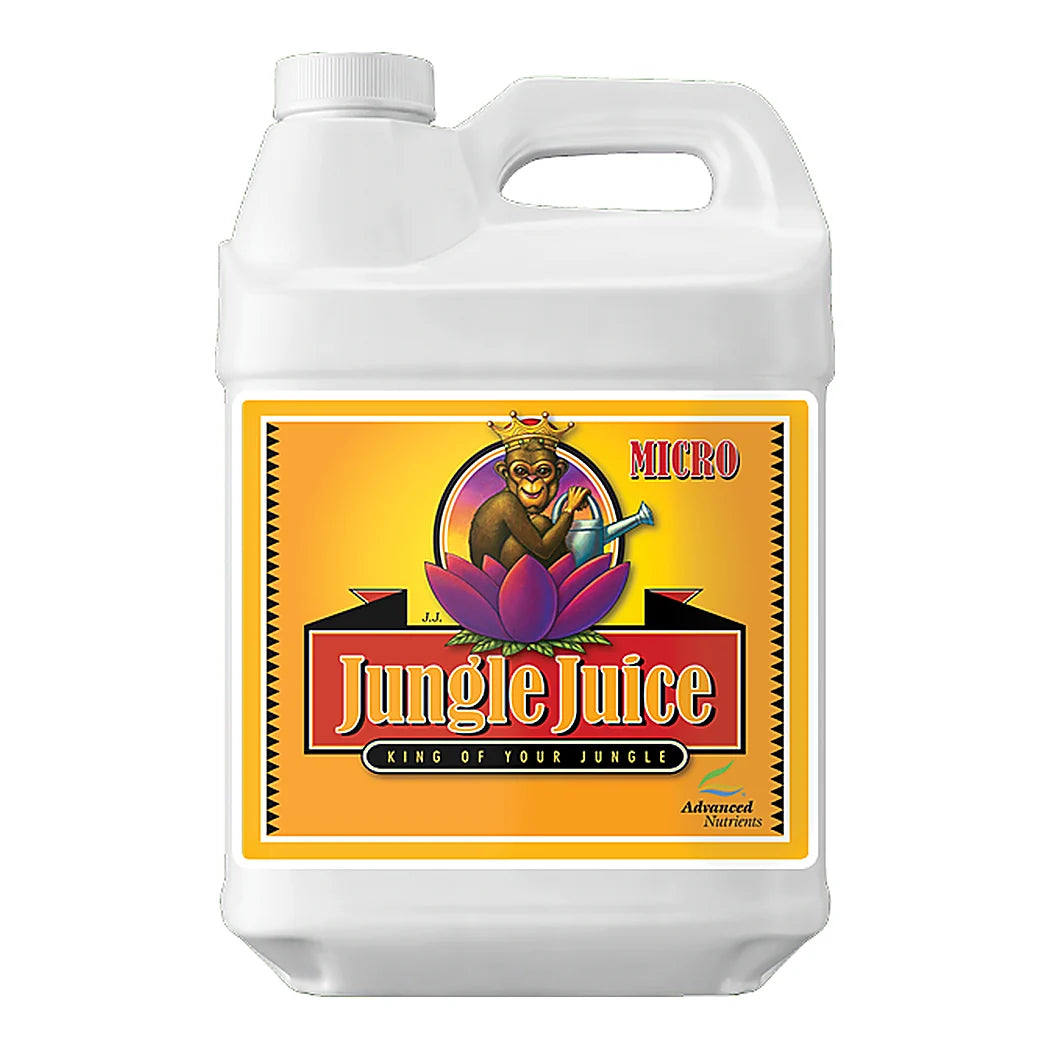
What Advanced Nutrients Jungle Juice Micro Carries
A three-part base line splits the job into three bottles. That means you can move one leg without moving the other two, and the Micro leg is where the calcium and the trace metals live. The label analysis on this bottle reads 5-0-1. Of that five percent nitrogen, 4.7 percent arrives as nitrate. The remaining 0.3 percent is ammoniacal, which is the split you want in a recirculating tank where ammonium drives pH down fast. Calcium sits at five percent, matching the nitrogen figure, and that pairing is why this bottle goes into the water first rather than last. Alongside it sits the trace package: boron, cobalt, copper, iron, manganese, molybdenum and zinc. Iron is the one worth naming, because it comes in three chelated forms rather than one. A single chelate holds iron across a narrow band of tank conditions. Outside that band the metal falls out of solution before a root ever sees it. Three chelates widen that band considerably. Growers in coco feel the difference first, since buffered coco is where iron lockout shows up as pale new growth while older leaves stay dark.
Dosing This Jungle Juice Fertilizer and Setting Your Own pH
The manufacturer chart runs Micro at 0.33 mL per litre in the first week of growth. It climbs to 1.32 mL per litre in the second week. From the third week onward, and through the whole of bloom, the rate holds at 2.64 mL per litre. That last figure is exactly ten millilitres per gallon, which is the number most growers keep in their heads. There is a second route as well. A two-bottle method pairs eight millilitres of Micro with sixteen of Bloom in a gallon and skips the Grow leg entirely. Either way, Micro enters the fresh water first, then Grow, then Bloom, with the tank stirred between each. Concentrates never touch each other undiluted, because calcium meeting sulfate at full strength drops gypsum straight to the bottom. One point deserves plain language. This line is not the pH Perfect technology, so it will not hold the tank for you. You set the meter yourself to roughly 5.6 in hydroponics, 5.8 to 6.0 in coco, and 6.3 in soil. That is the trade for a lower cost per gallon and the freedom to change one leg without disturbing the others.
Key Features
- Five Percent Calcium: The calcium figure matches the nitrogen figure, which is why this bottle enters the reservoir before the other two.
- Three Chelated Irons: Three chelate forms hold iron in solution across a wider band of tank conditions than any single chelate manages.
- Nitrate Dominant Nitrogen: At 4.7 percent nitrate against 0.3 percent ammoniacal, the tank drifts far less than an ammonium heavy feed would.
- Ten Millilitres Per Gallon: The 2.64 mL per litre chart rate converts to a clean ten millilitres per gallon from week three onward.
- Full Trace Package: Boron, cobalt, copper, manganese, molybdenum and zinc round out the micronutrients a base feed has to supply.
- Mixes With Any Line: It sits alongside pH Perfect and non pH Perfect base nutrients and supplements without a compatibility problem.
Technical Specifications
| Specification | Value |
|---|---|
| Guaranteed Analysis | 5-0-1 (N-P-K) |
| Total Nitrogen | 5% (4.7% nitrate, 0.3% ammoniacal) |
| Soluble Potash | 1% K2O |
| Calcium | 5% |
| Micronutrients | Boron, cobalt, copper, iron, manganese, molybdenum, zinc |
| Iron Chelation | Three chelated forms |
| Growth Rate | 0.33 mL/L week 1, 1.32 mL/L week 2, 2.64 mL/L weeks 3-4 |
| Bloom Rate | 2.64 mL/L (10 mL per gallon) throughout |
| Two-Part Option | 8 mL Micro plus 16 mL Bloom per gallon |
| Mixing Sequence | Micro into fresh water first, then Grow, then Bloom |
| pH Control | Manual: 5.6 hydroponics, 5.8-6.0 coco, 6.3 soil |
| Compatibility | pH Perfect and non pH Perfect base nutrients and supplements |
| Systems | Aeroponics, drip and emitters, NFT, flood and drain, deep water culture, coco, soil |
| Sizes | 10 L, 23 L, 57 L |