


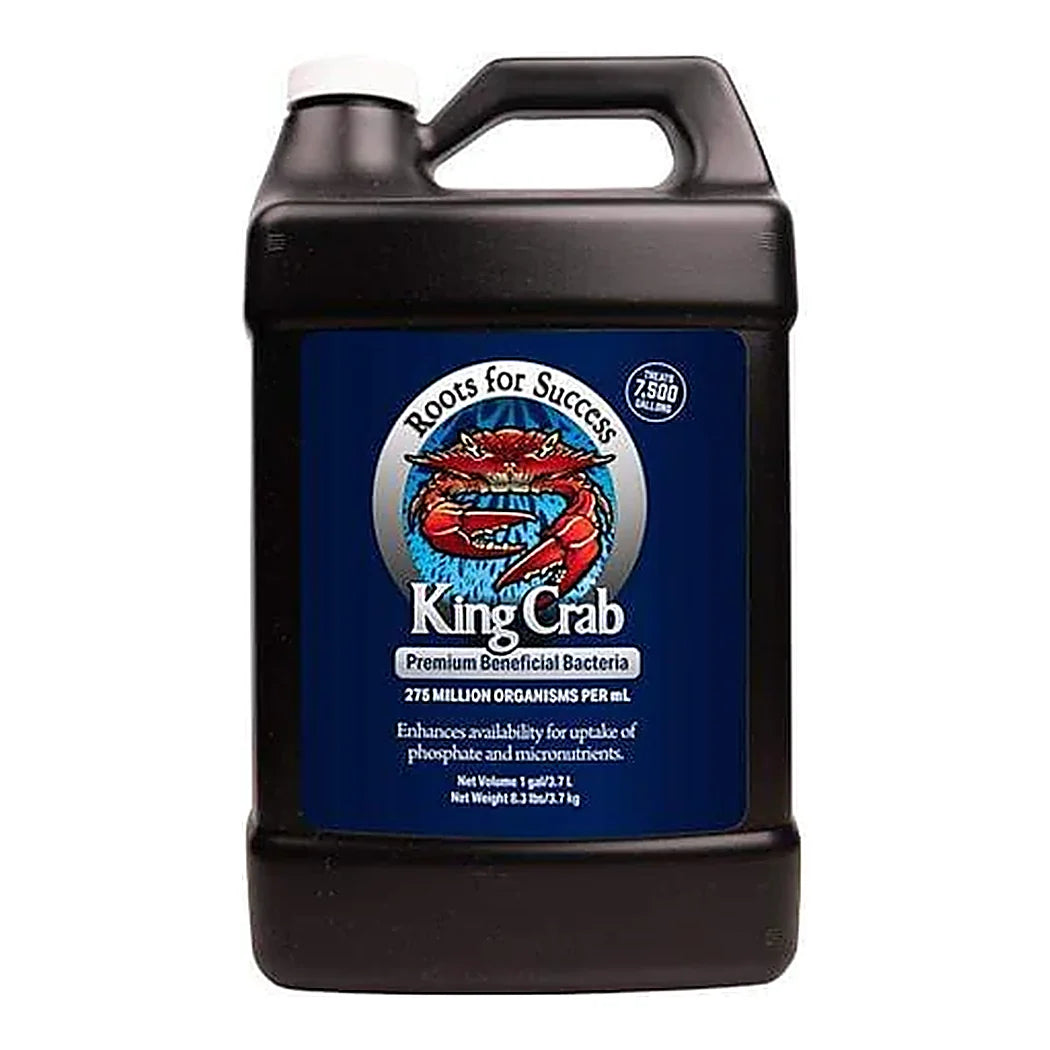
The Species List Behind Plant Success King Crab
Eleven bacteria, each guaranteed at 25,000,000 CFU per mL, which totals 275 million CFU in every millilitre. Seven are Bacillus: subtilis, licheniformis, amyloliquefaciens, megaterium, pumilus, coagulans and azotoformans. Two are Paenibacillus, polymyxa and durum, and two are Pseudomonas, fluorescens and aureofaciens. The label declares 99% other ingredients, inert as a non-plant-food component, so the bacteria are the entire active contribution. That is the reason the rate is so small: half a millilitre per gallon of water, in soil or in a hydroponic reservoir. A rate that low is easy to get wrong in the other direction, and more does not mean faster. What the mix is selected for is phosphorus availability. Phosphate binds to calcium, iron and aluminium in a root zone and stops being plant-available long before it leaves the medium. These genera release organic acids and phosphatase enzymes that pull some of it back into solution. The same activity improves micronutrient availability, which is the secondary effect on the label.
Running a Beneficial Bacteria Supplement Alongside Your Feed
The method is to mix it into water and saturate the rootball, which is a drench rather than a foliar pass. In a recirculating system it goes into the reservoir and gets carried to every root with the feed. It is compatible with any fertiliser line, so nothing in an existing schedule has to move to make room for it. Growers get the most out of it in a medium with a history. A fresh bag of inert media has nothing bound up in it yet to release. Reused coco, living soil and anything that has had bone meal or rock phosphate through it are the places phosphate accumulates. Timing matters as well, since a bacterial product works over weeks rather than in a single feed. Start it early and keep it going rather than reaching for it when a deficiency already shows. There is one honest caution here. Live bacteria and a strong oxidiser cannot share a tank, so peroxide, chlorine or a hypochlorous sanitiser will undo the application.
Key Features
- Eleven bacterial species: Seven Bacillus, two Paenibacillus and two Pseudomonas in one bottle.
- 25,000,000 CFU per mL each: Which totals 275 million CFU in every millilitre of product.
- Phosphorus solubilisation: Organic acids and enzymes return bound phosphate to solution.
- Micronutrient availability: The same activity frees micronutrients the medium had locked up.
- Half a millilitre per gallon: The rate for both soil drench and hydroponic reservoir.
- Works with any fertiliser: Nothing in an existing feed schedule has to change around it.
- Inert carrier: The label declares 99% other ingredients, so bacteria are the whole active.
- Three sizes: From a 4 oz bottle for a tent to a gallon for a commercial room.
Technical Specifications
| Specification | Value |
|---|---|
| SKUs | PRPSKICR04, PRPSKICR32OZ, PRPSKICR1G |
| Brand | Plant Success |
| Product | King Crab, a liquid bacterial inoculant |
| Species count | 11 |
| Guaranteed count | 25,000,000 CFU per mL of each species |
| Total viable count | 275,000,000 CFU per mL |
| Bacillus species | subtilis, licheniformis, amyloliquefaciens, megaterium, pumilus, coagulans, azotoformans |
| Paenibacillus species | polymyxa and durum |
| Pseudomonas species | fluorescens and aureofaciens |
| Other ingredients | 99%, inert as a non-plant-food ingredient |
| Soil rate | Mix 0.5 mL per gallon of water and saturate the rootball |
| Hydroponic rate | Mix with water at 0.5 mL per gallon |
| Compatibility | Any fertiliser line |
| Sizes | 4 oz, 32 oz and 1 gallon |
| Shipping weights | 0.26 lb, 2 lb and 8 lb respectively |
| Barcode | 689319200037 (1 gallon) |


