


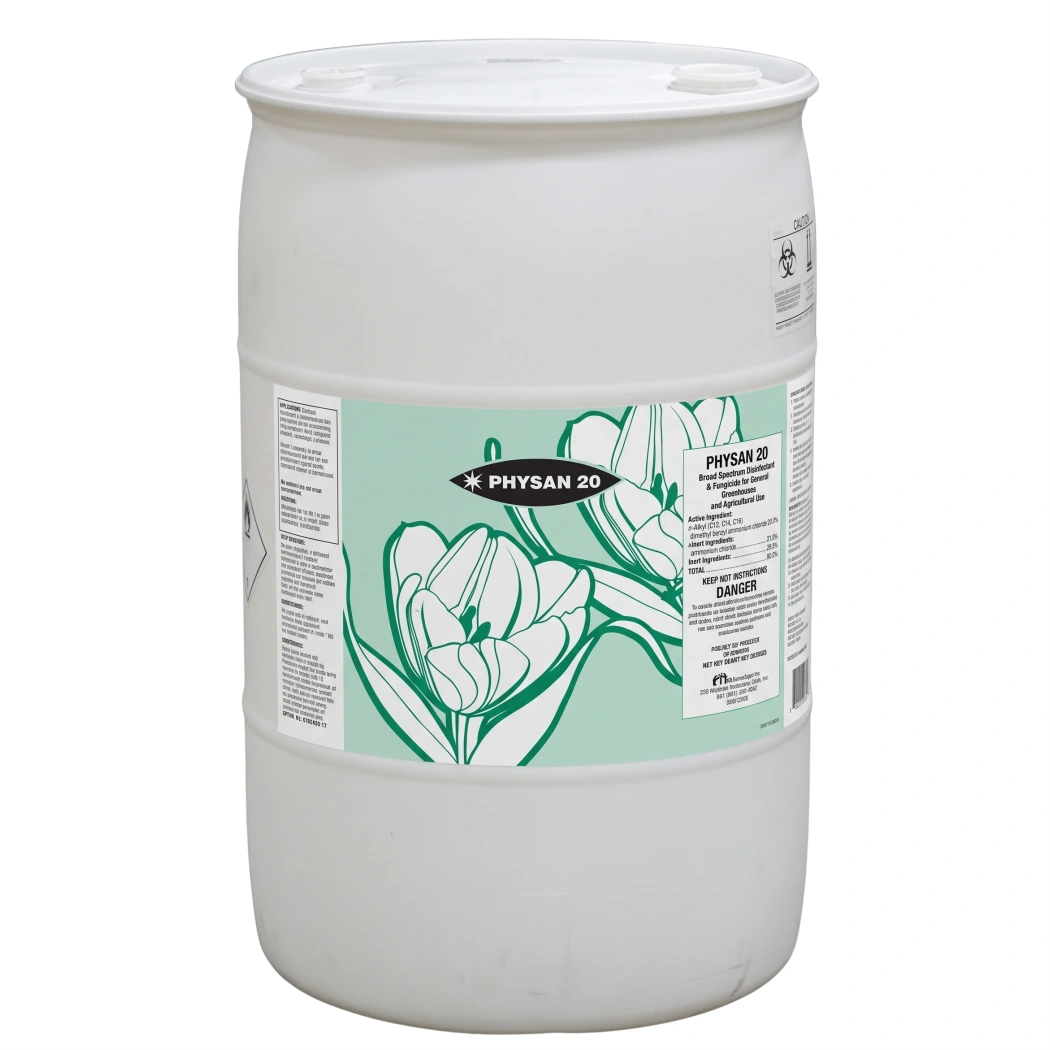
Physan 20 Fungicide for Benches, Tools, Pots and Orchids
Physan 20 is a concentrated disinfectant that kills algae, fungi, bacteria and viruses on contact, registered as EPA Reg 55364-5 by Maril Products. Two quaternary ammonium compounds do the work, each at 10%, with the remaining 80% inert. Quats break down cell membranes, which is why one bottle handles slimy algae on glass and Botrytis spores on a pruner. The base rate is 1 tablespoon per gallon, and that one mix covers floors, walls, benches, pots, flats and tools. Hard surfaces have to stay visibly wet for 10 minutes, so a fast wipe that flashes dry under the fans falls short. Greenhouse glass takes a lighter 1 teaspoon per gallon, sprayed on and left until the green film starts to fade. For seeds and seedlings fighting damping off, the label drops to 1½ teaspoons per gallon with a five-minute soak. Adult orchids get 2 teaspoons per gallon as a monthly preventive spray, or sooner when disease other than rot shows up. Spent rockwool soaks ten minutes at the base rate, dries, then rests a full week before replanting. Planted cubes with algae on top get the seedling-strength mix sprayed on the surface only. It is pH neutral, so it won't push runoff readings around.
Where This Greenhouse Disinfectant Fits, and Where It Doesn't
Most growers keep a sprayer of it on the potting bench and hit the work surface before each session and again between plants. Pruners soak edge-down in it for ten minutes before work, so TMV and Botrytis stop traveling from plant to plant. Used pots and flats get brushed or washed first and soaked after, so the solution reaches the plastic instead of old media. Evaporative cooler pads are fair game too, since the label covers algae and slime-forming fungi on the pads. It is not an insecticide, so mites, aphids and thrips need a separate product in your rotation. The label says it is not intended for greenhouses where food crops are grown. Its plant uses are also not approved in California. The federal label bars application through any irrigation system, so keep it out of drip lines and reservoirs. Treated areas carry a 12-hour restricted entry interval, and the DANGER signal word means gloves and eye protection every time. Keep rinse water away from ponds and fish tanks as well, because quats are toxic to fish. The 8 oz and 16 oz bottles suit a hobby orchid bench, while the 1 gallon, 5 gallon and 55 gallon drum serve ranges that sanitize weekly.
Key Features
- Twin Quat Actives: Two quaternary ammonium compounds at 10% each give broad kill across algae, fungi, bacteria and viruses.
- EPA Reg 55364-5: Every rate and use here follows the federal label.
- One Base Rate: A tablespoon per gallon with a ten-minute wet contact handles floors, benches, pots, flats and tools.
- Propagation Strength: A five-minute soak at one and a half teaspoons per gallon protects seeds and seedlings from damping off.
- Orchid Program: Two teaspoons per gallon sprayed once a month keeps a preventive routine running on adult plants.
- Glass and Cooler Pads: It knocks back green film on glazing and slime on evaporative cooler pads.
- pH Neutral: It will not shift runoff pH when used around substrates and planted cubes.
- Five Container Sizes: The 8 oz bottle through the 55 gallon drum scale from a hobby bench to a commercial range.
Technical Specifications
| Specification | Value |
|---|---|
| Product | Physan 20 |
| Manufacturer | Maril Products, Inc. |
| EPA Registration | 55364-5 |
| Active Ingredients | n-alkyl dimethyl benzyl ammonium chloride 10%; n-alkyl dimethyl ethylbenzyl ammonium chloride 10% |
| Inert Ingredients | 80% |
| Signal Word | DANGER |
| Hard Surface Rate | 1 tablespoon (1/2 fl oz) per gallon, surfaces wet 10 minutes |
| Greenhouse Glass Algae | 1 teaspoon per gallon, spray or swab |
| Seeds and Seedlings | 1-1/2 teaspoons per gallon, 5 minute soak |
| Adult Orchids | 2 teaspoons per gallon, monthly preventive spray |
| Rockwool Between Crops | 1 tablespoon per gallon, 10 minute soak, 7 days before planting |
| Restricted Entry Interval | 12 hours |
| Label Restrictions | Not for greenhouses where food crops are grown; no application through irrigation systems; plant uses not approved in California |
| Environmental | Toxic to fish |
| pH | Neutral |
| Sizes | 8 oz, 16 oz, 1 gallon, 5 gallon, 55 gallon drum |