


AzaMax Insecticide: Botanical Azadirachtin for Mites, Thrips and More
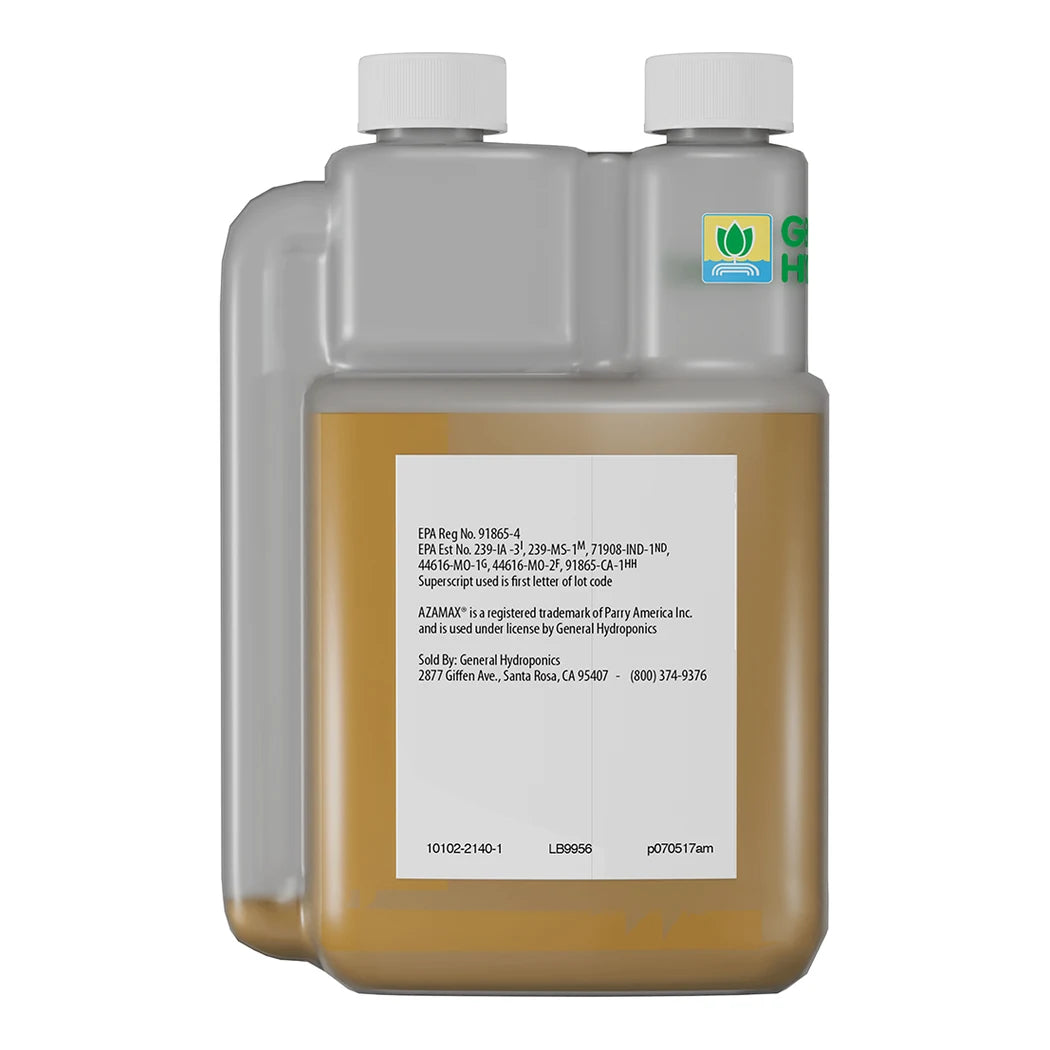
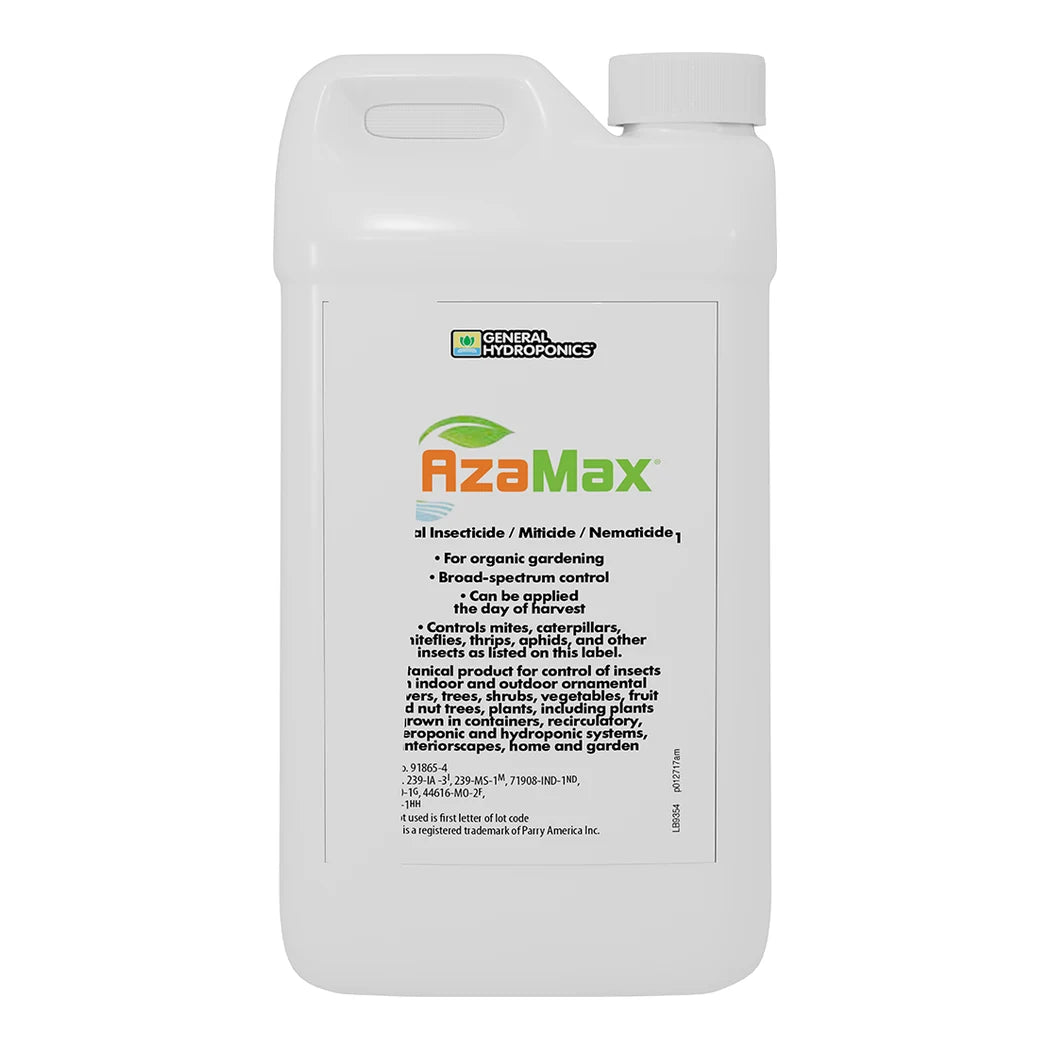
AzaMax from General Hydroponics is a botanical insecticide, miticide and nematicide registered with the EPA under registration number 91865-4. The active ingredient is azadirachtin at 1.2%, carried in an emulsifiable concentrate that mixes into plain water. Pests take it in on contact or by feeding, and it works in several ways at once. It repels, it stops feeding, and it discourages females from laying eggs on treated leaves. As an insect growth regulator, azadirachtin disrupts ecdysone, the molting hormone, so larvae and nymphs die before or during a molt. That is why AzaMax insecticide hits hardest on young stages, and early timing matters more than a heavy dose. The label covers aphids, whiteflies, mealybugs, scale crawlers, leafhoppers, leafminers and caterpillars. It also lists thrips, including western flower thrips, two-spotted spider mites, fungus gnats and shore flies, with nematodes listed for suppression. Apply it as a foliar spray or as a drench to soil or soilless media, indoors or out. Food crops can be sprayed up to and including the day of harvest, and the restricted-entry interval is 4 hours.
Using AzaMax for Spider Mites, Thrips and Fungus Gnats
Spider mites build up on leaf undersides, so the spray has to reach both surfaces of every leaf. The label calls for treatment as soon as nymphs appear, before the population turns severe. Repeat every 7 to 10 days, since the best results come after two or three applications. Thrips get the same early start, with sprays repeated until the infestation is under control. General Hydroponics puts the typical mix at 0.5 to 1 oz per gallon, with higher label rates for heavy pressure or a dense canopy. For fungus gnat larvae, drench the pot with one pint of finished solution per gallon of soil, mixed at 1 tablespoon per gallon of water. Two or three drenches spaced 10 to 14 days apart carry the treatment through the larval cycle. Keep the spray mix between pH 5 and 7, and use it within 24 hours of mixing. Spray in the morning or evening, and reapply if rain falls within two or three hours. Leave captan, Bordeaux mixture, lime sulfur and highly alkaline products out of the tank. Crop oils are not recommended on ornamentals, and a quick jar test settles any new tank mix.
Key Features
- 1.2% azadirachtin: Botanical active ingredient in an emulsifiable concentrate, 0.35 g per fl oz.
- Four-way action: Repellent, antifeedant, growth regulator and egg-laying deterrent in one spray.
- Insecticide, miticide, nematicide: Covers soft-bodied insects, spider mites, caterpillars, soil larvae and nematode suppression.
- Up to day of harvest: Food crops can be treated through harvest day; 4-hour restricted-entry interval.
- OMRI listed: Carries the OMRI seal and is labeled for organic gardening.
- Foliar spray or drench: Works on leaves and in the root zone of soil or soilless media.
- Fungus gnat drench: Targets larvae in the media, the stage a foliar spray never reaches.
- IPM rotation tool: The label lists it as a resistance management tool inside an IPM program.
Technical Specifications
| Specification | Value |
|---|---|
| Brand | General Hydroponics |
| Product Type | Botanical insecticide, miticide and nematicide |
| Active Ingredient | Azadirachtin 1.2% |
| Other Ingredients | 98.8% |
| Azadirachtin Content | 0.35 g per fl oz; 0.0987 lb (44.8 g) per gallon |
| Formulation | Emulsifiable concentrate |
| EPA Registration No. | 91865-4 |
| Signal Word | Caution |
| OMRI Listed | Yes |
| Mode of Action | Contact and ingestion: repellent, antifeedant, insect growth regulator, anti-oviposition |
| Target Pests | Aphids, whiteflies, thrips, spider mites, mealybugs, scale crawlers, leafhoppers, leafminers, fungus gnats, shore flies, caterpillars, beetles; nematodes (suppression) |
| Application Methods | Foliar spray; drench to soil or soilless media; chemigation |
| Use Sites | Indoor and outdoor ornamentals, vegetables, fruit and nut trees; plants in containers, recirculating, aeroponic and hydroponic systems; greenhouses, nurseries, interiorscapes, home and garden |
| Foliar Rate, Light Pressure | 0.32-1.0 fl oz per gallon (0.25-0.75%) |
| Foliar Rate, Moderate Pressure | 1.0-1.6 fl oz per gallon (0.75-1.25%) |
| Foliar Rate, Heavy Pressure | 1.6-2.18 fl oz per gallon (1.25-1.70%) |
| Fungus Gnat Drench | 1 Tbs per gallon of water (0.4%); 1 pint of solution per gallon of soil |
| Spray Interval | 7-10 days |
| Drench Interval | 10-14 days, 2-3 applications |
| Spray Mix pH | 5-7 |
| Restricted-Entry Interval | 4 hours |
| Pre-Harvest Interval | Up to and including the day of harvest |
| Sizes | 4 oz, 16 oz, 1 quart, 1 gallon |
| Storage | Original container in a dry, cool, well-ventilated area |
FAQs
How much AzaMax per gallon of water?
The label runs from 0.32 to 2.18 fl oz per gallon, which is about 9.5 to 64 mL. Use the low end of 0.32 to 1.0 fl oz for light infestations and early, uniform pest stages. Moderate pressure with mixed life stages calls for 1.0 to 1.6 fl oz. Heavy populations, late larvae, dense foliage and re-infestations take 1.6 to 2.18 fl oz. General Hydroponics lists 0.5 to 1.0 oz per gallon, about 15 to 30 mL, as the typical foliar mix.
Can AzaMax be used as a soil drench?
Yes, the label allows drenches to soil or soilless media for soil-borne larvae, including fungus gnats, nematodes and soil-dwelling thrips. Mix 0.4 to 0.8% by volume, which is 1 to 2 tablespoons per gallon of water. Apply one pint of finished solution for each gallon of soil in the pot, and avoid excessive leaching. Schedule two or three drenches at 10 to 14 day intervals.
Does AzaMax kill spider mites and thrips?
Two-spotted spider mites and western flower thrips are both on the label. Start when mite nymphs or the first thrips appear, and cover the upper and lower leaf surfaces completely. Repeat every 7 to 10 days until the infestation is controlled. Because azadirachtin acts on molting, young nymphs respond faster than adults.
Is AzaMax a systemic pesticide?
The label describes control on contact or by ingestion, with no systemic claim. Treat it as a contact and feeding material, so thorough coverage of leaves, stems and leaf undersides decides the result. A drench reaches pests living in the root zone.
Is AzaMax organic and safe to use close to harvest?
AzaMax carries the OMRI seal and is labeled for organic gardening. Food crops can be treated up to and including the day of harvest. The restricted-entry interval is 4 hours, and applicators wear long sleeves, long pants, shoes, socks and chemical-resistant gloves. It is toxic to fish and aquatic invertebrates, so keep spray and rinsate out of drains and waterways.
What is the difference between AzaMax and neem oil?
Azadirachtin is the main insect-active compound found in neem tree seeds. AzaMax is an EPA-registered concentrate standardized to 1.2% azadirachtin, so every bottle carries the same measured strength. It mixes into water as an emulsifiable concentrate and has label rates for each level of pest pressure.
Is AzaMax banned in the US?
No, AzaMax is an active EPA registration, number 91865-4, held by Hawthorne Hydroponics LLC doing business as General Hydroponics. State registration rules still apply, so check your state's pesticide list before use.
How should AzaMax be stored, and how long does it last?
Keep it in the original container in a dry, cool, well-ventilated area, away from direct sunlight and extreme temperatures. General Hydroponics states a shelf life of about two years unopened when stored correctly. An opened container should be used within one growing season.