
Rockwool
Dial in your root zone with rockwool for hydroponics, propagation, and mother plants. Explore stone wool plugs, cubes, blocks, and slabs from top brands to achieve consistent moisture, strong roots, and reliable results in greenhouses and indoor gardens.
-
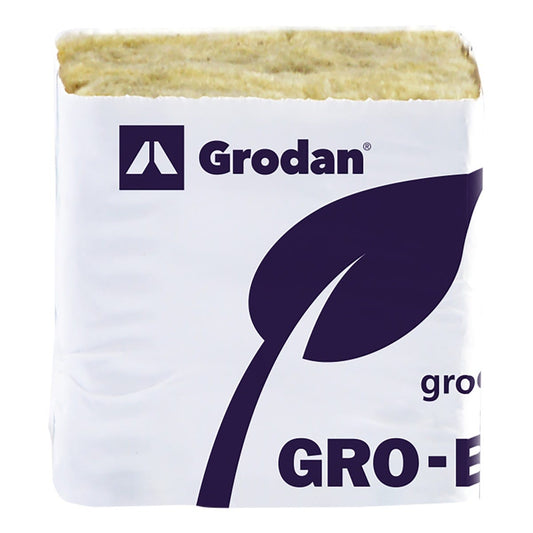
Grodan Gro-Block Improved Mini Block 1.5" (case of 50 strips)
Vendor:GrodanRegular price $577.19 USDRegular priceUnit price per
Rockwool
For Hydroponics, Propagation & Indoor Growing
Rockwool, also known as mineral wool or stone wool, is a high-performance growing medium made from melted volcanic rock and chalk spun into fine, fibrous slabs, blocks, and plugs. Its naturally porous structure holds moisture and nutrient solution while still allowing plenty of oxygen to reach young roots, making it a reliable choice for starting seeds, rooting cuttings, and supporting mother plants in hydroponic and soilless systems. Easy to cut and shape, rockwool for hydroponics helps growers stabilize the root zone, reduce watering stress, and achieve strong early growth in greenhouses, indoor gardens, and vertical farms...

Why Rockwool Growing Media Works for Modern Growers
As a rock-based, inert medium, rockwool for hydroponics does not break down or add extra nutrients to your solution, giving you precise control over feeding programs. Its fibers form millions of tiny cavities that can hold up to around 80% of their volume in water and nutrient solution, while the remaining 20% stays filled with oxygen-rich air. This balance helps roots stay hydrated without suffocating, reduces the risk of dry-back around delicate seedlings, and encourages dense, white root systems that drive faster vegetative growth and consistent yields.
By switching to rockwool for hydroponics, growers gain a clean, standardized root-zone medium that simplifies irrigation and nutrient management. Consistent moisture distribution supports even growth across the canopy, while strong, well-aerated roots improve nutrient uptake, stress tolerance, and overall plant vigor. Whether you are dialing in a small indoor garden or scaling a commercial greenhouse, rockwool growing media offers a proven path to healthier seedlings, more uniform crops, and repeatable results cycle after cycle.
Water, Air & Root Health
The key advantage of mineral wool is its ability to manage moisture and aeration at the same time. Because the fibers themselves do not soak up water, moisture sits in the pores where roots can access it readily, while excess solution drains away quickly. This makes rockwool growing media especially forgiving for new growers and extremely efficient for experienced growers who want tight control over irrigation cycles, EC, and root-zone oxygen levels.
Convenient Forms for Any Hydroponic System
Rockwool is manufactured in a wide range of formats to match almost any hydroponic or soilless setup. From small starter plugs and cubes for germination, to larger blocks and slabs for full-cycle production, you can easily transplant from one size to the next as plants develop. Slabs can be cut with simple tools, fitted into trays, and integrated into flood and drain, top-feed, drip, and ebb-and-flow systems, giving growers a scalable, modular rooting platform.
Best Uses of Rockwool in Hydroponic Systems
Rockwool is a top choice for hydroponic propagation, mother plants, and production crops where uniformity and precision matter. Use small plugs and cubes for starting seeds or rooting clones, then transfer to larger blocks or slabs for rapid vegetative development. In flood and drain and drip irrigation systems, stone wool slabs provide a clean, consistent root zone that responds predictably to changes in feed strength and irrigation frequency, making it easier to fine-tune recipes for different cultivars and stages.
Types of Rockwool Products
This rockwool collection brings together multiple stone wool formats to match your workflow. Choose starter plugs and cubes for germination and cloning, mid-size blocks for early veg, and larger blocks or slabs for full production cycles. Standard-density stone wool is ideal for general use, while specialized quick-drain formulations help move excess water out of the root zone faster in high-frequency irrigation strategies. By pairing the right type of rockwool growing medium with your system design, you can maximize root health and harvest consistency.
Frequently Asked Questions
What kind of rock is rockwool made from?
Rockwool is typically made from basalt and other volcanic rocks blended with materials such as limestone or chalk. These raw materials are melted at very high temperatures and then spun into fine fibers, forming the porous mineral wool structure used as a hydroponic growing medium.
Is rockwool considered hydroponic?
Yes. Rockwool is an inert, soilless medium, so it is widely considered a true hydroponic substrate. It does not supply nutrients on its own; instead, it holds water and nutrient solution around the roots while allowing air to circulate, making it ideal for hydroponic and fertigation-based systems.
Is rockwool good for starting seeds?
Rockwool is excellent for starting seeds and rooting cuttings because it retains moisture evenly, drains excess water efficiently, and maintains good air space around delicate roots. Pre-soaked cubes or plugs give seeds a stable environment for germination and make it easy to transplant young plants into larger blocks or slabs without disturbing the root zone.
What is the disadvantage of rockwool in hydroponics?
The main disadvantages are that new rockwool often starts with a higher pH and must be properly conditioned before use, the fibers can be irritating to skin and lungs if handled dry, and mineral wool does not break down quickly in the environment, so disposal requires planning. In addition, if irrigation is not managed correctly, rockwool can stay too wet, which may stress roots; careful watering practices help prevent this issue.