


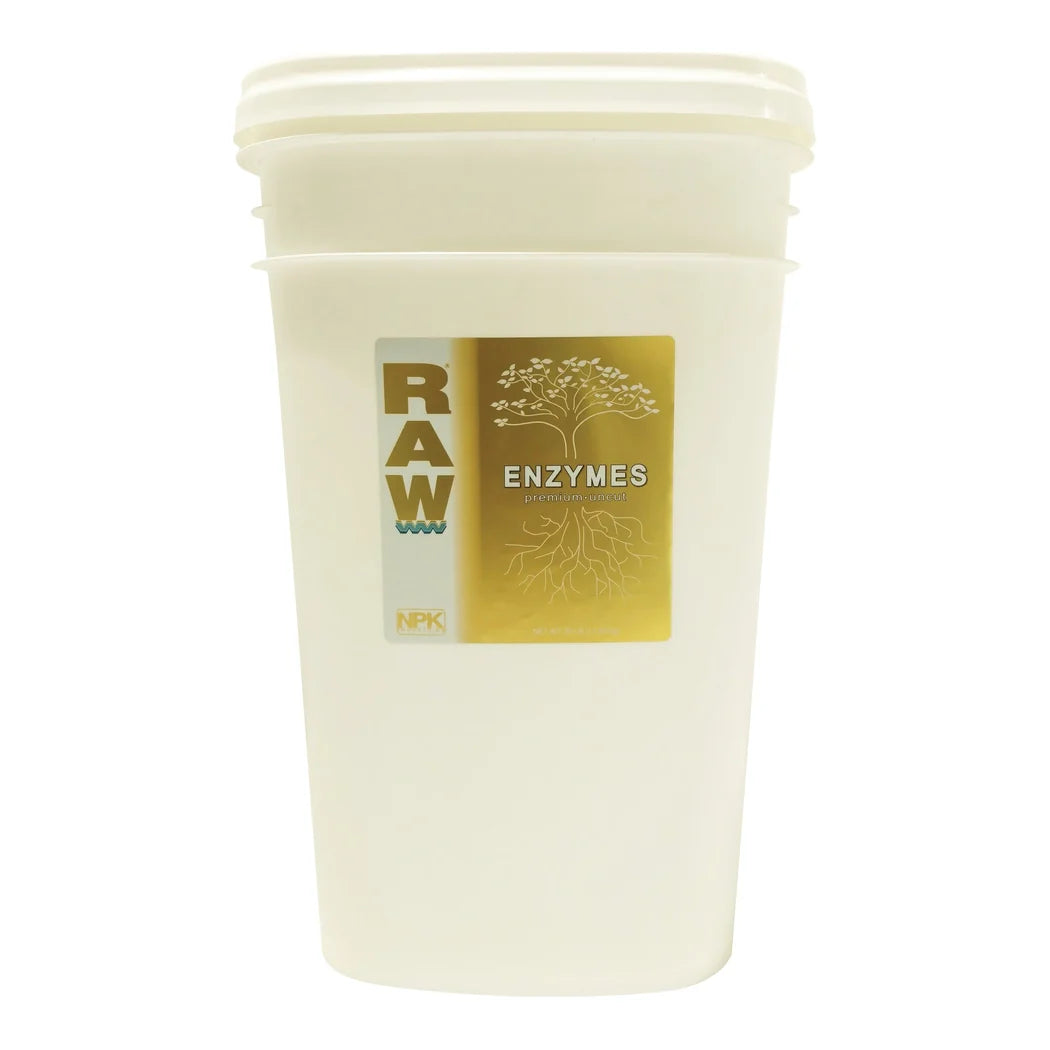
The Three Enzymes Inside NPK RAW Enzymes
Three enzymes, and the activity figures tell you which one is doing the work. Cellulase runs at 132,000 units per gram, xylanase at 8,000 and beta-glucanase at 5,000. That makes cellulase roughly sixteen times the xylanase and twenty six times the beta-glucanase. In other words this is a cellulase product with two supporting enzymes, not an even three way blend. Each has a different target. Cellulase breaks dead root material into simpler compounds a plant can take up again. Xylanase works on organic residues, which is what keeps media structure open rather than clogged. Beta-glucanase goes after complex carbohydrates and frees the nutrients bound inside them. Rates depend on the medium rather than the stage. Seedling and cutting media take a sixteenth of a teaspoon, about 0.3 of a gram, per gallon of water. Soil, coco and soilless media take an eighth of a teaspoon, roughly 0.6 of a gram. A hydroponic reservoir takes the same eighth of a teaspoon, dosed at every solution change.
What Enzymes for Plants Do, and What They Do Not
An enzyme does not feed anything. It unlocks what is already present, which is a different job from a fertiliser and a different job again from a microbe. Think of the root zone after a few weeks of growth. Dead root hairs, spent organic matter and old carbohydrate are all carbon and nutrients the plant paid for and can no longer reach. Cellulose is what stands between the two. That is why this kind of product earns its place in reused media and in long crops. It matters anywhere root mass accumulates faster than it breaks down. The hydroponic case is slightly different. There the target is the dead root and film collecting in the reservoir and lines. That is why the rate is tied to solution changes. There are two honest points to make here. An enzyme is a protein that does its work and is then spent. Unlike a bacterial inoculant it does not colonise or multiply, so it has to be re-dosed on schedule. And because this is an uncut powder, storage matters more than usual. Keep it sealed, cool, dry and out of sunlight, and reseal it straight after use.
Key Features
- Cellulase at 132,000 U/g: The dominant enzyme by a wide margin in this blend.
- Xylanase at 8,000 U/g: Works on organic residues, which keeps media structure open.
- Beta-glucanase at 5,000 U/g: Targets complex carbohydrates and frees what is bound inside.
- Rates set by medium: A sixteenth of a teaspoon in propagation, an eighth elsewhere.
- Dose at every solution change: The instruction for hydroponic reservoirs.
- Uncut and fully soluble: No fillers and no dyes, so the whole dose goes into solution.
- Safe at every growth stage: Compatible with any feed programme, in soil, coco or hydro.
- Not a living product: An enzyme is spent once it has worked, so re-dose on schedule.
Technical Specifications
| Specification | Value |
|---|---|
| SKUs | 717995, 717996, 717998 |
| Brand | NPK Industries |
| Product | Soluble enzyme root-zone supplement, powder |
| Cellulase activity | 132,000 U/g |
| Xylanase activity | 8,000 U/g |
| Beta-glucanase activity | 5,000 U/g |
| Fillers or dyes | None; uncut tech grade |
| Seedling and cutting media rate | 1/16 tsp, about 0.3 g, per gallon of water |
| Soil, coco and soilless rate | 1/8 tsp, about 0.6 g, per gallon of water |
| Hydroponic reservoir rate | 1/8 tsp per gallon, at each nutrient solution change |
| Compatibility | Any nutrient programme, all growth stages, soil, coco or hydroponic |
| Storage | Sealed, cool, dry, out of direct sunlight; reseal promptly after use |
| Sizes | 2 oz, 8 oz, 2 lb, 10 lb and 25 lb |
| Barcodes | 856606006393, 856606006409 and 856606006416 |