

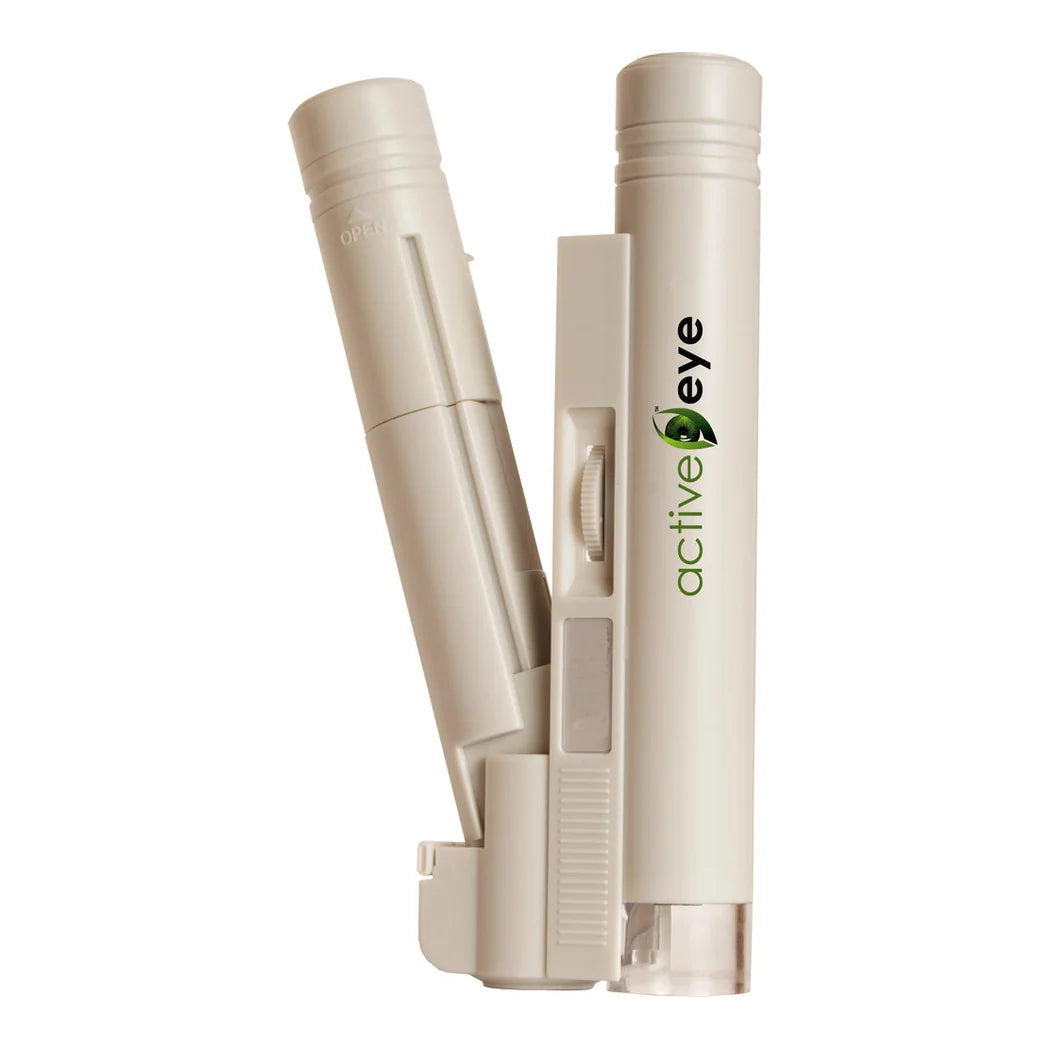
What the Active Eye Microscope Resolves at the Leaf
Magnification is fixed at 100X, with a bright LED built into the head so the specimen is lit from the same side you view it. The body measures about 6 x 2.3 x 1.3 in and the whole thing weighs 0.26 lb on the shipping scale. Batteries come in the box, along with a hard case and a tri-lingual color chart that doubles as the user guide. The case is what keeps the lens clean between uses, which matters more than it sounds in a room with perlite dust. Part number is AEM100 and the barcode reads 638104009768. At this magnification the useful subjects are the ones that defeat the naked eye entirely. Mite eggs, the first instar of a thrips, the waxy fringe on a whitefly nymph, the spore structures on a leaf lesion. Identification to species is what decides which mode of action goes in the sprayer. Life stage is what decides when. A follow-up look two days after an application tells you whether the eggs died with the adults.
Working a 100X Microscope on a Live Plant
Depth of field at this power is thin, and the working distance is short. That means the barrel rests against the leaf surface rather than hovering above it, and the leaf has to be supported from underneath. A fingertip or a piece of card behind the leaf stops the whole field drifting out of focus every time the plant moves. The underside of the leaf comes first, every single pass. Mites, thrips and whitefly all start on the lower surface, along the midrib and in the vein junctions. Work a diagonal across the room rather than the plants nearest the door, because the ones by the door are the ones everybody already checks. The LED helps most on a dark leaf and least on a glossy one, where it can throw a hot spot that hides detail. Tilting a few degrees off perpendicular usually kills the glare. It is also worth a look at a biocontrol shipment before release, since sachets that arrived warm do not always arrive alive. The honest limit is that a handheld at this power asks for a steady hand and a still leaf. It is a spot-check tool rather than something you sweep a whole canopy with.
Key Features
- Fixed 100X view: Resolves mite eggs and early larval stages that the naked eye cannot separate.
- Built-in LED: Lights the specimen from the viewing side, which is what makes a shaded leaf underside readable.
- Pocket format: At about 6 in long it goes into a pocket on the way into the room.
- Case included: Keeps the lens out of the dust between scouting passes.
- Batteries in the box: Usable the day it arrives rather than after a trip for cells.
- Tri-lingual color chart: Doubles as the user guide and as a reference while you are looking.
Technical Specifications
| Specification | Value |
|---|---|
| Magnification | 100X |
| Illumination | LED, built into the head |
| Included | Batteries, hard case, tri-lingual color chart |
| Unit dimensions | approx. 6 x 2.3 x 1.3 in |
| Shipping weight | 0.26 lb |
| Manufacturer part number | AEM100 |
| UPC | 638104009768 |
| GTIN-14 | 10638104009765 |