


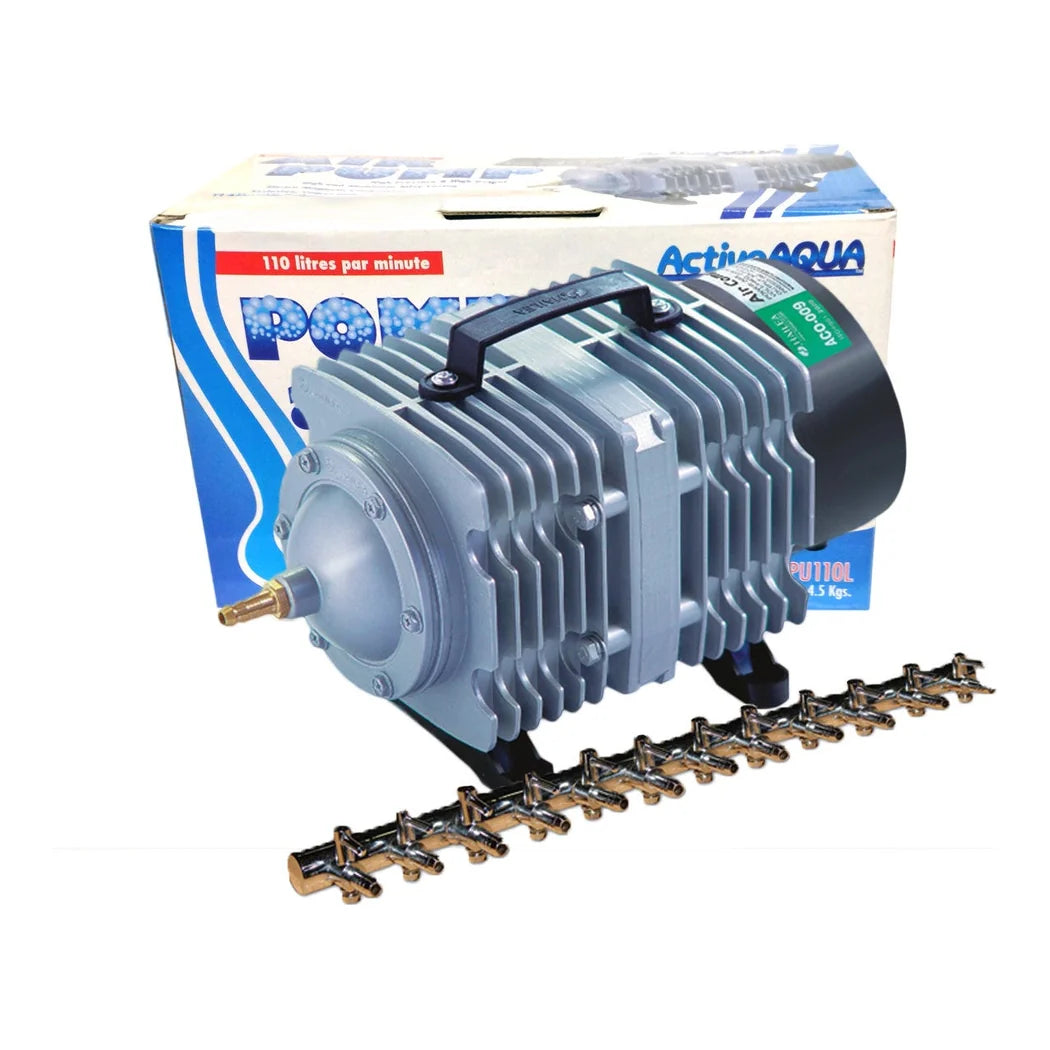
What the Active Aqua Commercial Air Pump Moves
Rated output is 110 L/min, which works out to roughly 1,743 GPH of air at the manifold. The motor draws 112 W on a 120 V supply and tops out near 1.0 A, so it sits easily on a shared room circuit. Twelve copper outlets sit on a divider bar, and each one carries its own valve. That means a site can be shut off or throttled without touching the other eleven. The housing is aluminum alloy, which matters on a piston pump that is expected to run for weeks without stopping. Inside it, a wear-resistant cylinder and piston carry the duty, and a multi-level muffler sits on the discharge side. Measured noise stays at or below 60 decibels. Working pressure is listed above 0.035 MPa, which is what pushes air down a long run of tubing to a deep reservoir. The pump weighs 11.5 lb and measures 11.5 x 6.4 x 7 in on the bench. Part number is AAPA110L and the barcode reads 638104000611. Cases hold four units, and the warranty runs one year.
Running an Air Pump for Compost Tea and Twelve Reservoirs
An air pump for compost tea earns its output in the first six hours of a brew, when the microbial population is climbing fastest. Dissolved oxygen is the limiting factor there, not nutrient concentration. A piston pump of this class holds its output against the back-pressure of a diffuser that is starting to clog. That is where smaller diaphragm units begin to fade. Outlet barbs take quarter-inch airline tubing straight on. Split that across twelve brewers, or gang several outlets onto one large vessel through a manifold. One big tank can take everything the pump has to give. Valve the unused outlets closed rather than leaving them open to the room. The same twelve-way bar suits a bank of deep water culture sites. Every bucket wants its own stone, and every stone wants its own trim. Mount the pump above the water line whenever possible. A check valve is otherwise the only thing between a power cut and a siphon back into the body. Give it a flat, hard surface instead of foam, because a piston pump transmits vibration into whatever it sits on. Keep the intake filter clean, and treat the cylinder and piston as the service parts they are. A pump kept on a shelf with clean air moving through it outlasts one standing in a puddle under a bench.
Key Features
- Twelve copper outlets: Each one carries its own valve on the divider bar.
- 110 L/min air output: About 1,743 GPH, which covers a long manifold or a bank of brewers.
- 112 W on a 120 V supply: Maximum current near 1.0 A keeps it on an existing room circuit.
- Aluminum alloy housing: Sheds heat from a piston assembly expected to run continuously for weeks.
- Multi-level muffler: Holds measured noise at or under 60 decibels for a piston design.
- Wear-resistant cylinder and piston: The moving parts are the service item rather than the whole pump.
- Quarter-inch outlet barbs: Standard airline tubing pushes on without an adapter or a step fitting.
Technical Specifications
| Specification | Value |
|---|---|
| Air output | 110 L/min (approx. 1,743 GPH) |
| Outlets | 12, copper, individually valved |
| Power consumption | 112 W |
| Voltage | 120 V |
| Maximum current | 1.0 A |
| Working pressure | greater than 0.035 MPa |
| Maximum noise | 60 dB |
| Housing material | Aluminum alloy |
| Outlet size | 1/4 in |
| Weight | 11.5 lb |
| Dimensions | 11.5 x 6.4 x 7 in |
| Units per case | 4 |
| Warranty | 1 year |
| Manufacturer part number | AAPA110L |
| UPC | 638104000611 |