


What Separates the ECO 20 Liter Rotary Evaporator From the Certified One
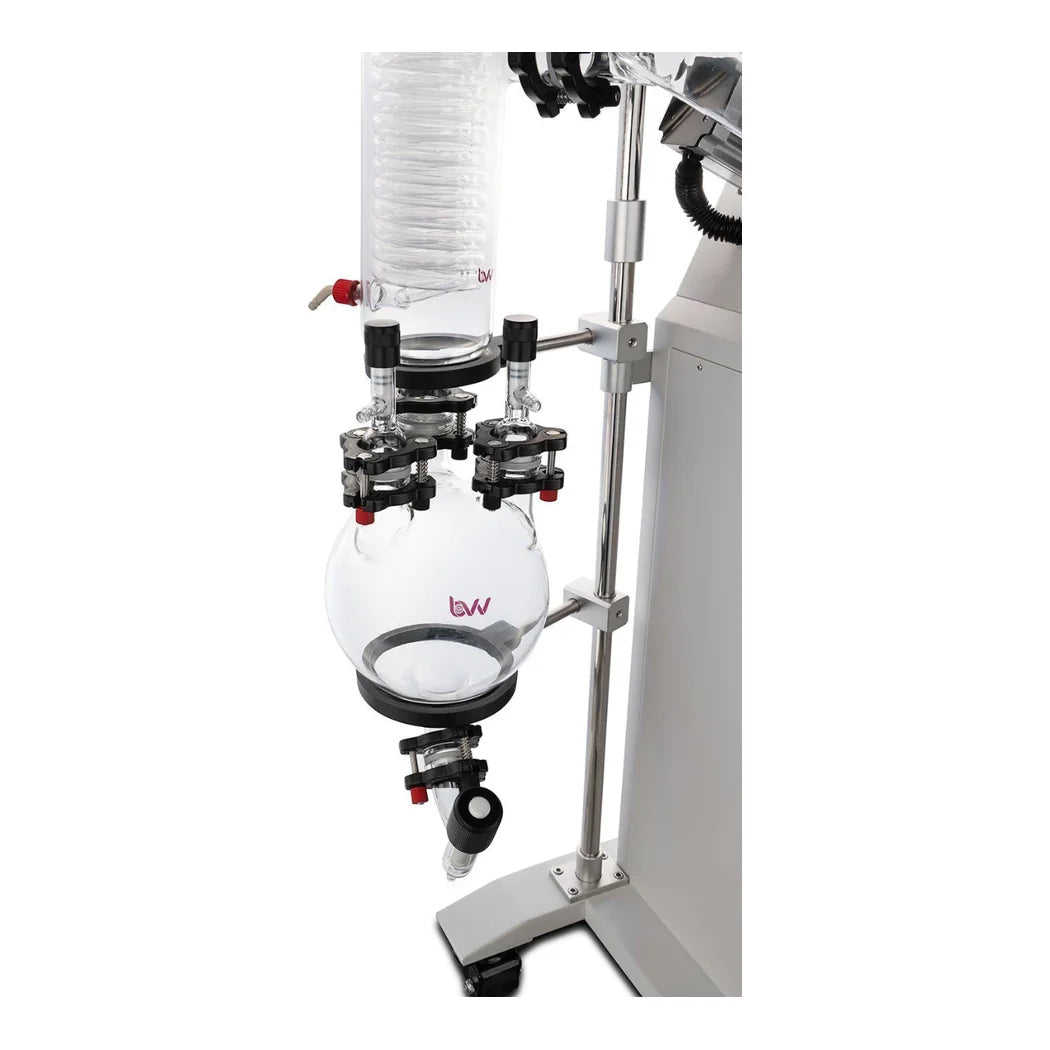
There are two machines at this flask size and the difference is worth understanding before choosing. Start with where the ECO is actually better. Its collection bottle holds the same volume as its evaporating flask, both 20 L. The certified build pairs the same evaporating flask with a smaller receiving bottle. On a long continuous run that is the difference between emptying the receiver once and emptying it twice. Rotation runs from twenty to one hundred and thirty rpm, which is a wider band at the top end than the certified machine offers. Heating is 3300 W into a fully sealed stainless pot, digitally controlled to within one degree. The bath runs from five degrees above ambient up to 99.9 degrees Celsius. The frame is aluminium alloy and the glass is GG-17 high borosilicate throughout. Lifting is electric rather than manual. The footprint is 42 by 24 by 77 in and it weighs 195 lbs, so it is shorter and heavier than the certified build.
Wiring and Running It for Ethanol Solvent Recovery
One thing has to be dealt with before anything else, and it usually gets buried. This unit ships with no plug on it. It is built to be hard-wired into a junction box on a 220 volt supply by a qualified electrician. One has to be booked before the machine is useful. Factor that into the install cost rather than discovering it on delivery day. What it is for is recovering ethanol and reusing it, and the efficient way to run it is continuous feed rather than batch. The short version runs like this. Chiller to the condenser and set cold, vacuum pump through a cold trap, bath to about forty degrees, rotation near one hundred rpm. Pull vacuum before anything goes in. Inject roughly 500 mL to prime it and let that evaporate. Then crack the injection valve open and leave it open, matching the rate going in to the rate dripping out of the condenser. A stable chiller temperature tells you the two are matched. If the chiller starts climbing you are feeding it faster than it can condense, so dial the valve back. Once it is stable it will run unattended with periodic checks.
Key Features
- 20 L collection, not 10 L: Same size as the evaporating flask, so fewer stops to empty.
- 20 to 130 rpm: A wider top end than the certified build in the same range.
- 3300 W sealed stainless pot: Digital control, accurate to plus or minus one degree.
- Bath to 99.9 degrees Celsius: From five degrees above ambient upward.
- GG-17 high borosilicate glass: On an aluminium alloy frame, with an electric lift.
- No plug fitted: It must be hard-wired into a junction box by an electrician.
- 42 by 24 by 77 in, 195 lbs: Shorter and heavier than the certified build.
- Not ETL certified: Which is the trade against the certified machine's price.
Technical Specifications
| Specification | Value |
|---|---|
| SKU | RT20L-ECO |
| Brand | BVV |
| Product | Rotary evaporator, ECO series |
| Rotary bottle capacity | 20 L |
| Collection bottle capacity | 20 L |
| Glass | GG-17 high borosilicate |
| Shelf material | Aluminium alloy |
| Pot material | Stainless steel, fully sealing and heating |
| Rotary power | 220V, 50 or 60 Hz |
| Rotation speed | 20 to 130 rpm |
| Heating power | 3300 W |
| Bath temperature range | Ambient plus five degrees to 99.9 C |
| Temperature control | Digital, accurate to plus or minus 1 C |
| Lifting mechanism | Electric |
| Dimensions assembled | 42 x 24 x 77 in |
| Weight | 195 lbs |
| Plug | None fitted; hard-wire into a junction box via a qualified electrician |
| Certification | None; the Neocision build is the ETL certified option |
| Valves | PTFE throughout |
BVV inspect every unit for broken glass or parts before it ships.
Glassware safety: BVV are not responsible for glassware failure. Glass has to be inspected before and after every use, because it can develop imperfections or damage through normal use, mishandling and thermal stress. If anything is found on inspection, do not use that piece. Failed glassware can cause injury and damage to the area around it.