

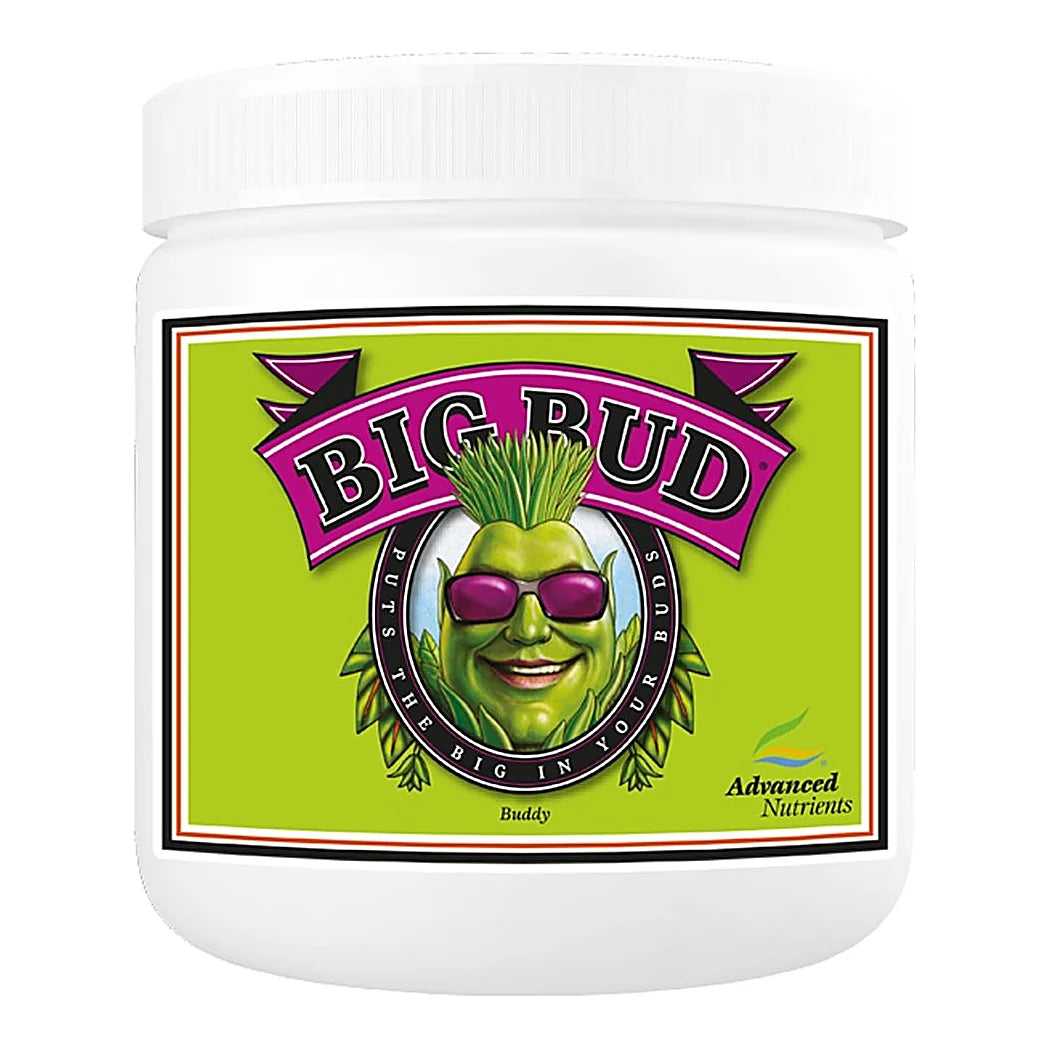
What Big Bud Powder Does in Weeks Two Through Five
A flowering additive earns its place in the schedule or it does not, and the label analysis is where you find out. This one runs 0-15-35, which is a deliberate set of numbers rather than a marketing shape. There is no nitrogen in it at all, and that absence is the point. Nitrogen in mid-flower pushes leaf at exactly the stage you want carbon going into flower instead. The phosphorus and potassium come from monopotassium phosphate and potassium sulfate, both of which dissolve clean and carry no filler into the tank. The third input is whey protein hydrolysate, which is where the L-form amino acid fraction originates. Magnesium arrives alongside the sulfate. Because the product is dry, you are not paying freight on water or giving up shelf space to bottles in the nutrient room. It goes fully into solution rather than settling out, so a dosing line does not clog on it. Advanced Nutrients states on its own label that the formula carries no paclobutrazol and no daminozide. That matters to anyone whose harvest meets a testing lab.
Running a Dry Bloom Booster Against a Liquid One
The rate is half a gram per litre and the window is weeks two, three, four and five of bloom. That window is narrower than most growers assume. Using it from the day of flip spends product on a plant that is still stretching. Carrying it into week seven pushes potassium while the plant is winding down. Ten grams into a 20 L reservoir lands the rate exactly, which is the number worth remembering at the bench. Dissolve it in warm water first rather than tipping powder onto a full tank. It mixes with any base line, including competitors, and the manufacturer says so plainly instead of leaving you to test it yourself. Two honest cautions belong with it. A potassium input this concentrated moves EC enough to notice, so read runoff rather than trusting the base-feed numbers to still hold. And this is the standard formulation rather than the coco-specific one, so growers in buffered coco should watch calcium as potassium climbs. For anyone already running a dry-salt program, it drops in without adding another jug to the bench.
Key Features
- Zero Nitrogen Analysis: At 0-15-35 there is no nitrogen to push leaf growth during the weeks the plant should be filling flower.
- Half a Gram Per Litre: Ten grams into a 20 L reservoir hits the label rate exactly, which makes bench dosing simple to repeat.
- Fully Soluble Salts: Monopotassium phosphate and potassium sulfate dissolve clean, so dosing lines and emitters stay clear.
- Amino Acid Fraction: Whey protein hydrolysate supplies the L-form amino acids that separate this from a plain PK salt.
- No Banned PGRs: Advanced Nutrients states the formula carries no paclobutrazol and no daminozide, which testing labs will check.
- Ships Dry: Nothing in the box is water, so freight and storage cost less per gallon of finished solution than a liquid equivalent.
- Mixes With Any Base: The manufacturer confirms compatibility with pH Perfect lines, non-pH-Perfect lines and competitor base nutrients.
- Six Sizes: From a 130 g pouch up to a 20 kg sack, the same formula scales from one tent to a commercial room.
Technical Specifications
| Specification | Value |
|---|---|
| Guaranteed Analysis | 0-15-35 |
| Form | Water-soluble powder |
| Application Rate | 0.5 g per litre |
| Timing | Weeks 2, 3, 4 and 5 of bloom |
| Derived From | Monopotassium phosphate, potassium sulfate, whey protein hydrolysate |
| Compatibility | pH Perfect and non-pH Perfect base nutrients, and competitor lines |
| Plant Growth Regulators | None; no paclobutrazol or daminozide |
| Systems | Hydroponics, coco, aeroponics, drip, NFT, flood and drain, DWC, hand watering |
| Sizes | 130 g, 500 g, 1 kg, 2.5 kg, 10 kg, 20 kg |