


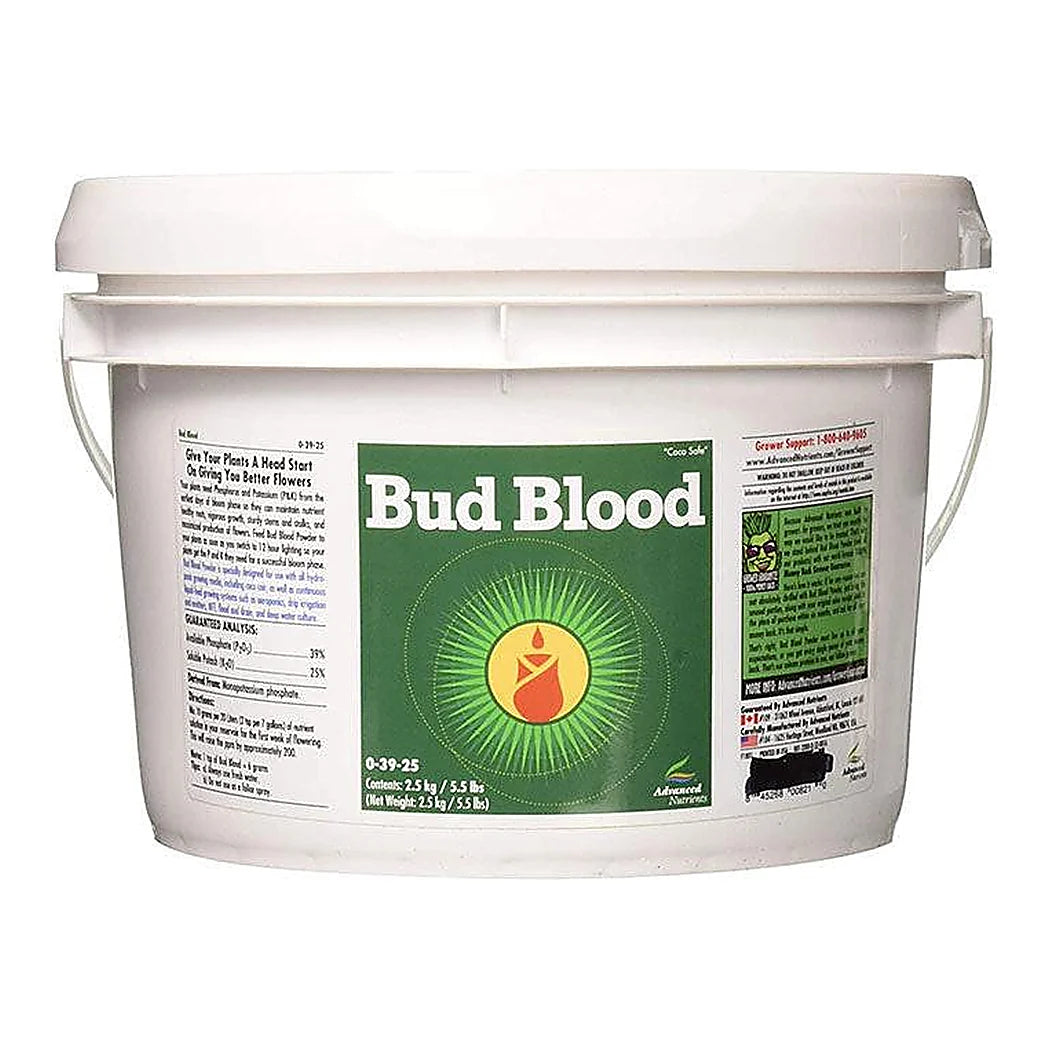
What Advanced Nutrients Bud Blood Does at the Flip
The switch from eighteen hours of light to twelve is the sharpest change a plant goes through, and the feed usually lags behind it. This additive exists for that gap. The analysis is 0-39-25, which puts phosphorus well ahead of potassium and leaves nitrogen out completely. Phosphorus is what the plant draws on to set sites. Having it available on the day the photoperiod changes is the whole argument for a transition product. The salts come from potassium sulfate, potassium phosphate and magnesium phosphate, so magnesium arrives alongside the phosphate rather than needing a separate correction. Everything dissolves, which matters because a transition dose goes in once and needs to be available immediately rather than over a fortnight. It is a dry powder, so nothing in the container is water. That keeps the freight and the shelf space proportional to the number of doses rather than the volume of packaging. The formula carries no paclobutrazol and no daminozide. For anyone whose flower goes to a testing lab, that sentence is the reason to read the label at all.
Where a PK Booster Belongs in the Schedule
The rate is half a gram per litre, and that dose lifts a reservoir by roughly 200 ppm. Ten grams into a 20 L tank puts you exactly on label. Timing is the part growers get wrong most often. This is a transition input, used as the plant shifts into the first week or two of flower. It is not something to run the whole way through bloom. Carrying it deep into flower stacks phosphorus the plant has already stopped asking for, and the base feed is usually supplying potassium by then anyway. Mix it into warm water before it meets the reservoir, then check EC afterwards rather than assuming the base numbers still apply. The label is explicit that this is not a foliar product, so it goes in the tank and nowhere else. Two honest limits are worth stating. A 39 percent phosphate input will move pH in a soft-water reservoir, so test after mixing rather than before. And a grower already running a separate bloom booster from week two should treat these as sequential rather than stacked.
Key Features
- Zero Nitrogen, Heavy Phosphate: At 0-39-25 there is nothing pushing vegetative growth while the plant is trying to set flower sites.
- Transition Timing: It is built for the flip and the first week or two after, not for the whole bloom period.
- Half a Gram Per Litre: Ten grams into a 20 L reservoir lands on label, and the dose lifts solution strength by roughly 200 ppm.
- Magnesium Included: Magnesium phosphate is one of the source salts, so the phosphate spike does not arrive on its own.
- Fully Soluble: Everything goes into solution, which matters for a one-shot dose that has to be available immediately.
- No Banned PGRs: There is no paclobutrazol and no daminozide in the formula.
- Reservoir Only: The label rules out foliar application, which keeps the decision simple at the bench.
- Five Sizes: From a 300 g pouch to a 20 kg sack, the same analysis covers a tent or a commercial room.
Technical Specifications
| Specification | Value |
|---|---|
| Guaranteed Analysis | 0-39-25 |
| Form | Water-soluble powder |
| Application Rate | 0.5 g per litre (1/10 tsp per quart) |
| Effect on Solution | Raises strength by approximately 200 ppm |
| Timing | Transition into bloom, first week or two of flower |
| Derived From | Potassium sulfate, potassium phosphate, magnesium phosphate |
| Foliar Use | Not permitted |
| Plant Growth Regulators | None; no paclobutrazol or daminozide |
| Sizes | 300 g, 500 g, 2.5 kg, 10 kg, 20 kg |