


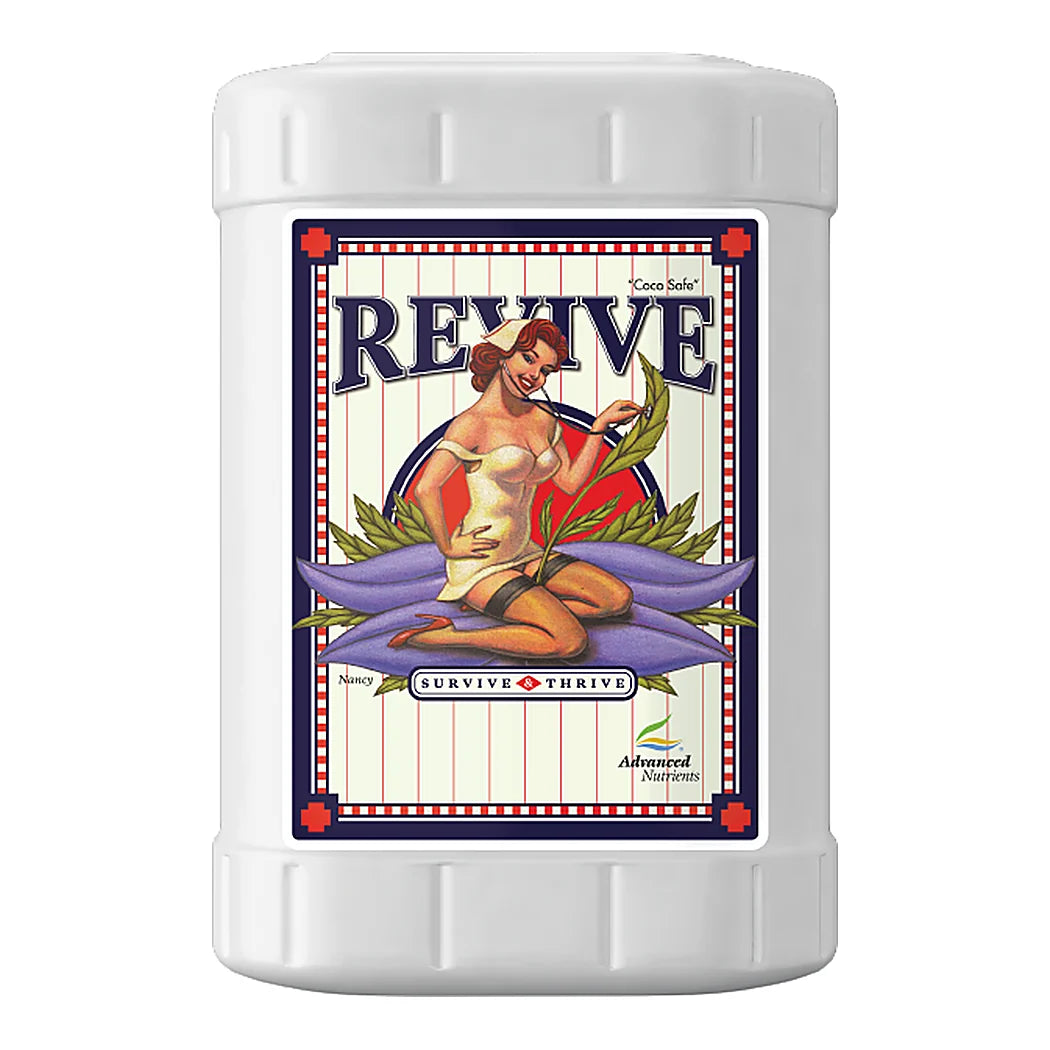
What Advanced Nutrients Revive Actually Contains
A rescue bottle is only as good as its label, and this one reads 1-0-0. That single percent of nitrogen is deliberate rather than thin. Of it, 0.6 percent is nitrate and 0.4 percent is urea. Part of the nitrogen is available the moment it hits the root zone, and the rest converts over the days that follow. There is no phosphorus and no potassium in the bottle at all. That is exactly what you want in a corrective. The point is to fix a gap without shifting the ratios your base feed already sets. The corrective work is done by three elements. Calcium sits at one percent, magnesium at half a percent in water soluble form, and iron at three tenths of a percent, fully chelated. Those three are the usual suspects behind interveinal yellowing, weak new growth and the pale flush that follows a transplant. Calcium and magnesium are secondary macronutrients rather than trace metals, and the quantities here reflect that.
When Revive Plant Food Earns Its Place in the Room
Three rates cover three different situations, and the difference between them matters. At 5 mL per litre the bottle is doing corrective work, and the manufacturer says to repeat after a week if the symptoms have not lifted. At 3 mL per litre it goes on as a foliar. That puts calcium and iron onto leaf tissue directly and skips a root zone that may already be locked out. At 1 mL per litre it rides along in the regular feed as insurance rather than treatment. Reach for it after a transplant, after a heat or light event, or when a lockout has already been diagnosed at the reservoir. What it will not do is fix the cause. If your runoff is reading high and the medium is loaded, a corrective on top makes the arithmetic worse. Flush the medium first, then correct. It mixes with every pH Perfect and non pH Perfect base line, and with competitor lines too. Advanced Nutrients also states on the label that there is no paclobutrazol and no daminozide in it.
Key Features
- One Percent Calcium: Calcium leads the analysis because it is the element most often short when new growth comes in weak or hooked.
- Chelated Iron: At three tenths of a percent and fully chelated, the iron stays available rather than dropping out in the tank.
- Water Soluble Magnesium: Half a percent of magnesium in soluble form addresses the interveinal yellowing that starts on older leaves.
- Split Nitrogen Source: Nitrate at 0.6 percent works immediately while the 0.4 percent urea fraction converts over the days that follow.
- Three Application Rates: Five millilitres corrects, three works as a foliar, and one millilitre rides along as routine insurance.
- No Banned PGRs: The label states no paclobutrazol and no daminozide, which is the first thing a testing lab looks for.
Technical Specifications
| Specification | Value |
|---|---|
| Guaranteed Analysis | 1-0-0 (N-P-K) |
| Total Nitrogen | 1% (0.6% nitrate, 0.4% urea) |
| Calcium | 1% |
| Magnesium | 0.5% water soluble |
| Iron | 0.3% chelated |
| Correction Rate | 5 mL/L, repeat after one week if needed |
| Foliar Rate | 3 mL/L, repeat after one week if needed |
| Maintenance Rate | 1 mL/L in the regular feed |
| Compatibility | All pH Perfect, non pH Perfect and competitor base nutrients |
| Systems | Aeroponics, drip and emitters, NFT, flood and drain, deep water culture, coco, soil |
| Plant Growth Regulators | None: no paclobutrazol, no daminozide |
| Sizes | 1 L, 4 L, 23 L |