


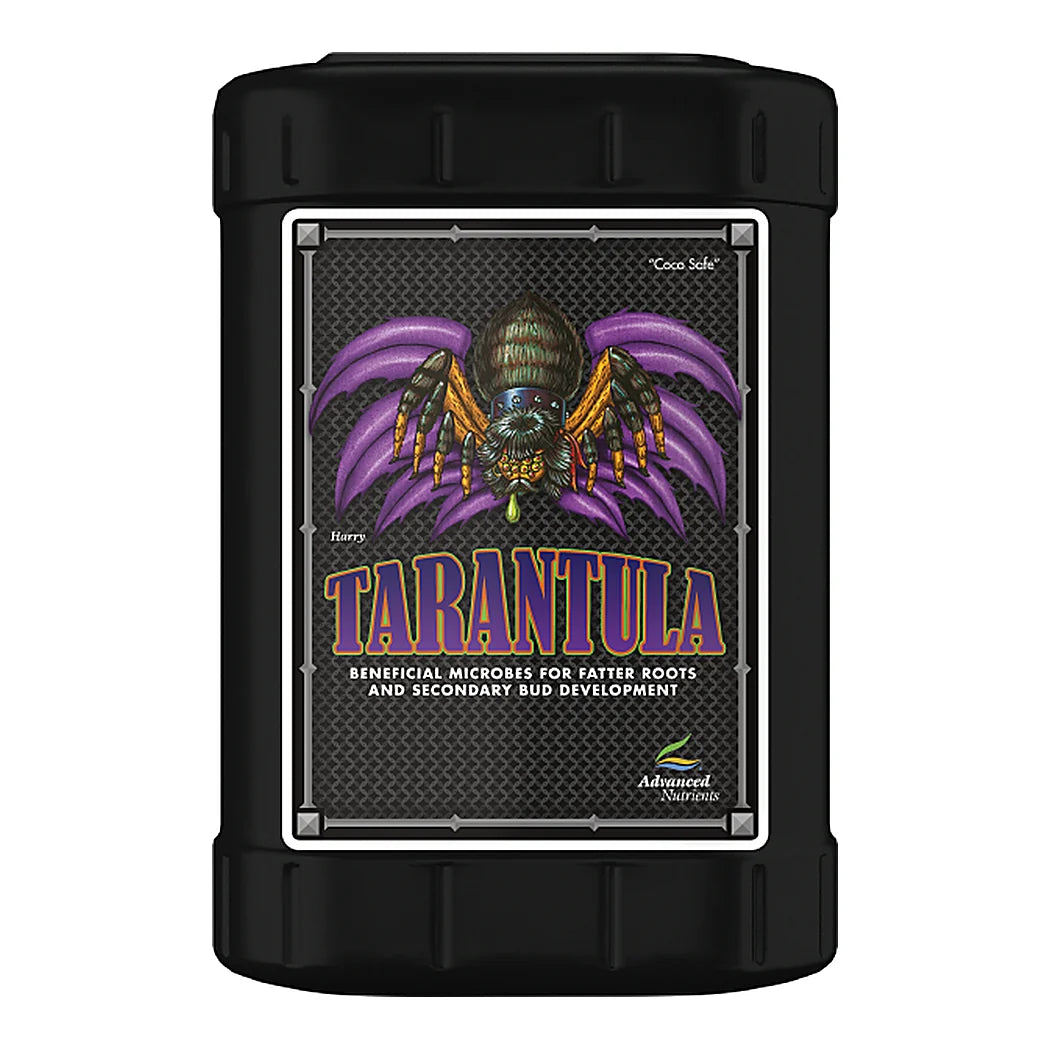
What Advanced Nutrients Tarantula Liquid Puts in the Root Zone
Microbial products are easy to describe and hard to verify, so start with the label. Tarantula names seven organisms rather than hiding behind a genus. Those are Arthrobacter globiformis, Bacillus coagulans, Bacillus licheniformis, Bacillus mucilaginous, Bacillus pumilus, Bacillus subtilis and Paenibacillus polymyxa. The count is ten million colony forming units per gram. These are rhizosphere organisms, and their work happens at the root surface rather than in the leaf. Several of them solubilise phosphorus that has bound to calcium or iron in the medium and gone out of reach. Others produce organic acids and siderophores, which is the mechanism behind the claim that iron becomes more available. Paenibacillus polymyxa and Bacillus subtilis are also well documented root colonisers. That matters, because an organism that cannot hold a place on the root does nothing for long. None of this replaces a base feed. It changes how much of that feed the plant actually reaches.
Dosing Beneficial Bacteria Without Killing Them First
The feed chart is shorter than most growers expect. Use two millilitres per litre in weeks one and two of the growth stage. Repeat at the same rate in weeks one and two of bloom. That is four applications across a full cycle rather than a weekly habit. The point of the timing is colonisation: you inoculate while roots are expanding into new medium, not once the plant has finished building them. Shake the bottle before every pour, because live cultures settle. Mix it into water that has had the chlorine taken off it. Municipal chlorine and chloramine are there to kill bacteria, and they do not distinguish between yours and theirs. For the same reason, keep it out of any tank being run with hydrogen peroxide or a hypochlorite sterilant. It pairs with every pH Perfect and non pH Perfect base line, and with competitor lines, so nothing in your existing schedule has to move.
Key Features
- Seven Named Species: Each organism is named rather than only a genus, which is what makes the product checkable.
- Ten Million CFU Per Gram: A defined colony count, so you can compare this against any other inoculant.
- Phosphorus and Iron: Several of these species work on nutrients that have bound in the medium and dropped out of reach.
- Four Doses Per Cycle: Weeks one and two of growth, then the same in bloom, which is far less product than a weekly additive.
- Works In Any Medium: Aeroponics, drip and emitters, NFT, flood and drain and deep water culture all take it the same way.
- No Banned PGRs: There is no paclobutrazol and no daminozide in the formula.
Technical Specifications
| Specification | Value |
|---|---|
| Type | Liquid bacterial inoculant |
| Named Species | Arthrobacter globiformis, Bacillus coagulans, Bacillus licheniformis, Bacillus mucilaginous, Bacillus pumilus, Bacillus subtilis, Paenibacillus polymyxa |
| Colony Count | 10,000,000 CFU per gram |
| Growth Rate | 2 mL/L, weeks 1 and 2 |
| Bloom Rate | 2 mL/L, weeks 1 and 2 |
| Water | Use dechlorinated water; avoid tanks running peroxide or hypochlorite |
| Compatibility | All pH Perfect, non pH Perfect and competitor base nutrients |
| Systems | Aeroponics, drip and emitters, NFT, flood and drain, deep water culture, coco, soil |
| Plant Growth Regulators | None: no paclobutrazol, no daminozide |
| Sizes | 1 L, 4 L, 10 L, 23 L |