

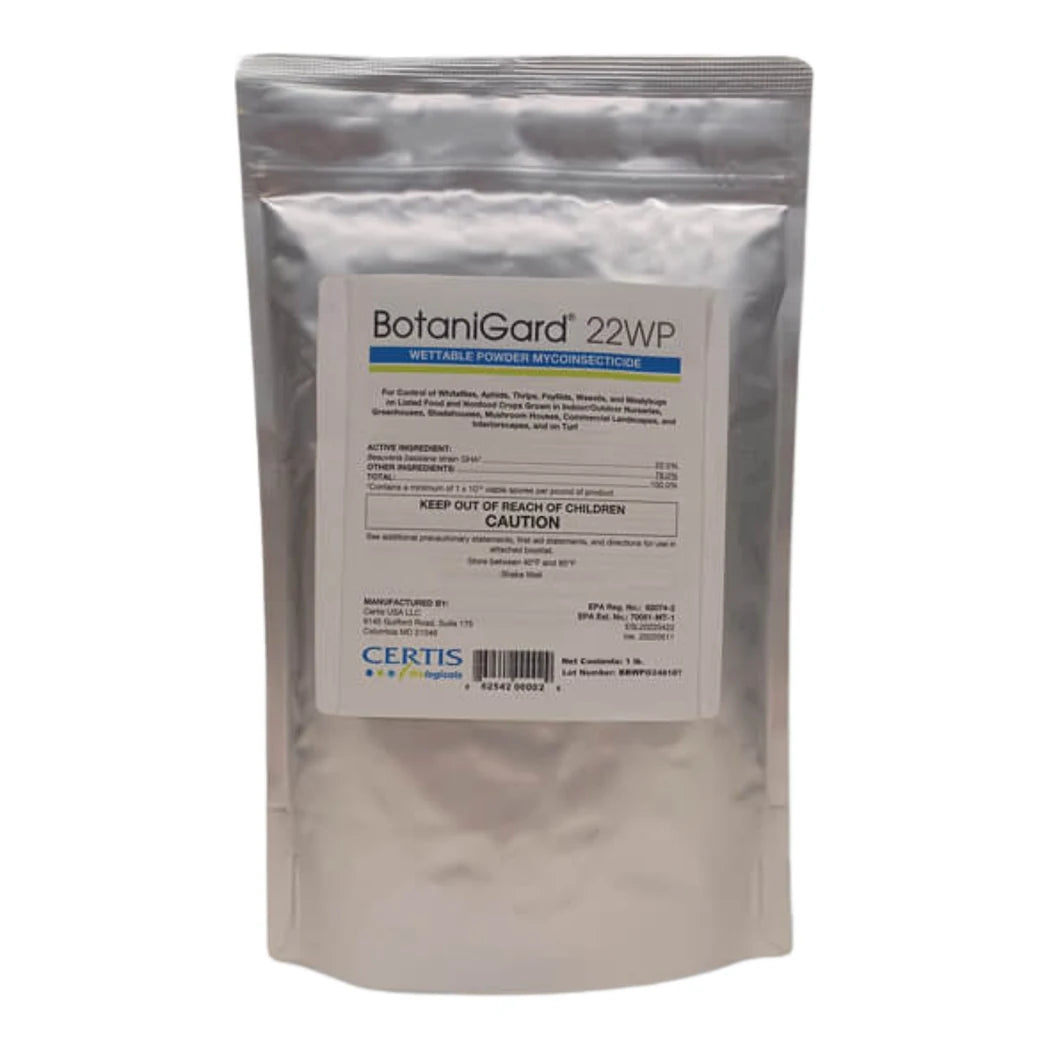
BotaniGard 22WP Mycoinsecticide for Greenhouse Pests
Whiteflies, aphids and thrips breed faster than most sprays can keep up, and a living fungus gives growers a different line of attack. This Certis mycoinsecticide, EPA registration 82074-2, contains 22.0% Beauveria bassiana strain GHA. Each pound carries at least 1 x 10¹³ viable spores. The spores stick to the pest, germinate and grow through the cuticle. The fungus then multiplies inside the insect until it dies. Because it works by contact, thorough coverage of leaf undersides matters as much as the rate. It controls whiteflies, aphids, thrips, psyllids, weevils and mealybugs, plus a long list of other labelled pests. Labelled sites include greenhouses, nurseries, shadehouses, interiorscapes and turf. Food crops on the label range from leafy greens and fruiting vegetables to berries, herbs and tree fruit. The restricted-entry interval is 4 hours, and the preharvest interval is 0 days. There is no limit on the number of applications in a season.
Spraying a Beauveria bassiana Insecticide
Start at the first sign of pests, since control is strongest before populations climb. Fill the tank halfway, start agitation, then add the powder and top up with water. One level cup holds about 4.5 dry ounces of product. For whiteflies and aphids, use 0.5 to 1 lb per 100 gallons, and use 1 to 2 lb for thrips. In low-volume sprayers, apply 0.5 to 2 lb over 5,000 to 20,000 square feet. Spray to wet without runoff, and keep agitating throughout. Repeat every five to ten days, tightening to two to five days under heavy whitefly or aphid pressure. Expect visible control seven to ten days after the first spray. Mix only what is needed that day, because spores in water die after 24 hours. Keep it apart from fungicides and some wetting agents, which can kill the spores. It must not be applied through irrigation systems. Store the bag cool and dry, between 40°F and 85°F.
Key Features
- Live Fungal Spores: 22% Beauveria bassiana GHA, at least 1 x 10^13 viable spores per pound.
- Broad Pest List: Labelled for whiteflies, aphids, thrips, psyllids, weevils, mealybugs and more.
- 4-Hour REI, 0-Day PHI: Crews can re-enter quickly, and crops can be harvested the day of spraying.
- No Seasonal Cap: Repeat applications as long as pest pressure lasts.
- Cutting Dips: A 1/4 to 1/2 dry oz per gallon dip treats unrooted and rooted cuttings before planting.
- IPM Friendly: Works alone, in rotation or with compatible insecticides for heavy outbreaks.
Technical Specifications
| Specification | Value |
|---|---|
| Product code | BGRD22WP |
| Net weight | 1 lb |
| EPA Reg. No. | 82074-2 |
| Active ingredient | Beauveria bassiana strain GHA 22.0% (minimum 1 x 10^13 viable spores/lb) |
| Formulation | Wettable powder |
| Signal word | CAUTION |
| Whiteflies, aphids | 0.5–1 lb per 100 gal |
| Thrips | 1–2 lb per 100 gal |
| Low-volume sprays | 0.5–2 lb per 5,000–20,000 sq ft |
| Cuttings dip | 1/4–1/2 dry oz per gallon |
| Interval | 5–10 days; 2–5 days under high pressure |
| REI / PHI | 4 hours / 0 days |
| Chemigation | Not permitted |
| Storage | Cool, dry, 40–85°F |
| Manufacturer | Certis USA |
Pests Controlled
| Pest group | Pests |
|---|---|
| Aphids | Aphids, multiple species, including green peach, melon, cotton, potato, rose and root aphids |
| Beetles | Bean leaf beetle (Cerotoma trifurcata), Colorado potato beetle (Leptinotarsa decemlineata), spotted cucumber beetle (Diabrotica undecimpunctata howardi), striped cucumber beetle (Acalymma vittatum), flea beetle, green June beetle |
| Weevils | Alfalfa weevil (Hypera postica), black vine weevil (Otiorhynchus sulcatus), strawberry root weevil (Otiorhynchus ovatus), root weevils (Otiorhynchus spp.), pecan weevil (Curculio caryae), weevils, multiple species |
| White grubs | Masked chafer (Cyclocephala spp.), May/June beetle (Phyllophaga spp.) and European chafer (Rhizotrogus majalis) larvae |
| Caterpillars | Cabbage looper (Trichoplusia ni), imported cabbage worm (Pieris rapae), diamondback moth (Plutella xylostella), European corn borer (Ostrinia nubilalis), southwestern corn borer (Diatraea grandiosella) |
| Leafhoppers | Potato leafhopper (Empoasca fabae), grape leafhopper (Erythroneura elegantula), beet leafhopper (Circulifer tenellus) and other leafhoppers |
| Plant bugs | Tarnished plant bug (Lygus lineolaris), chinch bugs (Lygaeidae), lace bugs (Corythucha spp.), stink bugs, including harlequin bug (Murgantia histrionica) |
| Mealybugs and psyllids | Mealybugs (Pseudococcus spp.), psyllids, multiple species |
| Mole crickets | Mole crickets (Scapteriscus spp.) |
| Thrips | Western flower thrips, onion thrips, greenhouse thrips, Thrips palmi |
| Whiteflies | Greenhouse whitefly (Trialeurodes vaporariorum), silverleaf whitefly (Bemisia sp.), sweetpotato whitefly (Bemisia tabaci) |