

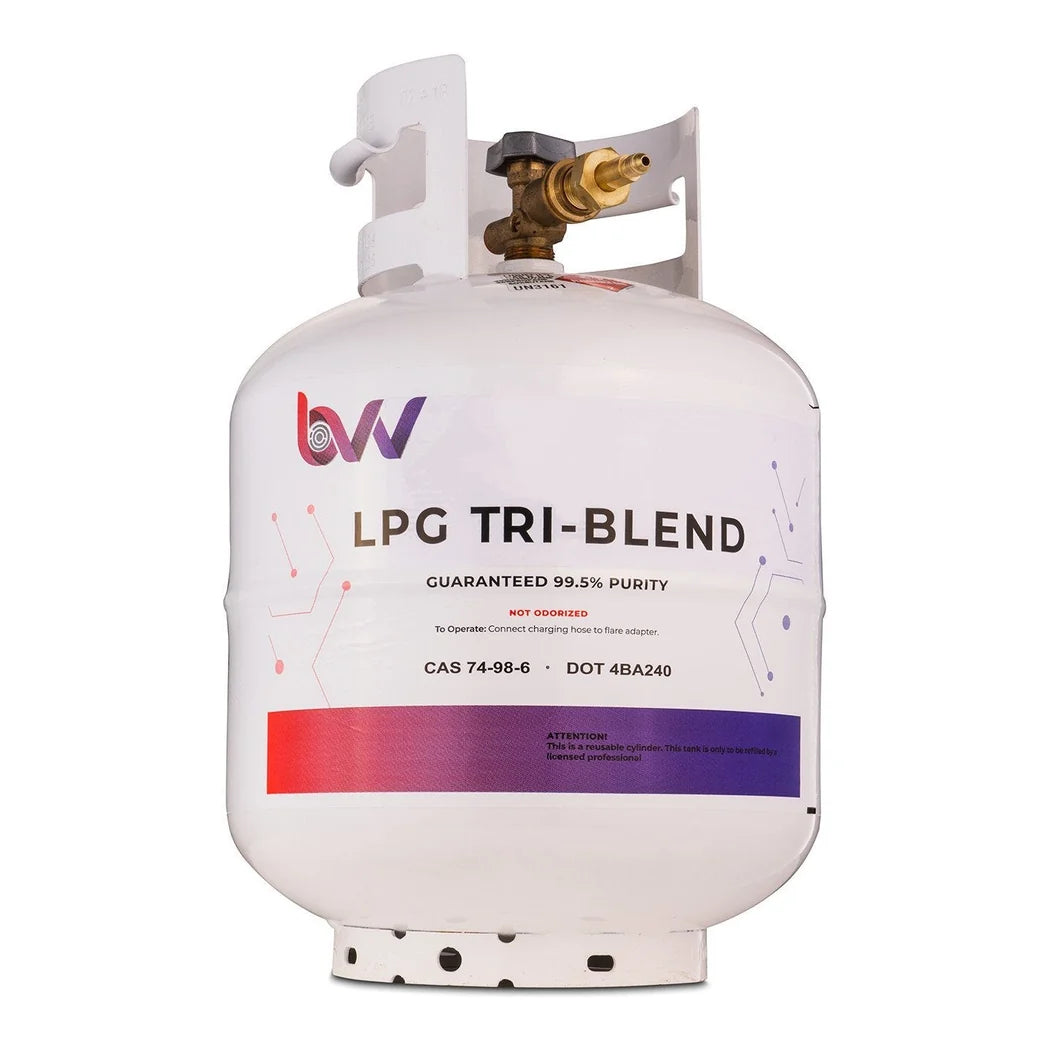
What Is Actually in This High Purity Butane Blend
Three gases go into this tank and each one does a different job. Half the charge is n-butane, which boils at 31.1 degrees Fahrenheit and does the bulk of the pulling. A quarter is iso-butane, boiling at 10.8 degrees, which thins the mix and moves it through a packed column faster. The last quarter is propane, boiling at minus 43.6 degrees, and it carries the lighter aromatic fraction that straight butane leaves behind. That is the whole argument for a three gas charge rather than one gas. It also explains why the blend asks more of the equipment than n-butane alone. Each of the three gases carries its own CAS number, listed in the table below.
Pressure, Fittings and Draw on a 20lb Butane Tank
There are two practical matters to settle before this tank goes into service. The first of those is pressure. Propane's boiling point sits far below the other two gases, so its vapour pressure at room temperature is much higher. Iso-butane on its own runs about 3.1 atmospheres at seventy degrees Fahrenheit, and propane runs well above that. Every column, sight glass, hose and recovery pump in the loop has to be rated for the propane figure rather than the butane one. The second matter is the connection. The CGA 510 fitting is a separate item rather than part of the tank, so plan the hookup around it, because a tank with no fitting cannot be connected. There is a related trap in the same area. The fitting options are JIC flare and MNPT, and a JIC flare seat is 37 degrees where an SAE flare is 45. They thread together and then weep, which on a flammable gas is not a small problem. One more thing follows from the tank having no diptube. Upright, it gives up vapour rather than liquid, and the propane fraction leaves first because it is the most volatile of the three. Draw vapour from it repeatedly and what is left behind is no longer a 50/25/25 mix. Invert it for liquid draw, or run the diptube tank if the blend ratio has to stay put across a whole cylinder.
Key Features
- Three gases, not one: Half n-butane, a quarter iso-butane and a quarter propane by mass.
- 99.5 percent guaranteed: Minimum purity for this blend, with the gas sourced in the USA.
- Higher working pressure: The propane fraction, so rate the whole loop for propane.
- DOT refillable LP tank: No diptube fitted, so upright it gives up vapour rather than liquid.
- CGA 510 connection: The fitting is a separate item, not included with the tank.
- JIC flare, not SAE: A 37 degree seat against 45 degrees, and the two are not interchangeable.
Technical Specifications
| Specification | Value |
|---|---|
| SKU | 502525USA20B |
| Brand | BVV |
| Product | Hydrocarbon gas mixture, liquefied, for closed loop extraction |
| Composition | 50% n-butane / 25% iso-butane / 25% propane |
| Purity guarantee | 99.5% minimum |
| Net liquid weight | 20 lbs of blend |
| Chemical formula | C4H10 plus C3H8 |
| Molar mass | 58.12 g/mol and 44.10 g/mol |
| CAS numbers | 106-97-8 (n-butane), 75-28-5 (iso-butane), 74-98-6 (propane) |
| Appearance | Colorless |
| Odour | Faint petroleum |
| Solubility in water | Low |
| Boiling point, n-butane | 31.1 F, or minus 0.5 C |
| Boiling point, iso-butane | 10.8 F, or minus 11.78 C |
| Boiling point, propane | Minus 43.6 F, or minus 42 C |
| Vapour pressure, iso-butane | 3.1 atm at 70 F; propane is substantially higher |
| Tank | DOT refillable LP cylinder |
| Diptube | None fitted on this size; BVV offer a diptube tank at 120 lbs |
| Valve connection | CGA 510 |
| Fitting options | Brass or stainless, 1/4 in, 3/8 in or 1/2 in JIC flare, or 1/4 in MNPT |
| CGA 510 fitting | Not included |
| UN ID | 1965 |
| Proper shipping name | Hydrocarbon gas mixture, liquefied, n.o.s. |
| Hazard class | 2.1, flammable gas |
| GHS signal word | Danger |
| California | Retail supply above 150ml restricted to licensed and commercial operators |
This solvent is intended for legal use only, in accordance with local laws and ordinances, and only in a well ventilated space. BVV recommend distilling every solvent before it goes into a run. The tank contains no diptube.
California restricts retail supply of butane in quantities above 150ml. Permitted recipients include medical collectives or cooperatives operating under California Health and Safety Code section 11362.775. They also include persons licensed for volatile solvent extraction under California Business and Professions Code Division 10. Manufacturers, wholesalers, resellers and retailers acquiring it for resale are covered as well.