

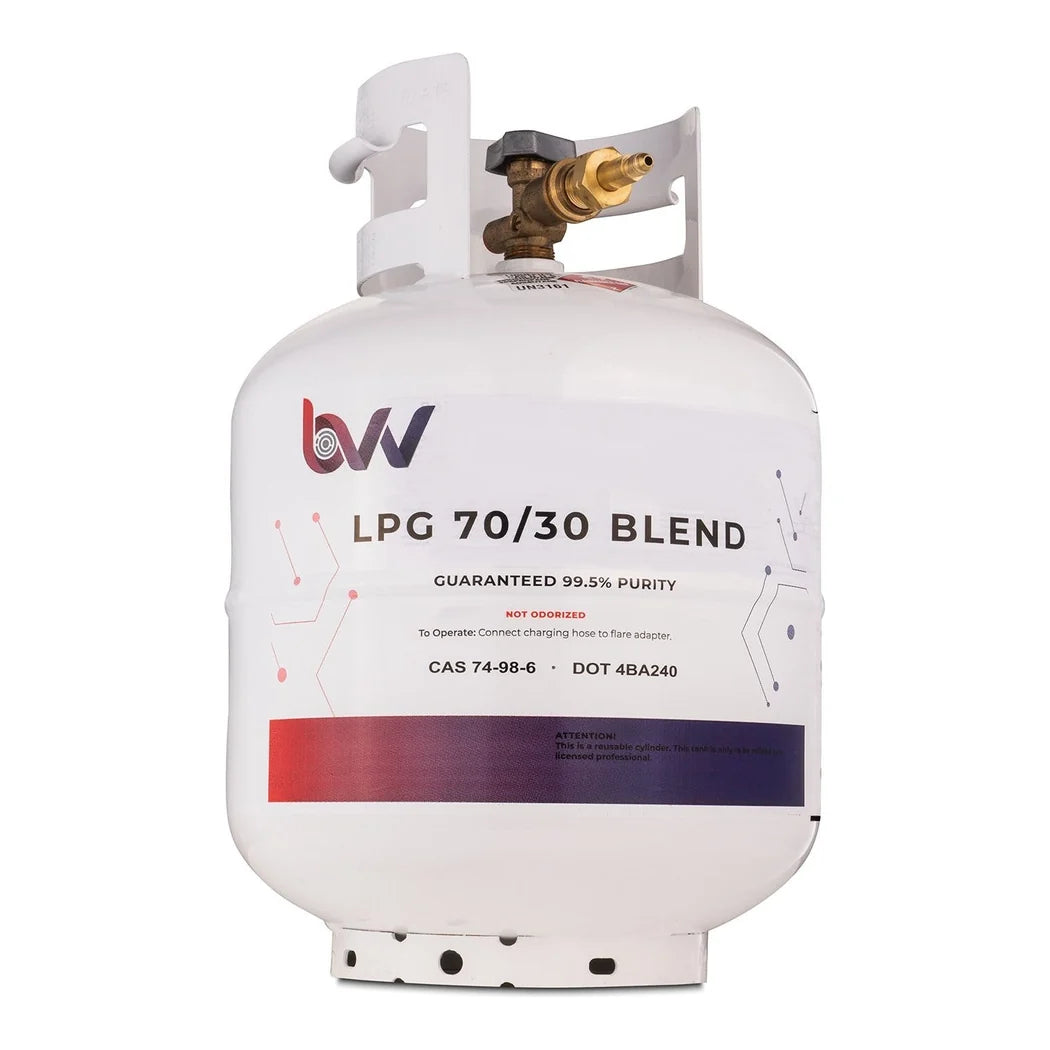
Why a 70/30 Butane Propane Mix Rather Than Straight Butane
The ratio is the product here, so start there. Seventy percent of the charge is n-butane and thirty percent is propane. N-butane boils at 31.1 degrees Fahrenheit and does most of the dissolving. Propane boils at minus 43.6 degrees, which is seventy four degrees colder. That gap is the entire reason the two are blended. The propane fraction stays mobile at temperatures where butane alone has gone sluggish. It also carries lighter aromatic compounds that straight butane tends to leave in the material, and it comes out of a finished extract more readily. Against all of that, thirty percent propane is a lot of propane. It is more than the three gas blend carries and it takes the working pressure of the whole system up with it. There is no iso-butane in this one, which is the other difference worth knowing. The three gas blend uses a quarter iso-butane to thin the mix and move it through a packed column faster. This one does not have that, so it behaves like butane with a hard cold edge rather than like a thinned solvent. Purity is guaranteed to 99.5 percent and the gas is sourced in the USA. Each gas carries its own CAS number.
What Thirty Percent Propane Means on BVV Butane Blends in Practice
Pressure first, because it decides what belongs in the loop. Propane's vapour pressure at room temperature is far above butane's. A charge that is nearly a third propane follows the propane number rather than the butane one. Every part the solvent touches has to be rated for it. That means the column, the sight glasses, the hoses, the receiving vessel and the recovery pump. A loop assembled for straight butane is not automatically ready for this. Recovery is the second thing that changes. The same volatility that helps during a purge makes the propane fraction harder to condense back down. A chiller that kept up with butane will struggle, and the symptom is a recovery that slows to a crawl near the end. Colder coolant and more condenser surface are the answer there, not a bigger pump. Third, the tank has no diptube. Standing upright it gives up vapour, and the propane leaves first because it is the more volatile of the two. Pull vapour from it several times over and the liquid left behind is butane rich rather than the ratio on the label. Invert it for liquid draw if the ratio matters to the run. One housekeeping point wants settling before it arrives. The CGA 510 connection fitting is a separate item rather than part of the tank, and the tank cannot be connected without it.
Key Features
- Seventy / thirty by mass: N-butane does the dissolving and propane does the cold work.
- 99.5 percent guaranteed: Minimum purity, with the gas sourced in the USA.
- No iso-butane in this blend: The three gas blend uses a quarter iso-butane; this one has none.
- Rate the loop for propane: Column, sight glasses, hoses, receiver and pump, not just the tank.
- Recovery needs colder coolant: The propane fraction is harder to condense than butane.
- DOT refillable LP tank: No diptube fitted, so upright it gives up vapour rather than liquid.
- CGA 510 connection: The fitting is a separate item, not included with the tank.
Technical Specifications
| Specification | Value |
|---|---|
| SKU | 7030USA20B |
| Brand | BVV |
| Product | Hydrocarbon gas mixture, liquefied, for closed loop extraction |
| Composition | 70% n-butane / 30% propane |
| Purity guarantee | 99.5% minimum |
| Net liquid weight | 20 lbs of blend |
| Chemical formula | C4H10 plus C3H8 |
| Molar mass | 58.12 g/mol and 44.10 g/mol |
| CAS numbers | 106-97-8 (n-butane) and 74-98-6 (propane) |
| Appearance | Colorless |
| Odour | Faint petroleum |
| Solubility in water | Low |
| Boiling point, n-butane | 31.1 F, or minus 0.5 C |
| Boiling point, propane | Minus 43.6 F, or minus 42 C |
| Tank | DOT refillable LP cylinder |
| Diptube | None fitted |
| Valve connection | CGA 510 |
| Fitting options | Brass or stainless, in JIC flare and NPT sizes |
| CGA 510 fitting | Not included |
| UN ID | 1965 |
| Proper shipping name | Hydrocarbon gas mixture, butane and propane, liquefied, n.o.s. |
| Hazard class | 2.1, flammable gas |
| GHS signal word | Danger |
| California | Retail supply above 150ml restricted to licensed and commercial operators |
This solvent is intended for legal use only, in accordance with local laws and ordinances, and only in a well ventilated space. BVV recommend distilling every solvent before it goes into a run. The tank contains no diptube.
California restricts retail supply of butane in quantities above 150ml. Permitted recipients include medical collectives or cooperatives operating under California Health and Safety Code section 11362.775. They also include persons licensed for volatile solvent extraction under California Business and Professions Code Division 10. Manufacturers, wholesalers, resellers and retailers acquiring it for resale are covered as well.