

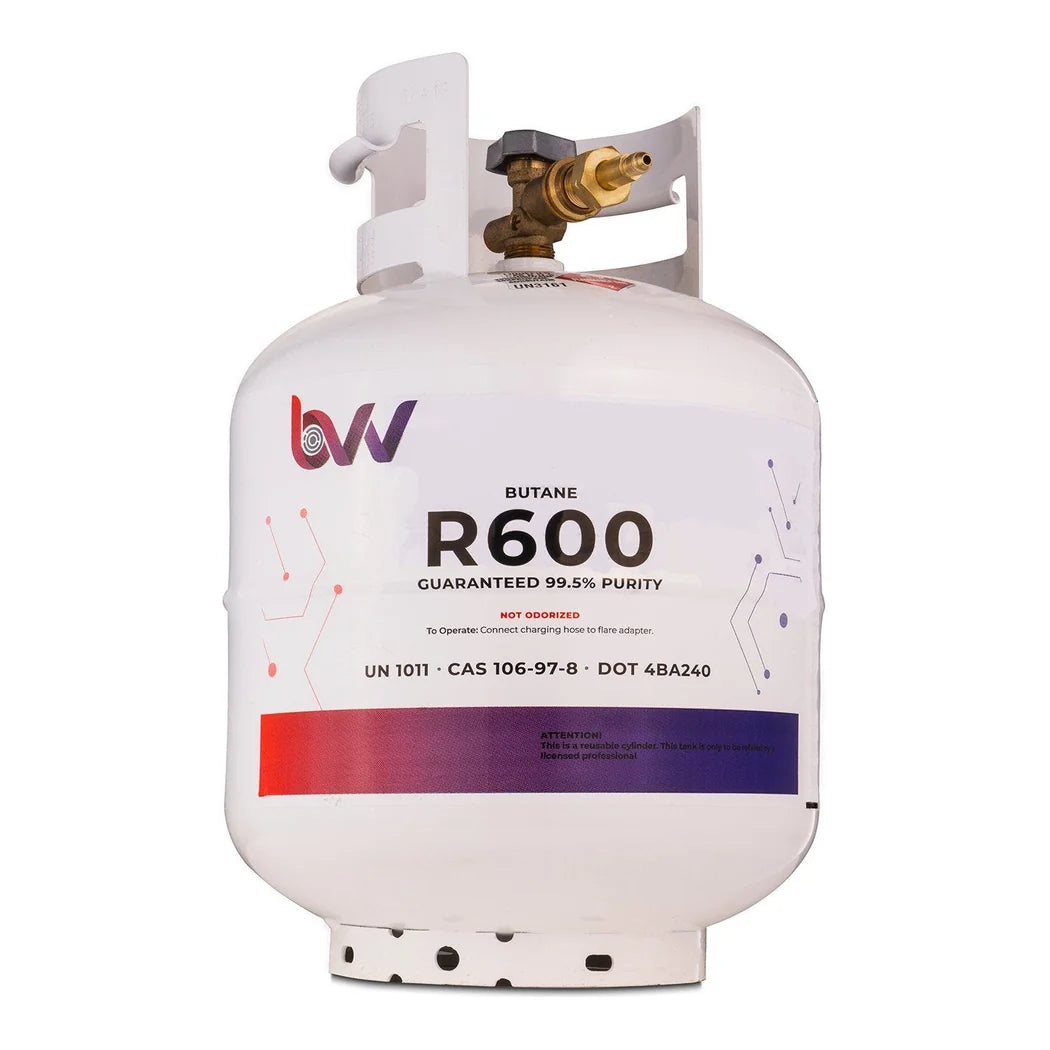
When a Single Gas N-Butane Extraction Solvent Is the Right Call
This is one gas and nothing else, which is the whole reason to choose it. The tank holds n-butane, CAS 106-97-8, guaranteed to 99.5 percent minimum. The boiling point is 30.2 degrees Fahrenheit, or minus one degree Celsius. Either figure makes it the warmest boiling of the common hydrocarbon solvents. That is what makes it the easy one to run. Lower vapour pressure than propane or iso-butane means less asked of the column, the hoses and the recovery pump. A loop rated for straight butane is the baseline that every blend then asks more of. It also means a slower, gentler pull and a purge that takes longer than a propane bearing charge. The trade is simple and worth stating out loud. The lot assay is 99.83 percent against a guaranteed minimum of 99.5 percent, and each lot carries a certificate of analysis. Impurities sit at iso-butane below 1500 ppm, propane below 500 ppm and isopentane below twenty ppm. Water, oxygen and nitrogen are each in single or low double figures of ppm, and sulphur is not detected.
R600 and R600a Are Not the Same Gas
The two designations look like a typo for one another and they are different chemicals. R600 is n-butane, the gas in this tank, carrying CAS number 106-97-8. The other one is iso-butane, which ships as a separate tank, carrying CAS number 75-28-5. Same formula and same molar mass, different arrangement of the carbon chain. The practical difference is temperature and pressure. Iso-butane boils at 10.8 degrees Fahrenheit against this gas at around thirty degrees. That means it runs at noticeably higher pressure for the same bath temperature. It is also the thinner of the two, which is why it turns up as a quarter of the three gas blend. Neither is a drop in replacement for the other. A loop set up for one is not automatically ready for the other, so check the letter on the tank before connecting anything. Two housekeeping points close this out. The tank has no diptube, so standing upright it gives up vapour rather than liquid, and it has to be inverted for a liquid draw. The CGA 510 connection fitting is a separate item rather than part of the tank, and the tank cannot be connected without it. The hazard class is flammable gas, and the proper shipping name for pure butane is butane, liquefied, under UN 1011.
Key Features
- One gas, not a blend: Pure n-butane, so the behaviour is predictable run to run.
- Lowest pressure of the four: It boils warmest, so it asks least of the column and the pump.
- R600, not R600a: R600a is iso-butane, a different gas in a separate tank.
- 99.5 percent guaranteed: Minimum purity, with the gas sourced in the USA.
- Lot assay of 99.83 percent: A batch figure, against a 99.5 percent guarantee.
- UN 1011, butane liquefied: A different classification from the blends, which travel as UN 1965.
- DOT refillable LP tank: No diptube fitted, so upright it gives up vapour rather than liquid.
- CGA 510 connection: The fitting is a separate item, not included with the tank.
Technical Specifications
| Specification | Value |
|---|---|
| SKU | NBUTANE50B |
| Brand | BVV |
| Product | N-butane, liquefied, for closed loop extraction |
| Composition | N-butane only |
| Refrigerant designation | R600 (R600a is iso-butane, a different product) |
| Purity guarantee | 99.5% minimum |
| Lot assay | 99.83% |
| Net liquid weight | 20 lbs |
| Chemical formula | C4H10 |
| Molar mass | 58.12 g/mol |
| CAS number | 106-97-8 |
| Appearance | Colorless |
| Odour | Faint petroleum |
| Solubility in water | Low |
| Boiling point | 30.2 F, or minus 1 C |
| Iso-butane content | Below 1500 ppm |
| Propane content | Below 500 ppm |
| Isopentane content | Below 20 ppm |
| Methane content | Below 1 ppm |
| Ethane content | Below 10 ppm |
| Water content | Below 3 ppm |
| Carbon monoxide plus dioxide | Below 5 ppm |
| Oxygen content | Below 3 ppm |
| Nitrogen content | Below 10 ppm |
| Sulphur content | Not detected |
| Tank | DOT refillable LP cylinder |
| Diptube | None fitted |
| Valve connection | CGA 510 |
| CGA 510 fitting | Not included |
| UN ID | 1011 |
| Proper shipping name | Butane, liquefied |
| Hazard class | 2.1, flammable gas |
| GHS signal word | Danger |
| California | Retail supply above 150ml restricted to licensed and commercial operators |
This solvent is intended for legal use only, in accordance with local laws and ordinances, and only in a well ventilated space. BVV recommend distilling every solvent before it goes into a run. The tank contains no diptube.
California restricts retail supply of butane in quantities above 150ml. Permitted recipients include medical collectives or cooperatives operating under California Health and Safety Code section 11362.775. They also include persons licensed for volatile solvent extraction under California Business and Professions Code Division 10. Manufacturers, wholesalers, resellers and retailers acquiring it for resale are covered as well.