

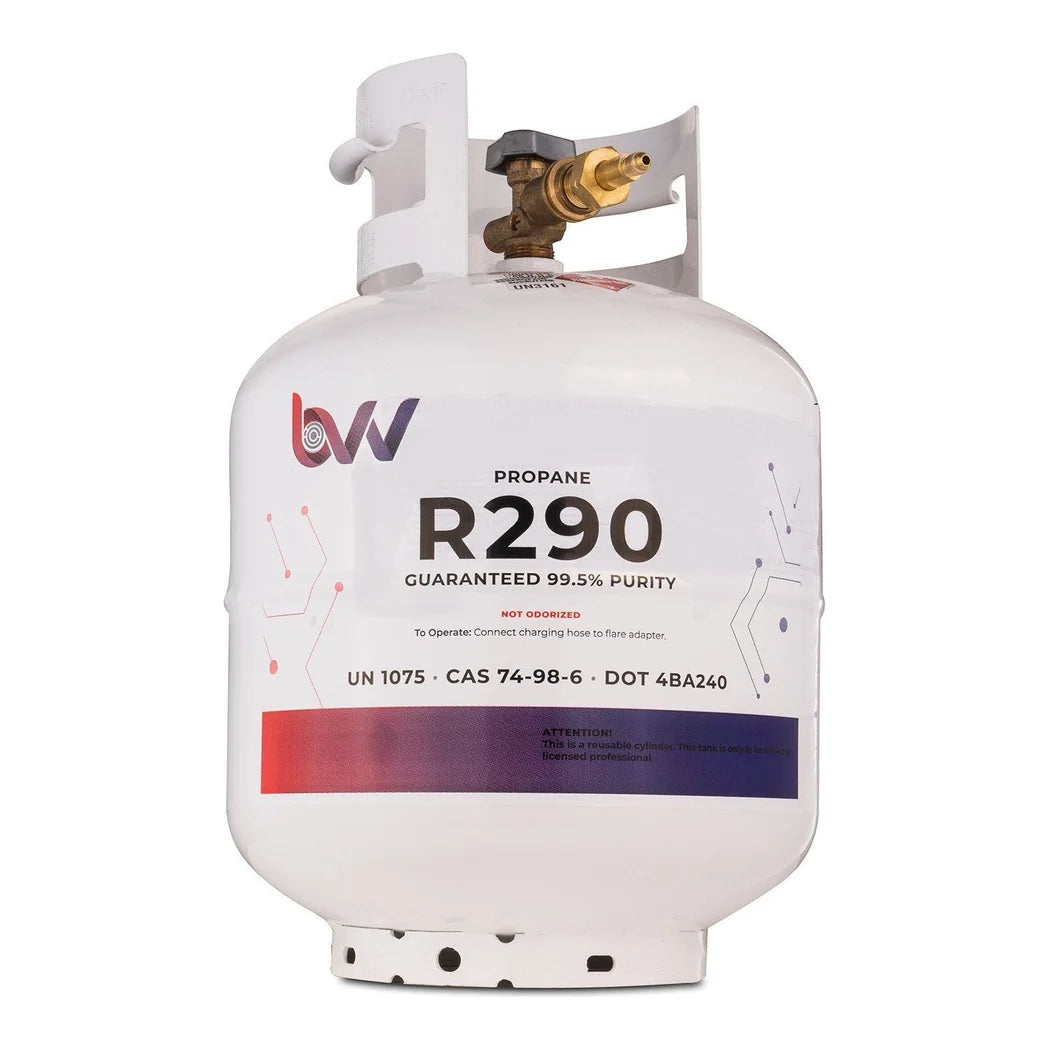
What High Purity Propane R290 Does That Butane Cannot
Propane on its own is the most demanding of the four BVV solvents. It boils at minus 40 degrees Fahrenheit, roughly seventy degrees below n-butane. Everything else follows from that one number. At room temperature it sits at a far higher vapour pressure than any butane charge. The whole loop has to be rated for propane rather than for butane. It pulls the lightest fraction of the material, which is where the volatile aromatics live, and leaves more of the heavier waxes behind. That makes it the choice for a light, aroma forward product rather than a maximum yield run. It also comes out of the finished material fast, so purge times are short. Yield is lower than a butane charge, and that is the honest trade. The lot analysis for this tank holds up. Propane is 99.5 percent or better. Iso-butane sits at 2380 ppm and n-butane at 251 ppm, which is the normal residual of a propane stream. Methane is below one ppm, ethane below three, propylene below five and isopentane below one. Water is below three ppm and sulphur below one. The lot assay is 99.66 percent against that 99.5 percent standing guarantee.
Rating the Kit for Propane for Closed Loop Extraction
The pressure point is not a formality and it decides what is safe to connect. A column, sight glass, hose or recovery pump rated only for butane service has no business on a propane charge. Check the stamped rating on each part rather than assuming the assembly is fine. Recovery is the other thing that changes. Propane is far harder to condense back than butane, so a chiller that coped before will not cope now. The symptom is a recovery that stalls near the end while the chiller temperature climbs. Colder coolant and more condenser surface are the answer there, not a bigger pump. Two notes on the tank itself. There is no diptube, so upright it gives up vapour rather than liquid, and it has to be inverted for a liquid draw. On a single gas that costs nothing in composition, which is the one advantage a pure charge has over a blend. The CGA 510 fitting is not included. Confirm the fitting before connecting, and remember that a JIC flare seat is 37 degrees against an SAE flare at 45. Propane also classifies differently from butane in transport, travelling as petroleum gases, liquefied, under UN 1075.
Key Features
- Coldest boiling of the four: Around minus 40 F, roughly seventy degrees below n-butane.
- Highest working pressure: Rate the column, hoses, sight glasses, receiver and pump for propane.
- Lightest pull, shortest purge: It takes the volatile aromatics and leaves more of the waxes.
- Lower yield than butane: That is the trade for a lighter, aroma forward product.
- Lot analysis: Propane 99.5%+, iso-butane 2380 ppm, n-butane 251 ppm.
- Single gas, so vapour draw is free: No diptube, but with one gas the composition cannot drift.
- CGA 510 connection: Not included
- UN 1075, petroleum gases liquefied: A third classification again, different from both butane and the blends.
Technical Specifications
| Specification | Value |
|---|---|
| SKU | PROPANE50B |
| Brand | BVV |
| Product | Propane, liquefied, for closed loop extraction |
| Composition | Propane only |
| Refrigerant designation | R290 |
| Purity guarantee | 99.5% minimum |
| Lot assay | 99.66% |
| Net liquid weight | 20 lbs |
| Chemical formula | C3H8 |
| Molar mass | 44.10 g/mol |
| CAS number | 74-98-6 |
| Appearance | Colorless |
| Odour | Gasoline |
| Solubility in water | Slightly soluble |
| Boiling point | Minus 40 F |
| Propane content | 99.5% or better |
| Iso-butane content | 2380 ppm |
| N-butane content | 251 ppm |
| Methane content | Below 1 ppm |
| Ethane content | Below 3 ppm |
| Propylene content | Below 5 ppm |
| Isopentane content | Below 1 ppm |
| Water content | Below 3 ppm |
| Sulphur content | Below 1 ppm |
| Tank | DOT refillable LP cylinder |
| Diptube | None fitted |
| Valve connection | CGA 510 |
| CGA 510 fitting | Not included |
| UN ID | 1075 |
| Proper shipping name | Petroleum gases, liquefied |
| Hazard class | 2.1, flammable gas |
| GHS signal word | Danger |
| California | Retail supply above 150ml restricted to licensed and commercial operators |
This solvent is intended for legal use only, in accordance with local laws and ordinances, and only in a well ventilated space. BVV recommend distilling every solvent before it goes into a run. The tank contains no diptube.
California restricts retail supply of butane in quantities above 150ml. Permitted recipients include medical collectives or cooperatives operating under California Health and Safety Code section 11362.775. They also include persons licensed for volatile solvent extraction under California Business and Professions Code Division 10. Manufacturers, wholesalers, resellers and retailers acquiring it for resale are covered as well.