

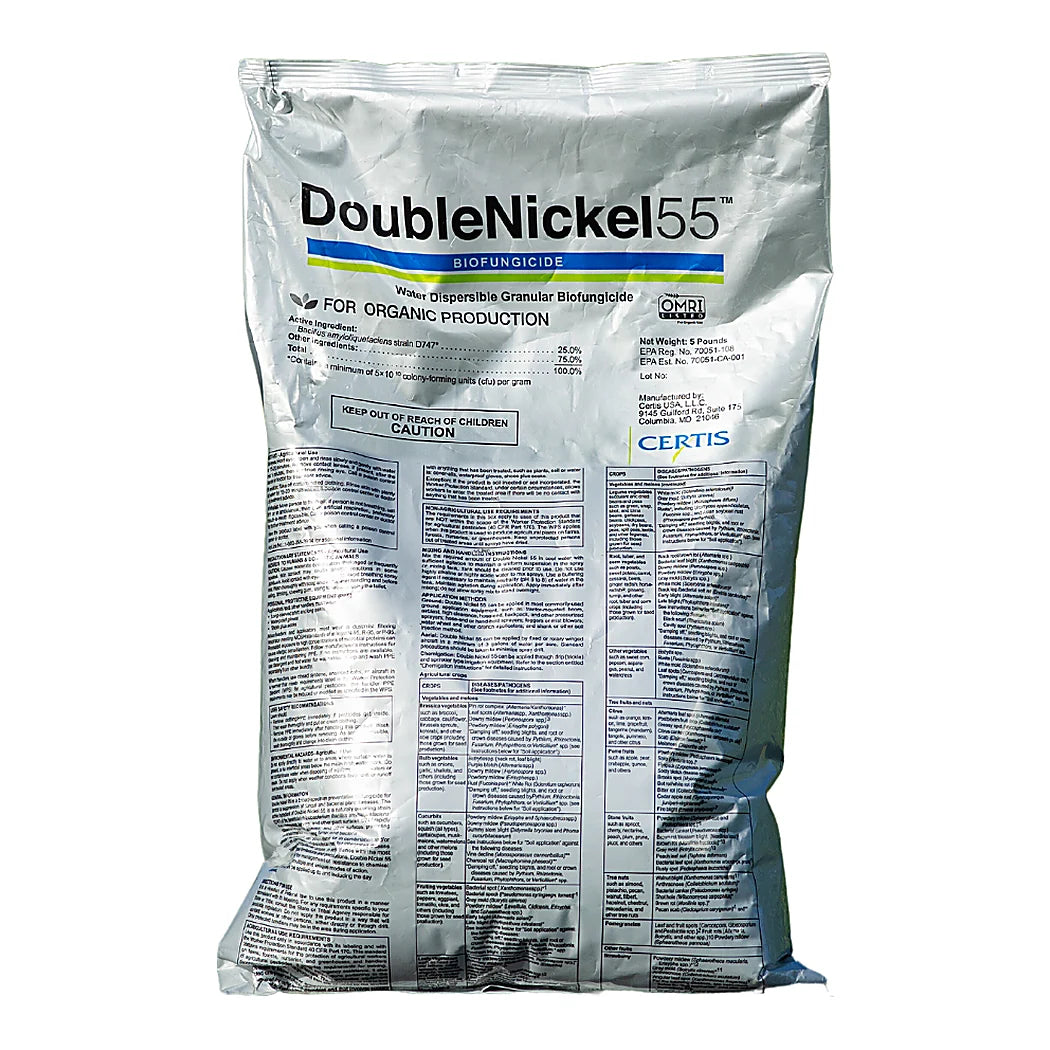
What Double Nickel 55 Puts on the Leaf Surface
The active ingredient is Bacillus amyloliquefaciens strain D747, present at 25.0% of the granule by weight. That works out to a minimum of five billion colony-forming units in every gram of product. The formulation is a water-dispersible granule, so it goes into the tank as a wettable solid rather than a liquid concentrate. Bag size here is 5 lb. Registration is EPA number 70051-108, the signal word on the label is CAUTION, and the re-entry interval runs four hours. Residues are exempt from tolerance, and the label allows application up to and including the day of harvest. It is NOP approved and OMRI listed for certified organic production. The strain works by colonizing leaf and root surfaces ahead of a pathogen, occupying the sites a disease organism needs to establish. Growers also report better nutrient uptake on treated roots, which is a side effect of that colonization rather than a feeding claim. The label covers more than ninety diseases across seventy-four or more crops, built on over seven hundred field trials.
Spraying Double Nickel Fungicide Through the Season
A double nickel fungicide behaves differently from a synthetic, and the spray interval is where that shows up first. Foliar rates run from a quarter pound to three pounds per acre. Half a pound to one pound covers normal pressure, and one to two pounds handles tougher diseases. Soil applications run lighter, from an eighth of a pound up to one pound per acre. Reapply foliar sprays every seven to ten days, tightening to three or seven days when disease pressure is climbing. Soil applications go on every two to four weeks, or every two weeks under pressure. Shorter residual is the trade for the shorter re-entry interval, so the calendar carries more of the work. Mix into cool water and hold the tank between pH six and pH eight, buffering first if the source water sits outside that. Keep the agitator running the whole time the tank is in use. Spray it the same day it is mixed and never let a mixed tank stand overnight. Coverage decides the outcome more than rate does, since a living organism only protects the surface it actually lands on. Rotating modes of action keeps resistance pressure low, and a biological with several modes is a useful partner in that rotation.
Key Features
- Bacillus amyloliquefaciens D747: Present at 25.0% of the granule by weight.
- Five billion CFU per gram: Minimum guaranteed count, which is what drives surface colonization.
- Four-hour re-entry interval: Crews are back in the room the same working day.
- Zero days to harvest: Labeled for use up to and including the day of cutting.
- OMRI listed and NOP approved: Cleared for certified organic programs without a separate exemption.
- Water-dispersible granule: Measures dry and disperses into the tank with agitation running.
- Over ninety labeled diseases: Covers seventy-four or more crops across seven hundred field trials.
Technical Specifications
| Specification | Value |
|---|---|
| Active ingredient | Bacillus amyloliquefaciens strain D747 |
| Concentration | 25.0% |
| Minimum CFU | 5 x 10^10 CFU per gram |
| Formulation | Water-dispersible granule |
| Package size | 5 lb |
| EPA registration number | 70051-108 |
| Signal word | CAUTION |
| Re-entry interval | 4 hours |
| Days to harvest | 0 |
| Residue tolerance | Exempt |
| Organic status | NOP approved, OMRI listed |
| Foliar rate | 0.25 - 3 lb per acre |
| Soil rate | 0.125 - 1 lb per acre |
| Tank pH range | 6 - 8 |