


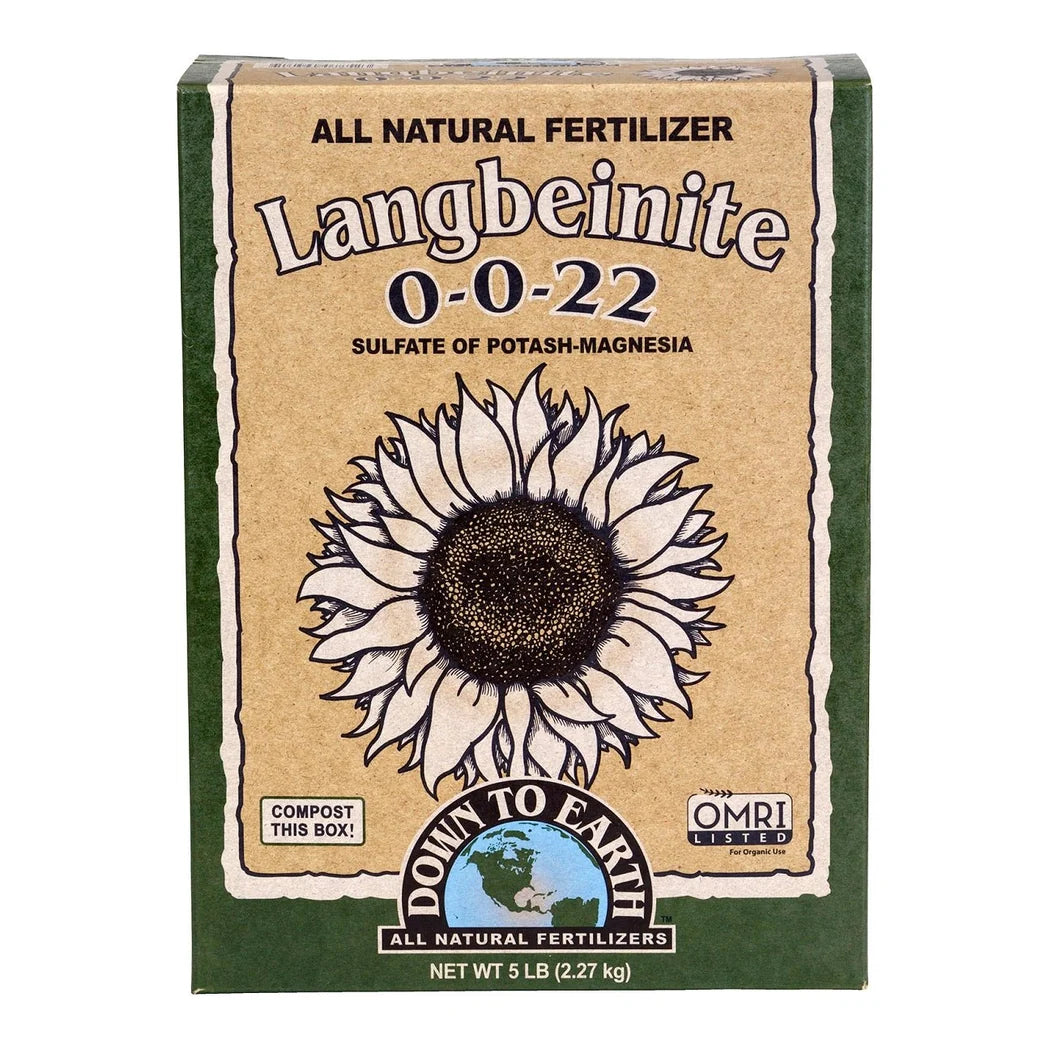
What Down To Earth Langbeinite Supplies in One Application
Three nutrients arrive from a single mineral here, which is unusual and is the whole argument for using it. The guaranteed analysis is 22.0 percent soluble potash, 10.8 percent magnesium and 22.0 percent sulfur, with chlorine capped at 3.0 percent. The magnesium is listed as fully water soluble and the sulfur as combined sulfur. It is derived from langbeinite and nothing else, so there is no blend and no filler in the bag. That single-source composition is what earns the OMRI listing and CDFA approval. Rates depend on where it goes. New garden beds take one to two pounds per hundred square feet, worked in during preparation. Established plantings get one to two tablespoons per plant as a monthly side dressing.
Where a Sul Po Mag Mineral Fits Against Other Amendments
Reach for this when two or three deficiencies point the same direction at once. Magnesium shortage shows as interveinal yellowing on older leaves, potassium as scorched leaf margins, and sulfur as a general pale cast on new growth. Anything that corrects one of those alone risks pushing another out of balance, whereas a mineral carrying all three in fixed proportion cannot. Potting containers take a different approach from beds. Mix one tablespoon per gallon of soil when making up a new batch, or one to two pounds per cubic yard on a larger mix. Established containers get topped up at one to two teaspoons per gallon monthly. Trees and shrubs work to trunk diameter, at half a pound to a pound per inch. The honest limit is that the ratio is fixed by geology rather than by a formulator. A grower who needs potassium alone adds magnesium and sulfur whether the crop wants them or not. Check a soil test before relying on it as a potassium source.
Key Features
- Soluble potash: 22.0 percent, from a single naturally occurring mineral
- Magnesium: 10.8 percent, all of it listed as water soluble magnesium
- Sulfur: 22.0 percent, in combined form
- Chlorine: Capped at a maximum of 3.0 percent
- Derived from: Langbeinite alone, with no blending and no filler
- Certification: OMRI Listed and approved by the CDFA for organic use
- New beds: One to two pounds per hundred square feet during preparation
- Containers: One tablespoon per gallon of soil, or one to two pounds per cubic yard
- Established plants: One to two tablespoons per plant, monthly through the season
- Fixed ratio: The proportions come from geology, so all three arrive together
Technical Specifications
| Specification | Value |
|---|---|
| Brand | Down To Earth |
| Guaranteed analysis | 0 - 0 - 22 |
| Soluble potash | 22.0 percent |
| Magnesium | 10.8 percent, water soluble |
| Sulfur | 22.0 percent, combined sulfur |
| Chlorine | 3.0 percent maximum |
| Derived from | Langbeinite |
| OMRI | Listed for organic production |
| CDFA | Approved for organic input use |
| New bed rate | 1 to 2 lb per 100 square feet |
| Side dressing | 1 to 2 tbsp per plant, monthly |
| Container mix | 1 tbsp per gallon of soil, or 1 to 2 lb per cubic yard |
| Established containers | 1 to 2 tsp per gallon, monthly |
| Trees and shrubs | Half a pound to a pound per inch of trunk diameter |
| Sizes | 5 lb and 50 lb, SKUs 723732 and 723734 |