


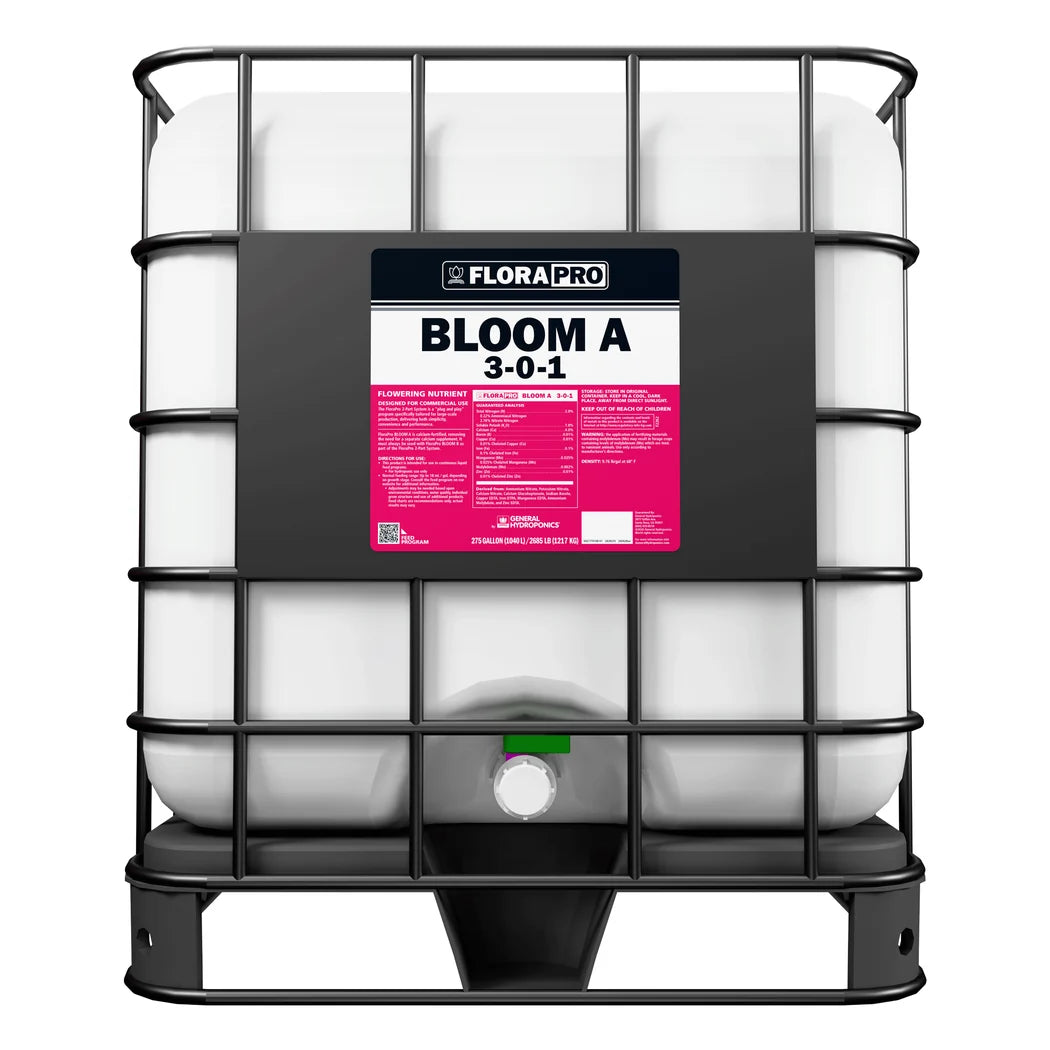
FloraPro Bloom A 3-0-1 Calcium and Micronutrient Base
Bloom A is the half of the flowering base with no phosphorus in it at all, and that is on purpose. It runs 3-0-1 with 4.0% calcium behind a full chelated micro package. That means 0.1% iron as DTPA, 0.025% manganese, 0.01% each of boron, copper and zinc, plus 0.002% molybdenum. Calcium is the element a heavy flower crop runs short of first. Cell walls need it to hold bract structure through week eight. Once a plant runs short, there is no pulling it back out of old tissue. Run the label numbers and the calcium-to-nitrogen ratio lands at 1.33 to 1. At standard rates that is roughly 42 ppm calcium against 32 ppm nitrogen. What nitrogen is there arrives mostly as nitrate, 2.78% against 0.22% ammoniacal, so it stays available without dragging root-zone pH down.
Holding a Nitrogen-Free Calcium Source Through Late Flower
Most calcium in bloom rides in on calcium nitrate. Topping up late means adding back the nitrogen you spent the whole cycle walking down. Bloom A gets around that by carrying a second calcium source that brings no nitrogen with it. You keep the structural calcium and still get the fade. Rates follow the same ladder as Bloom B, matched one to one. Run 14 mL/gal in weeks 1-3 and 13 mL/gal in weeks 4-6. Late flower takes 8 mL/gal, and week nine closes at 4 mL/gal. Keep the concentrate in Tank A, well clear of the B side, and mix into RO where you can. The chelated micros stay in solution that way instead of dropping out. Skip the separate Cal-Mag while you are on this program. Bloom B brings the magnesium and sulfur, so between the two tanks the secondary nutrients are already covered.
Key Features
- 4.0% Calcium: Enough structural calcium to hold bract integrity through late flower without a supplemental Cal-Mag.
- Full Chelated Micro Package: Iron DTPA plus EDTA-chelated copper, manganese and zinc stay plant-available across the normal fertigation pH band.
- 1.33:1 Calcium to Nitrogen: The ratio keeps calcium climbing while nitrogen tapers, which is what drives a clean fade instead of a chemical one.
- Nitrate-Dominant Nitrogen: 2.78% nitrate against 0.22% ammoniacal avoids the root-zone pH drift that ammonium-heavy feeds cause.
- Zero Phosphate by Design: Leaving P out of the A side is what lets calcium and phosphate share a program without meeting as concentrates.
- Three Production Volumes: 6, 55 and 275 gallon formats scale from one flower room to a tote feeding a full fertigation loop.
Technical Specifications
| Specification | Value |
|---|---|
| N-P-K | 3-0-1 |
| Total Nitrogen (N) | 3.0% (0.22% ammoniacal, 2.78% nitrate) |
| Soluble Potash (K2O) | 1.0% |
| Calcium (Ca) | 4.0% |
| Iron (Fe) | 0.1% chelated |
| Manganese (Mn) | 0.025% chelated |
| Boron (B) | 0.01% |
| Copper (Cu) | 0.01% chelated |
| Zinc (Zn) | 0.01% chelated |
| Molybdenum (Mo) | 0.002% |
| Calcium to Nitrogen Ratio | 1.33:1 (approx. 42 ppm Ca / 32 ppm N at standard rates) |
| Derived From | Ammonium nitrate, potassium nitrate, calcium nitrate, a second nitrogen-free calcium source, sodium borate, copper EDTA, iron DTPA, manganese EDTA, ammonium molybdate, zinc EDTA |
| Feed Rate | 4-14 mL/gal by bloom week |
| Application | Hydroponic use only, continuous liquid feed, Tank A |
| Sizes | 6 Gallon, 55 Gallon (208 L / 537 lb), 275 Gallon |
