


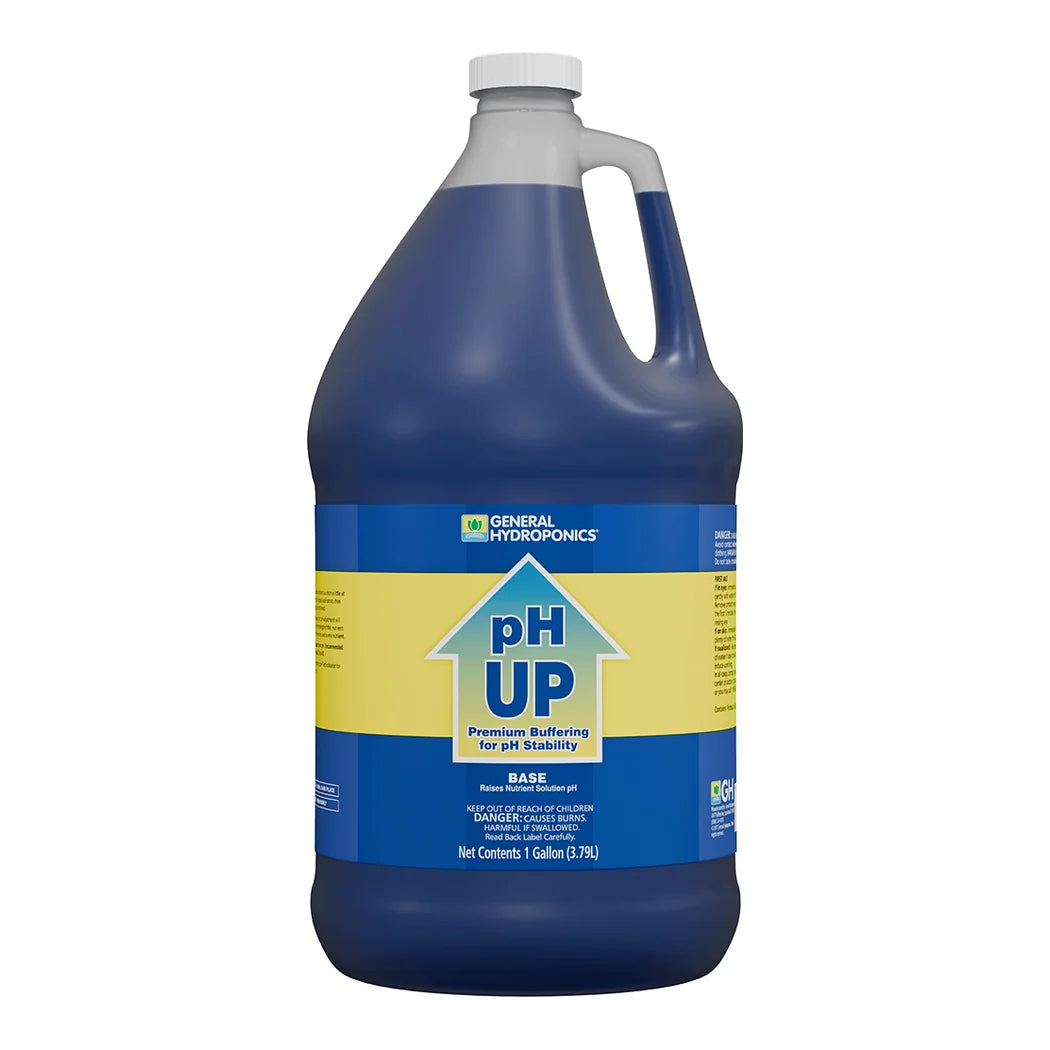
How Much General Hydroponics pH Up You Actually Need
There is no teaspoons-per-gallon figure on this one, and that is deliberate rather than an oversight. Two reservoirs of the same volume can want wildly different amounts, because the buffering capacity of the water decides how hard it resists a change. Hard tap water barely moves at all. Reverse osmosis swings on almost nothing. So the instruction is the same every time. Add a small amount, circulate or stir it properly, test, and repeat until the number sits where you want it. Most crops want 5.5 to 6.5. Mix nutrients into fresh water first and adjust afterwards, because the feed moves pH on its way in. One thing is worth knowing. The chemistry doing the lifting is potassium hydroxide and potassium carbonate, so what raises the pH also adds a little potassium.
When a pH Up Liquid Is the Wrong Tool
Most growers reach for Down far more often than Up, because most tap water arrives alkaline. So if you are going through Up steadily, it is usually one of three things. Reverse osmosis or rainwater, stripped of buffer, swinging on any input at all. An organic or microbial feed that keeps acidifying in the tank as it works. Or overshooting with Down and then correcting back the other way. That third one is worth catching, because every correction leaves salts behind, and those salts are what you end up flushing later. This is caustic material. Wear eye protection, keep it off skin, and never put the two concentrates together undiluted.
Key Features
- Potassium hydroxide and carbonate: The chemistry that raises pH, which also puts a little potassium in the tank.
- No fixed dose: Water buffering decides the amount, so the method is add, circulate, test, repeat.
- Target 5.5 to 6.5: Where most crops keep nutrients available rather than locked out.
- Nutrients first, then adjust: Feed shifts pH as it mixes in, so adjusting beforehand means doing it twice.
- RO water swings hardest: Stripped of buffer, it moves on almost nothing. Go in very small steps.
- Organic feeds keep acidifying: A microbial tank can drift down over days, which is a real reason to need Up.
- Watch for overshoot: Correcting Down with Up and back again leaves salts you will flush later.
- Caustic: Eye protection on, off the skin, and never mixed straight with pH Down.
- Works across media: Hydroponics, coco, soil, rockwool, peat mixes and water culture.
- Two sizes: A quart for a tent or single reservoir, a gallon for a site on RO.
Technical Specifications
| Specification | Value |
|---|---|
| Brand | General Hydroponics |
| Part Number | 722090 / 722095 |
| Product | pH Up liquid adjuster |
| Function | Raises pH in nutrient solution |
| Derived From | Potassium hydroxide and potassium carbonate |
| Adds | A small amount of potassium alongside the pH change |
| Dosing | No fixed rate. Add a small amount, circulate, test, repeat |
| Target Range | 5.5 to 6.5 for most crops |
| Sequence | Mix nutrients into fresh water first, then adjust |
| Suitable Media | Hydroponics, coco, soil, rockwool, peat mixes, water culture |
| Most Needed With | Reverse osmosis water, rainwater and organic or microbial feeds |
| Safety | Caustic. Eye and skin protection required |
| Do Not | Mix undiluted pH Up and pH Down together |
| Storage | Sealed and upright, cool and dry, out of direct sunlight |
| Sizes | 1 quart and 1 gallon |