

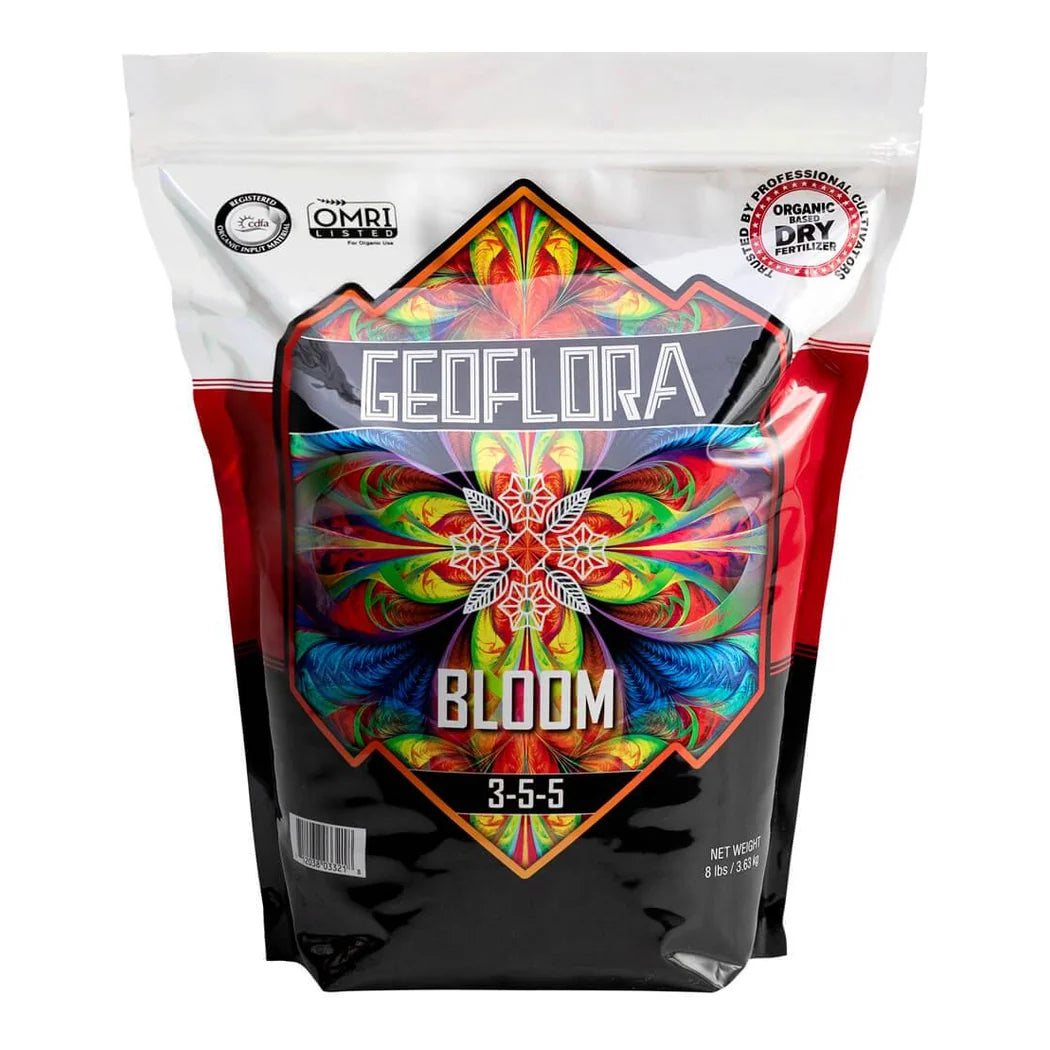
What the Geoflora Bloom Case Gives You
Five sealed eight pound bags come in the box, forty pounds altogether, and the contents are identical to the single bag product. The analysis is 3-5-5 with calcium at 5 percent, magnesium at 0.75, sulfur at 1 percent and humic acid at 0.6 percent. Most of the nitrogen is water insoluble, so it releases as soil biology works through the meals rather than dissolving into the water. The inputs are named on the label rather than hidden behind a trade name. Alfalfa, bat guano and three animal meals lead it. Composted turkey litter, crustacean meal, fish bone meal and fish protein hydrolysate follow. Kelp, neem seed meal, rock phosphate, volcanic ash and two mineral sulfates close the list. A beneficial bacteria blend is carried with the granules. It is OMRI Listed and a registered CDFA Organic Input Material.
Why Five Bags Beat One Sack of Dry Granular Fertilizer
The argument for a case over a single large sack is moisture, not price. Meals, guano and composted litter all draw water out of the air once a bag has been opened. A damp amendment clumps, loses its dustless handling, and starts composting inside its own packaging. Four sealed bags sitting beside one in use solves that without decanting anything. The case also splits cleanly across rooms or sites, which a single sack does not. Coverage works out at eighty applications, taking eight ounces per ten gallon pot. On open ground that is roughly six hundred square feet of bed at two tablespoons per square foot. Applied fortnightly through flower and stopped two weeks before harvest, that is a long time for most rooms. The same limitation applies as to any bag of it. Aquaponics and inert media such as rockwool have no biology to break the meals down. This belongs in soil, or in peat and coconut fibre mixes.
Key Features
- Case contents: Five factory sealed bags of eight pounds each
- Total weight: Forty pounds of the 3-5-5 granular in one box
- Why a case: Four bags stay sealed while only one is open and exposed
- Analysis: The same 3-5-5 as the single bags, with calcium and humic acid
- Release: Mostly water insoluble nitrogen, broken down by soil biology
- Certification: OMRI Listed and a registered CDFA Organic Input Material
- Coverage: Around eighty container applications, or six hundred square feet
- Timing: Fortnightly through flower, stopping two weeks before harvest
- Limitation: Not for aquaponics or inert media such as rockwool
Technical Specifications
| Specification | Value |
|---|---|
| SKU | GFLBL-8-C |
| Brand | Geoflora |
| Case contents | 5 bags of 8 lb |
| Total weight | 40 lb |
| Formulation | Dry granular amendment, not water soluble |
| Guaranteed analysis | 3 - 5 - 5 |
| Total nitrogen | 3 percent, of which 2.5 is water insoluble |
| Water soluble nitrogen | 0.5 percent |
| Available phosphate | 5 percent |
| Soluble potash | 5 percent |
| Calcium | 5 percent |
| Magnesium | 0.75 percent |
| Sulfur | 1 percent |
| Humic acid | 0.6 percent |
| Derived from | Alfalfa meal, bat guano, blood meal, bone meal, composted turkey litter, crustacean meal, feather meal, fish bone meal, fish protein hydrolysate, kelp meal (Macrocystis pyrifera), magnesium sulfate, natural volcanic ash, neem seed meal, potassium sulfate and rock phosphate |
| Biology | A selected blend of beneficial bacteria is included |
| Certification | OMRI Listed and a registered CDFA Organic Input Material |
| Container rate | 8 oz, or one cup, per ten gallon pot every two weeks |
| Soil rate | 1 oz, or two tablespoons, per square foot |
| Start | At the first signs of flowering |
| Stop | Two weeks before harvest |
| Pairs with | Geoflora VEG, on a one to one ratio across the cycle |
| Not for | Aquaponics, or inert media such as rockwool |