


Why Geoflora Bloom Releases the Way It Does
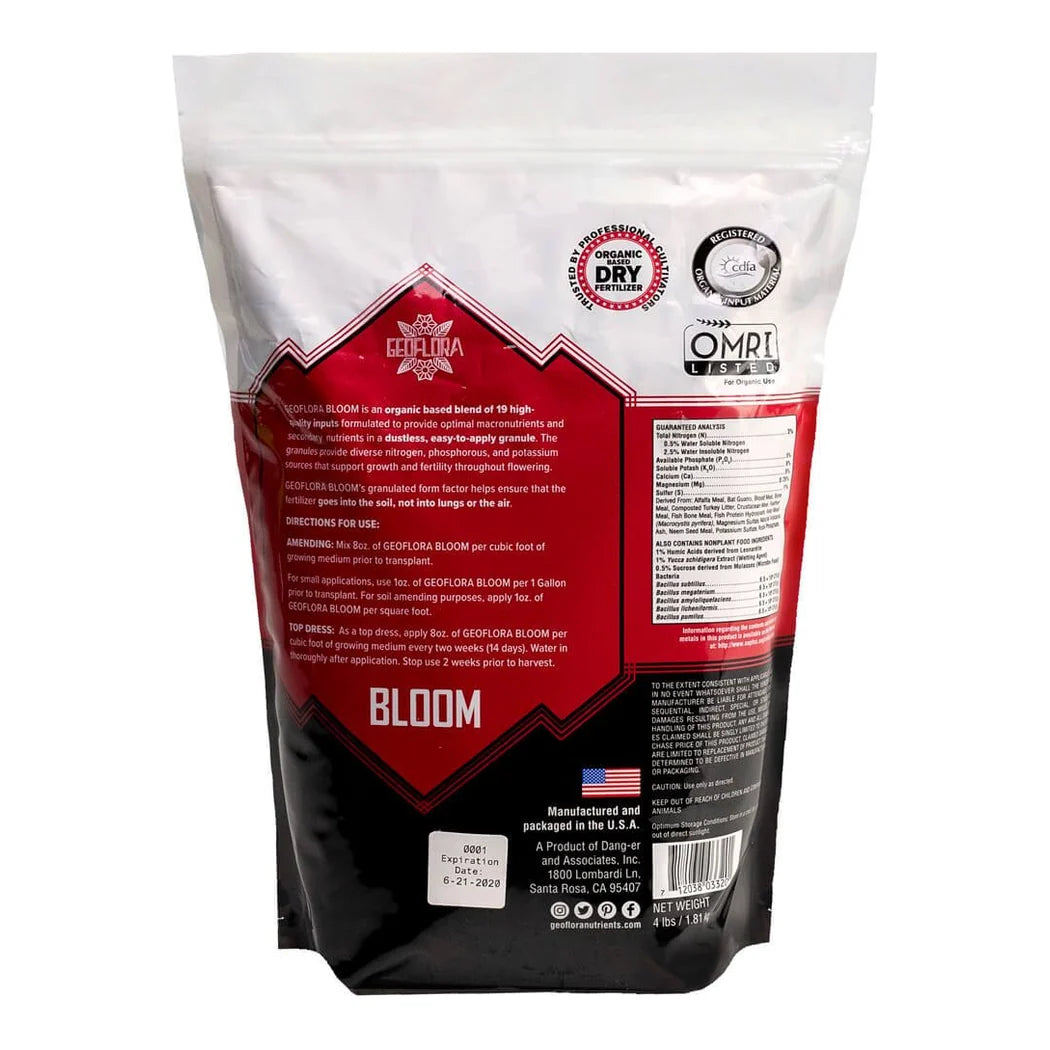
One line in the guaranteed analysis explains this product. Total nitrogen is 3 percent, and 2.5 of those points are WATER INSOLUBLE nitrogen, leaving only 0.5 percent water soluble. Five sixths of the nitrogen cannot dissolve into your water at all. It becomes available when soil biology breaks the meals down, which is why the granules carry a bacteria blend with them. Phosphate and potash both sit at 5 percent, with calcium at 5 percent, magnesium at 0.75 and sulfur at 1 percent. Humic acid adds another 0.6 percent. The inputs behind those numbers are named rather than hidden. Alfalfa, bat guano and three animal meals sit alongside composted turkey litter and crustacean meal. Fish bone meal, fish protein hydrolysate, kelp and neem seed meal follow. Rock phosphate, volcanic ash and two mineral sulfates finish the list. The nitrogen is deliberately low because this is the flowering half of a two-part system. It is OMRI Listed and a registered CDFA Organic Input Material.
How to Top Dress It, and Where It Will Not Work
The rate is simple and the timing is not negotiable. Into a ten gallon container, work eight ounces, which is one level cup, into the surface every fortnight from the first signs of flowering. On open soil the rate is one ounce, or two tablespoons, per square foot. Water as normal afterwards and let the biology do the rest. Stop applying two weeks before harvest, since granules added later will still be breaking down at the end. Now the limitation nobody advertises. This will not work in a system that has no biology to break it down. Aquaponic setups and inert media such as rockwool cannot process water insoluble nitrogen, so the amendment sits there and does nothing useful. It needs peat or coconut fibre based media, or real soil, to function at all. The granules are dustless, which matters more than it sounds when working a cup of meal into a canopy at chest height.
Key Features
- Analysis: A 3-5-5, with calcium, magnesium, sulfur and humic acid alongside
- Release: Five sixths of the nitrogen is water insoluble and biology driven
- Inputs: Fifteen named organic inputs, from alfalfa meal to rock phosphate
- Biology: A beneficial bacteria blend travels with the granules
- Certification: OMRI Listed and a registered CDFA Organic Input Material
- Container rate: Eight ounces per ten gallon pot, every two weeks
- Soil rate: One ounce, or two tablespoons, per square foot of bed
- Timing: Start at first flower and stop two weeks before harvest
- Form: Dustless granules rather than a powder that becomes airborne
- Limitation: Will not work in aquaponics or inert media such as rockwool
Technical Specifications
| Specification | Value |
|---|---|
| SKU prefix | GFLBL, sized 4, 8, 25 and 50 lb |
| Brand | Geoflora |
| Formulation | Dry granular amendment, not water soluble |
| Guaranteed analysis | 3 - 5 - 5 |
| Total nitrogen | 3 percent, of which 2.5 is water insoluble |
| Water soluble nitrogen | 0.5 percent |
| Available phosphate | 5 percent |
| Soluble potash | 5 percent |
| Calcium | 5 percent |
| Magnesium | 0.75 percent |
| Sulfur | 1 percent |
| Humic acid | 0.6 percent |
| Derived from | Alfalfa meal, bat guano, blood meal, bone meal, composted turkey litter, crustacean meal, feather meal, fish bone meal, fish protein hydrolysate, kelp meal (Macrocystis pyrifera), magnesium sulfate, natural volcanic ash, neem seed meal, potassium sulfate and rock phosphate |
| Biology | A selected blend of beneficial bacteria is included |
| Certification | OMRI Listed and a registered CDFA Organic Input Material |
| Container rate | 8 oz, or one cup, per ten gallon pot every two weeks |
| Soil rate | 1 oz, or two tablespoons, per square foot |
| Start | At the first signs of flowering |
| Stop | Two weeks before harvest |
| Pairs with | Geoflora VEG, on a one to one ratio across the cycle |
| Not for | Aquaponics, or inert media such as rockwool |