

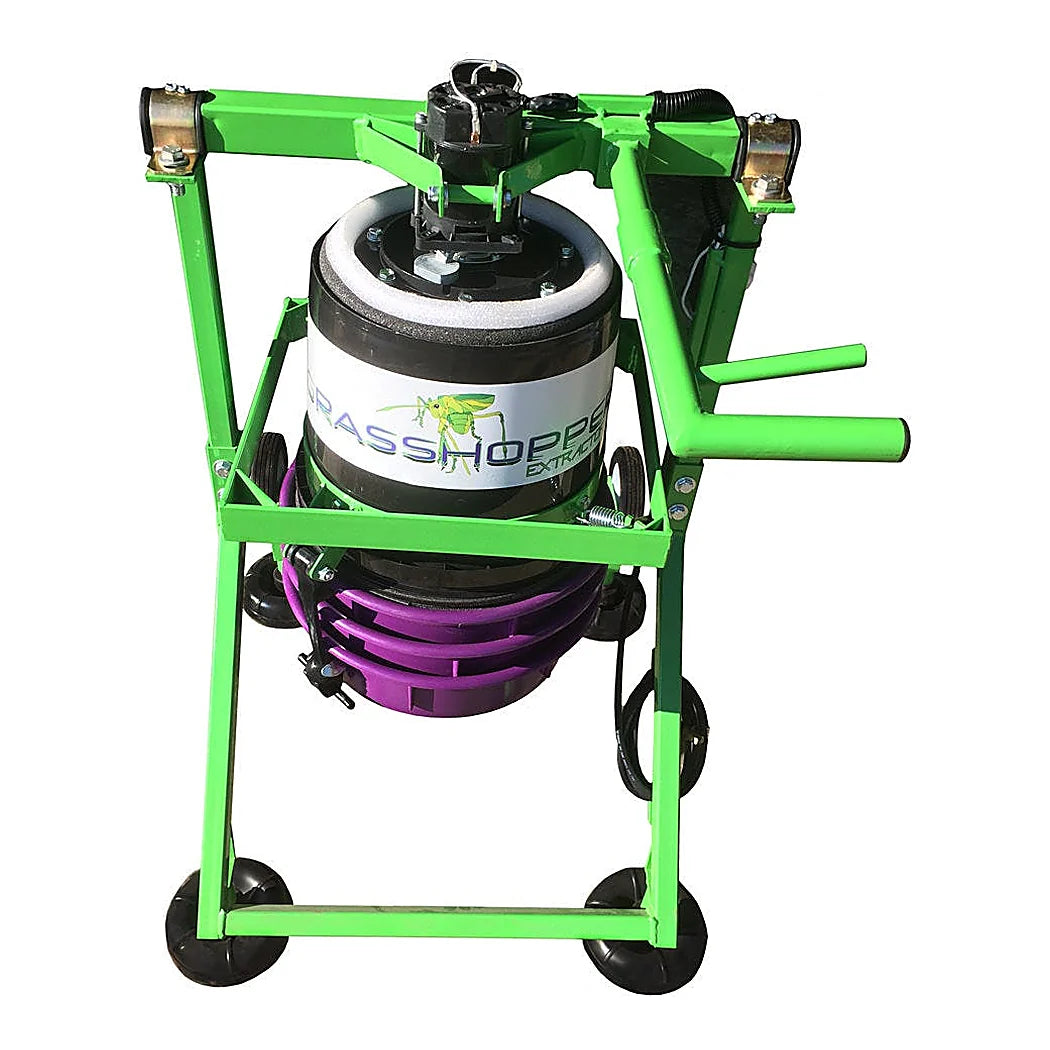
How a Pollen Extractor Using Frozen Carbon Dioxide Works
Cold is doing the work here, not chemistry. Resin glands sit on the plant surface, brittle when frozen and sticky when warm. Crushed dry ice sits at roughly a hundred and nine degrees below zero Fahrenheit. Five minutes against it carries plant material well past that brittle point. Gentle agitation then knocks the heads off intact instead of smearing them across leaf. A 400 W motor rated at one third horsepower automates that agitation. Tumbling stays consistent between batches rather than depending on how tired your arms are. A single load is a pound of dried material with three pounds of crushed medium. Expect about sixty grams of sift from the first five minute cycle, and a further thirty six grams from a second run. That is a little over three ounces from the pound, roughly twenty percent.
Handling Dry Ice, Screen Choice and Where Quality Is Lost
Three classifier grades come in the box and the difference between them is what ends up in the jar. A number four mesh sifting screen holds back stalk and leaf before anything finer sees the material. Below it sit classifiers at 100, 74 and 50 micron, and they run in sequence rather than alone. The coarser mesh passes more weight, and more of that weight is plant matter. The finest gives the cleanest product and the smallest return. Time works against you in the same way, because every extra minute drives more frozen leaf through the mesh. Stop the cycle earlier than feels right and the first pull stays pale. The medium itself deserves more attention than it usually gets. Solid carbon dioxide sublimates straight to gas, and one pound of it releases roughly eight cubic feet. Work in a ventilated space and never seal it in a closed container, since that gas displaces breathable air and builds pressure. Insulated gloves are not optional at that temperature, and screens attach with rubber straps so a grade change takes seconds. The machine is built in Southern Oregon and extra screen sets are available as the originals wear.
Key Features
- Method: Mechanical sifting with frozen carbon dioxide, and no solvent
- Motor: 400 W, rated at one third horsepower
- Batch size: A pound of dried plant material with three pounds of medium
- Cycle: About five minutes of freezing and five minutes of agitation
- Output: Sixty grams on the first run and thirty six on the second
- Screens supplied: A number four mesh sifter with 100, 74 and 50 micron classifiers
- Screen fixing: Rubber straps, so a grade change takes seconds
- Collection: A collection plate is included in the box
- Cleaning: Compressed air only, with no cleaner or lubricant needed
- Built: In Southern Oregon, with spare screen sets available separately
Technical Specifications
| Specification | Value |
|---|---|
| SKU | GHE |
| Brand | Grasshopper |
| Model | Dry Ice Extraction System, 2016 update |
| Motor | 400 W |
| Motor rating | 1/3 HP |
| Batch capacity | 1 lb of dry plant material |
| Medium | 3 lb of crushed dry ice per batch |
| Cycle time | About 15 minutes for a full process |
| Yield | Up to 25 percent |
| Sifting screen | #4 mesh |
| Classifier screens | 100, 74 and 50 micron |
| Also included | Collection plate |
| Screen attachment | Rubber straps |
| Cleaning | Compressed air; no solvents, cleaners or lubricants |
| Origin | Made in Southern Oregon |