


What GreenGro All Purpose Fertilizer 5-5-5 Is Made Of
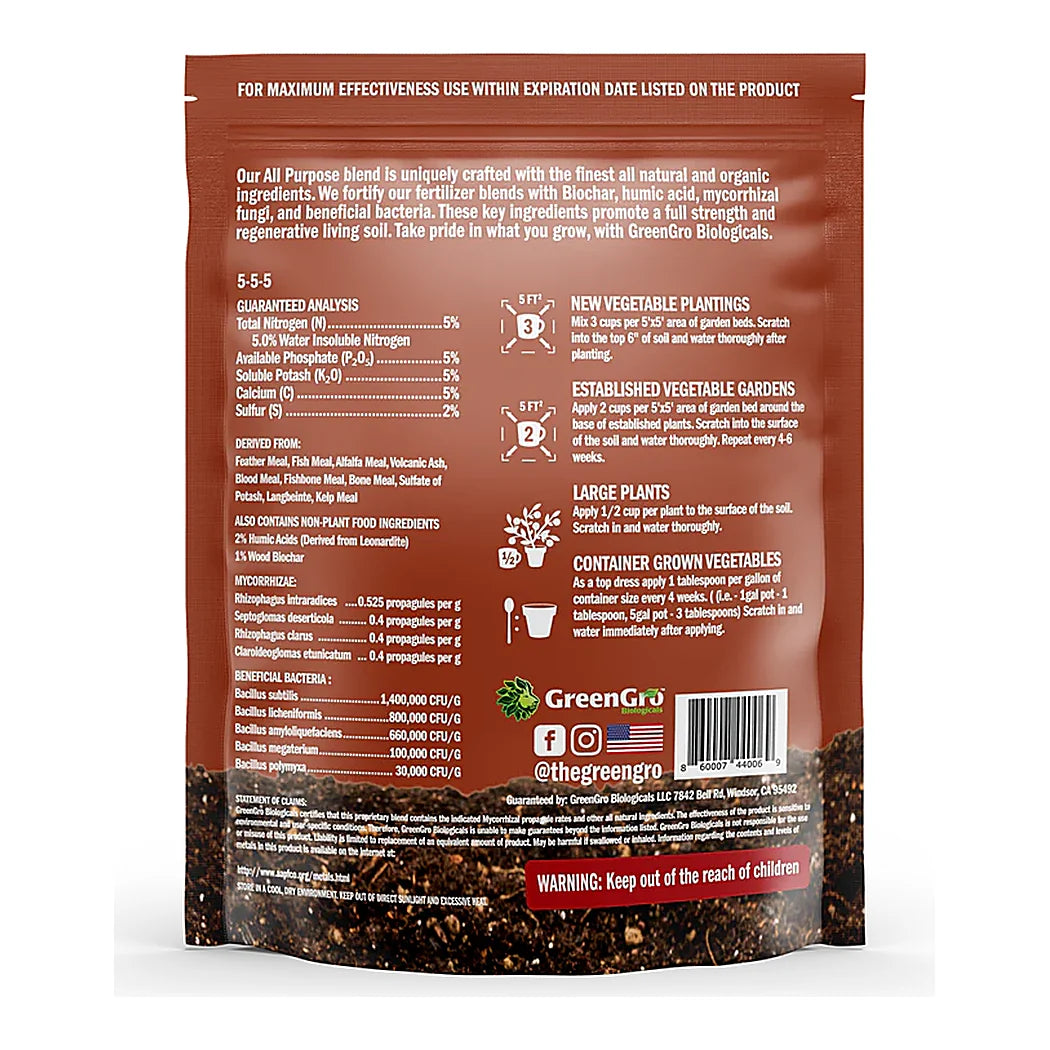
The analysis is 5-5-5, equal parts nitrogen, phosphate and potash, and the nitrogen comes from feather meal, fish meal and alfalfa meal rather than a salt. That is why it can go on vegetables, flowers, shrubs, trees and container plants alike. A meal-based nitrogen releases as the soil life breaks it down, over weeks rather than days. A balanced bag suits a mixed garden where nothing wants a surge. The three parts that make a GreenGro bag more than a bag of meal are the same in every size. Biochar is a charcoal with an open pore structure that holds water and nutrient in the root zone and gives soil microbes somewhere to live. Mycorrhizal fungi colonise the roots and extend their reach for water and phosphorus well past where the root hairs stop. A beneficial bacteria blend works the organic matter into forms the plant can take up. GreenGro calls the result regenerative living soil, and the idea is that each application leaves the bed more alive than it found it. The bag is OMRI listed for organic growing. It comes as a 4 lb bag, packed ten to a case, and a 10 lb bag, packed four to a case. The mix inside is the same. GreenGro's directions are the same for every plant type. Apply at planting, then every 4 to 6 weeks in garden beds and every 2 to 4 weeks in containers, and water well afterwards. Containers get it more often because they hold less soil and leach faster, not because the plant in them eats more.
Working an Organic All Purpose Fertilizer Into a Living Bed
An organic all purpose fertilizer is a feed for the soil before it is a feed for the plant. It pays to treat it that way. Scratch it into the top inch or two rather than leaving it on the surface. The meals break down fastest where soil, moisture and microbes meet. Water it in the same day. A dry granule of feather meal does nothing until it is wet. A bed that sits dry for a week after feeding has not been fed. At planting, mix it through the backfill and the bottom of the hole so the mycorrhizae land where the new roots will be. The fungi have to touch a root to colonise it. A granule sitting on top of the bed is a granule the roots may never reach. Keep the feeding schedule by the calendar, 4 to 6 weeks in beds and 2 to 4 in pots, rather than by the look of the plant. A slow organic feed shows a shortage a fortnight after the shortage began, and feeding on the calendar stays ahead of it. Skip the synthetic salts between applications. A high-salt feed sets the microbes back and undoes the point of paying for biochar and a bacteria blend. Mulch over the fed soil in summer so the biochar and the fungi stay moist and the surface does not bake. Store the bag closed and dry. Meals draw moisture and the bacteria blend keeps best cool, so a bag in a hot shed in August is a weaker bag by September.
Key Features
- 5-5-5 balanced: Equal nitrogen, phosphate and potash from feather, fish and alfalfa meal.
- Biochar: Holds water and nutrient and houses the soil life.
- Mycorrhizae and beneficial bacteria: Extend root reach and release the meals.
- OMRI listed: For organic growing.
- For everything in the garden: Vegetables, flowers, shrubs, trees and containers.
- Schedule: At planting; every 4 to 6 weeks in beds; every 2 to 4 weeks in pots.
- 4 lb bag or 10 lb bag: Ten or four to a case.
Technical Specifications
| Specification | Value |
|---|---|
| Brand | GreenGro Biologicals |
| Product | GreenGro All Purpose Fertilizer |
| Analysis | 5-5-5 |
| Form | Dry granular, organic |
| Biologicals | Biochar, mycorrhizal fungi, beneficial bacteria blend |
| Listing | OMRI listed |
| Derived from | Feather meal, fish meal, alfalfa meal |
| Use | All plant types: vegetables, flowers, shrubs, trees, containers |
| Application | At planting; every 4 - 6 weeks in beds; every 2 - 4 weeks in containers; water well |
| Sizes | 4 lb bag (APF-4, UPC 860007440069, 10 per case); 10 lb bag (APF-10, UPC 860009711303, 4 per case) |
| Storage | Closed, cool, dry |