

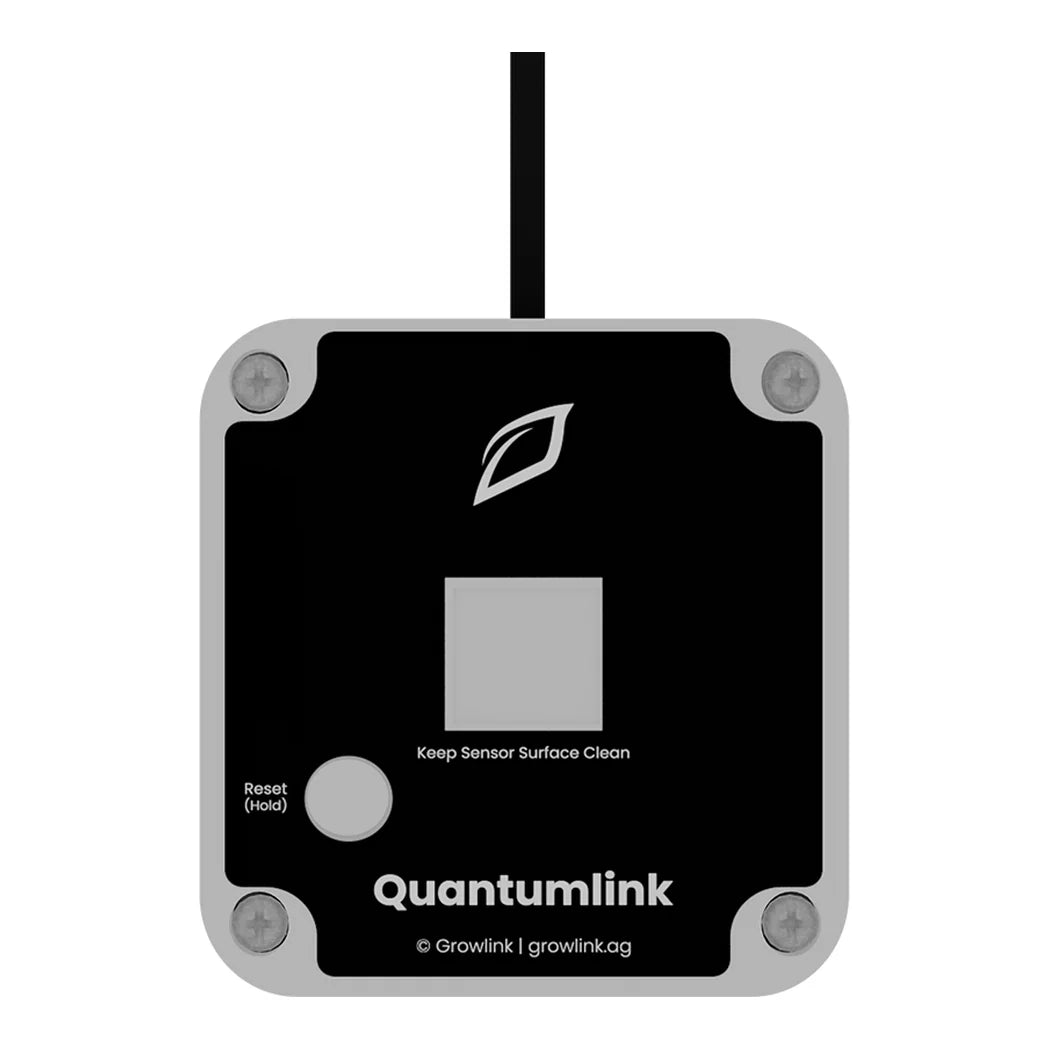
The Growlink Quantum Light Sensor Logs PPFD and DLI at Canopy Height
The Quantumlink is a fixed quantum sensor for the Growlink LINKS system. It stays mounted at the canopy instead of riding around in a back pocket. The head reads photosynthetic photon flux density from 0 to 5,000 µmol·m⁻²·s⁻¹ across a 400–750 nm window. That reach runs a little past the classic 400–700 nm PAR band, so far-red from modern LED bars gets counted. The same head also reports 0–250,000 lux, color temperature from 0 to 10,000 K and flicker frequency up to 120 Hz. PPFD is the number plants respond to, while lux and color temperature help when matching fixtures after a lamp swap. GrowlinkOS turns the running PPFD log into a daily light integral, the photon total from lights-on to lights-off. As a reference, 900 µmol held for 12 hours works out to about 38.9 mol·m⁻²·d⁻¹. Watching that total, not a single noon reading, shows whether a dimming schedule or a gray greenhouse day shorted the crop. Connection is one M8 lead into a canopyLINK or a LINKS HUB, with a hold-to-reset button on the face.
Where a Fixed PAR Sensor Earns Its Place in the Grow Room
Placement is most of the job with any canopy sensor. Set the head level and facing straight up at the top of the plants, then raise it as the crop stretches into early flower. A sensor left at the old height reads lower than the tops actually receive, and the log drifts away from what the plants see. Because one head reports one spot, many growers walk it bed to bed during the first week of a run. That pass maps the hot spots under fixture centers and the dead zones along walls and aisles. Once the map looks even, the sensor goes back to a representative position and logs from there for the rest of the cycle. GrowlinkOS alerts then flag a drop in intensity, which can point to a failed driver, a dimming change or a bumped fixture. A flicker reading that departs from the room's normal pattern is worth a look at that fixture's driver. Greenhouse teams lean on the daily total most, since it shows how much supplemental light a gray day really needs. Keep the diffuser clean, because dust, spray residue and fingerprints read as lower light and can push a controller to overcorrect. It reports nothing without a canopyLINK or LINKS HUB and a GrowlinkOS account, so it belongs in rooms already running Growlink hardware. It is a fixed logger rather than a handheld wand, so a quick spot check across several rooms still means moving it by hand.
Key Features
- Full-Spectrum PAR: PPFD measured across 400–750 nm keeps LED, HPS and mixed rooms on one comparable scale.
- DLI Tracking: Daily light integral is calculated in GrowlinkOS, so light delivery stays consistent cycle to cycle.
- Canopy Mapping: Moving the head bed to bed exposes hot spots and dead zones before they show up in the plants.
- Multi-Metric Head: PPFD, lux, color temperature and flicker frequency all come from one sensor.
- Energy Right-Sizing: Logged PPFD shows where fixture output can come down without shorting the crop.
- M8 Plug-and-Play: One M8 lead connects to a canopyLINK or LINKS HUB, and the sensor appears in the platform.
- GrowlinkOS Logging: Continuous monitoring, alerts and history sit alongside the rest of the room data.
Technical Specifications
| Specification | Value |
|---|---|
| Brand / Model | Growlink Quantumlink |
| SKU | GL-LINK-QUANTUM |
| Sensor Type | Full-spectrum quantum (PAR) sensor |
| PPFD Range | 0–5,000 µmol·m⁻²·s⁻¹ |
| Spectral Range | 400–750 nm |
| Lux Range | 0–250,000 lux |
| Color Temperature | 0–10,000 K |
| Flicker Frequency | 0–120 Hz |
| Calculated Metric | Daily light integral (DLI) in GrowlinkOS |
| Lighting Types | LED, HPS, metal halide and mixed |
| Connector | M8, to canopyLINK or LINKS HUB |
| Platform | GrowlinkOS monitoring, logging and alerts |
| Controls | Reset button (hold) |
| Made In | USA |