


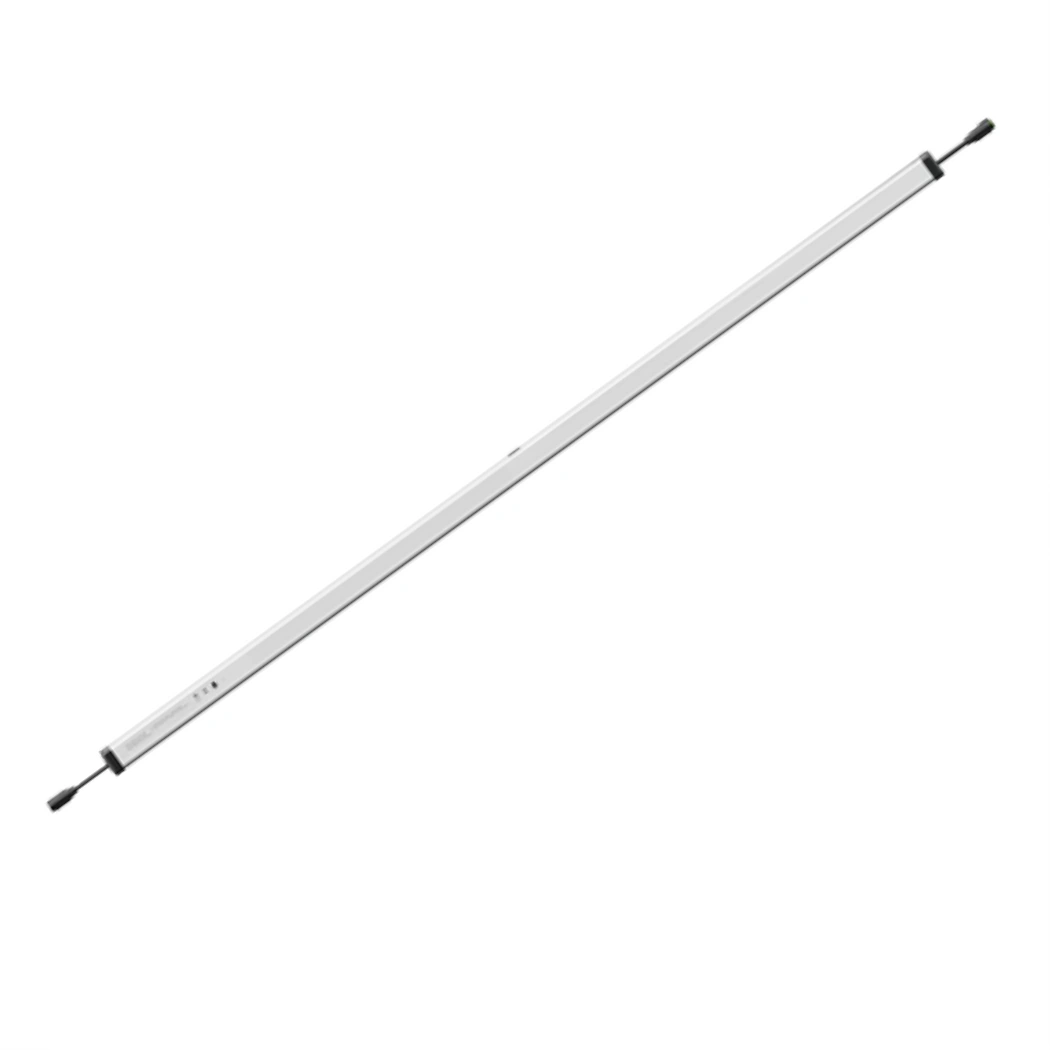
GrowPros Under Canopy Bars: Models, Output and Build
GrowPros builds this bar in 4 ft and 8 ft lengths and four spectrum models. The single-channel Model 1 and Model 2 draw 125W at 4 ft or 250W at 8 ft. They are rated at 350 µmol/s and 700 µmol/s. Model 1 is full spectrum with about 5% far red, and Model 2 puts 80% of its output in deep red. The dual-channel Model 3 and Model 4 draw 150W or 300W and reach 450 µmol/s or 900 µmol/s. Model 3 splits into two 75W channels, one UVA, blue and 5000K, the other deep red, far red and 3000K, at 3.0 µmol/J. Model 4 pairs a red and white channel with a separate far-red channel at 730 nm. Every bar runs on 120–277V with a power factor above 0.9. Cooling is passive, and the housing is IP65 rated for 0–104°F. An RJ12 data line rides inside the power cord, and the bars carry DLC and ETL listings. They are rated to L90 beyond 36,000 hours with a 5-year limited warranty.
Choosing Under Canopy Lighting by Row Length and Spectrum
Under canopy lighting pays off when dense plants shade their own lower bud sites. Match the bar length to the row, using the short bar on tables and the long bar on benches. Pick the spectrum by what the top lights already supply. Under full-spectrum top lights, the 80% red bars add the flowering push lower buds lack. The dual-channel bars let you run far red or UV on their own schedule, such as late in flower. These bars do not switch on by themselves, so plan an external controller before they arrive. Most market controllers work over the RJ12 line. Daisy chains are limited by voltage, from 8 dual-channel bars on household voltage to 18 on commercial service. Clear the lowest growth first, then bring the bars in dimmed and raise output over several days. Watch the lower leaves for bleaching as you ramp. Short plants in a small tent have little lower canopy to feed, so the payback there is thin.
Key Features
- Two lengths: 4 ft and 8 ft bars to match tables or long benches.
- Four spectrum models: Full spectrum, 80% deep red, dual-channel UV plus IR, or dual-channel red plus far red.
- 350 to 900 µmol/s: Output scales with length and channel count.
- Independent dual-channel dimming: Run far red or UV on its own schedule on Models 3 and 4.
- IP65 passive build: No fans, sealed against humidity and overspray.
- DLC and ETL listed: Supports rebates and inspections, with a 5-year limited warranty.
Technical Specifications
| Specification | Value |
|---|---|
| Lengths | 4 ft, 8 ft |
| Model 1 (Full Spectrum) | 125W / 250W, 350 / 700 µmol/s, full spectrum + ~5% far red, single channel |
| Model 2 (80% Red) | 125W / 250W, 350 / 700 µmol/s, 80% deep red, single channel |
| Model 3 (Full + UV + IR) | 150W / 300W, 450 / 900 µmol/s, 3.0 µmol/J; Ch1 UVA + blue + 5000K, Ch2 deep red + far red + 3000K |
| Model 4 (80% Red + IR) | 150W / 300W, 450 / 900 µmol/s; red + white channel plus 730 nm far-red channel |
| Growth Phase | Flower supplement, under canopy |
| Input Voltage | 120–277V, 50/60 Hz |
| Current, Model 3 4 ft | 1.28A @ 120V, 0.73A @ 208V, 0.63A @ 240V, 0.54A @ 277V |
| Power Factor | > 0.9 |
| Control | External controller required; RJ12 data in power cord |
| Daisy Chain, Model 3 4 ft | 8 @ 120V, 12 @ 208V, 16 @ 240V, 18 @ 277V |
| Cooling | Passive |
| IP Rating | IP65 |
| Operating Temperature | 0–104°F |
| Lifespan | L90 > 36,000 hours |
| Certifications | DLC, ETL |
| Warranty | 5 years limited |
