


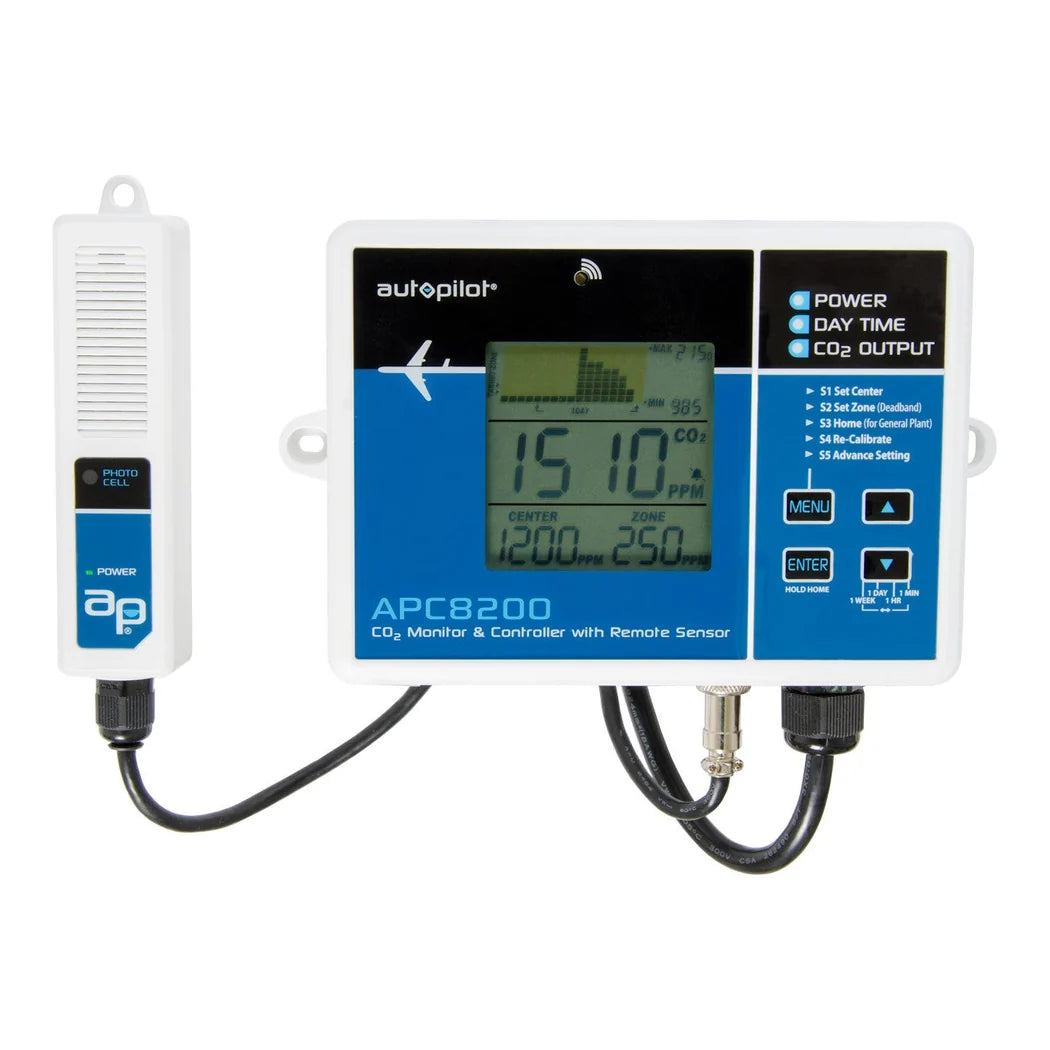
What the Autopilot CO2 Controller Reads and Switches
The sensing element is a two-channel low-drift NDIR type, carried in a remote probe that also holds a photocell. That probe rides on a 15 ft data cable, so it can hang in the canopy while the box stays on a wall. Range on the CO2 function runs from 0 to 5000 ppm. That covers ambient outdoor air at one end and a heavily enriched sealed room at the other. Both the setpoint and the ppm deadband are adjustable. The deadband is what stops a generator short-cycling around the target, and it is the first setting worth thinking about. Readings land on a trend chart that records per minute, per hour, per day and per week. Memory holds up to seven days, and an adjustable zoom steps through those intervals. Green LED lights report the unit status at a glance. The unit measures 9.7 x 7.5 x 3.9 in and ships at 2.3 lb. Part number is APC8200, with UPC 638104020701 and GTIN-14 10638104020708. The warranty runs three years from the date of sale.
Setting Up a CO2 Controller for Grow Room Enrichment
A co2 controller for grow room work only pays off once the room is genuinely sealed. Enrichment bleeds out of a leaky tent faster than any source can replace it, so weatherstripping comes before programming. Set the target for lights-on only, because plants stop fixing carbon in the dark and the gas just accumulates. The photocell in the probe handles that switch without a separate timer on the circuit. A wide deadband means fewer source starts and a slower swing, while a narrow one holds tighter and cycles more often. Most sealed rooms settle somewhere in between once the chart shows how fast they bleed down. That chart is the real diagnostic tool on this unit. A sawtooth that falls away quickly between fills points at a leak, or at an exhaust fan still running on its own timer. A flat line that never reaches target points at an undersized source or an empty tank. The fault codes are worth knowing before anything goes wrong. Err4 flags the infrared lamp and Err6 flags the sensor connection. Err7 is a temperature or humidity fault, while Err5 and Err8 are internal to the unit. Mount it where the display can be read and the outlet is easy to reach. Keep the probe clear of a burner discharge and out of the direct path of an intake fan.
Key Features
- Two-channel NDIR sensor: A low-drift infrared reading rather than a chemical cell.
- 0 to 5000 ppm range: Covers ambient air through a heavily enriched sealed room.
- 15 ft remote probe: Puts the sensor in the canopy with the display out on the wall.
- Photocell on the probe: Separates lights-on from lights-off with no extra timer needed.
- Adjustable setpoint and deadband: Tunes how tightly the room is held and how often the source fires.
- Trend chart with zoom: Logs ppm by minute, hour, day and week, and holds seven days.
- Three-year warranty: Covered for three years from the date of sale.
Technical Specifications
| Specification | Value |
|---|---|
| CO2 range | 0 - 5000 ppm |
| CO2 sensor | 2-channel low-drift NDIR, remote probe |
| Photocell | Yes, on the probe |
| Sensor cable length | 15 ft |
| Zones | Single zone |
| Data logging | Per minute, hour, day and week; up to 7 days |
| Setpoint | Adjustable (ppm) |
| Deadband | Adjustable (ppm) |
| Status indicators | Green LED |
| Unit dimensions | 9.7 x 7.5 x 3.9 in |
| Shipping weight | 2.3 lb |
| Warranty | 3 years |
| Manufacturer part number | APC8200 |
| UPC | 638104020701 |
| GTIN-14 | 10638104020708 |