


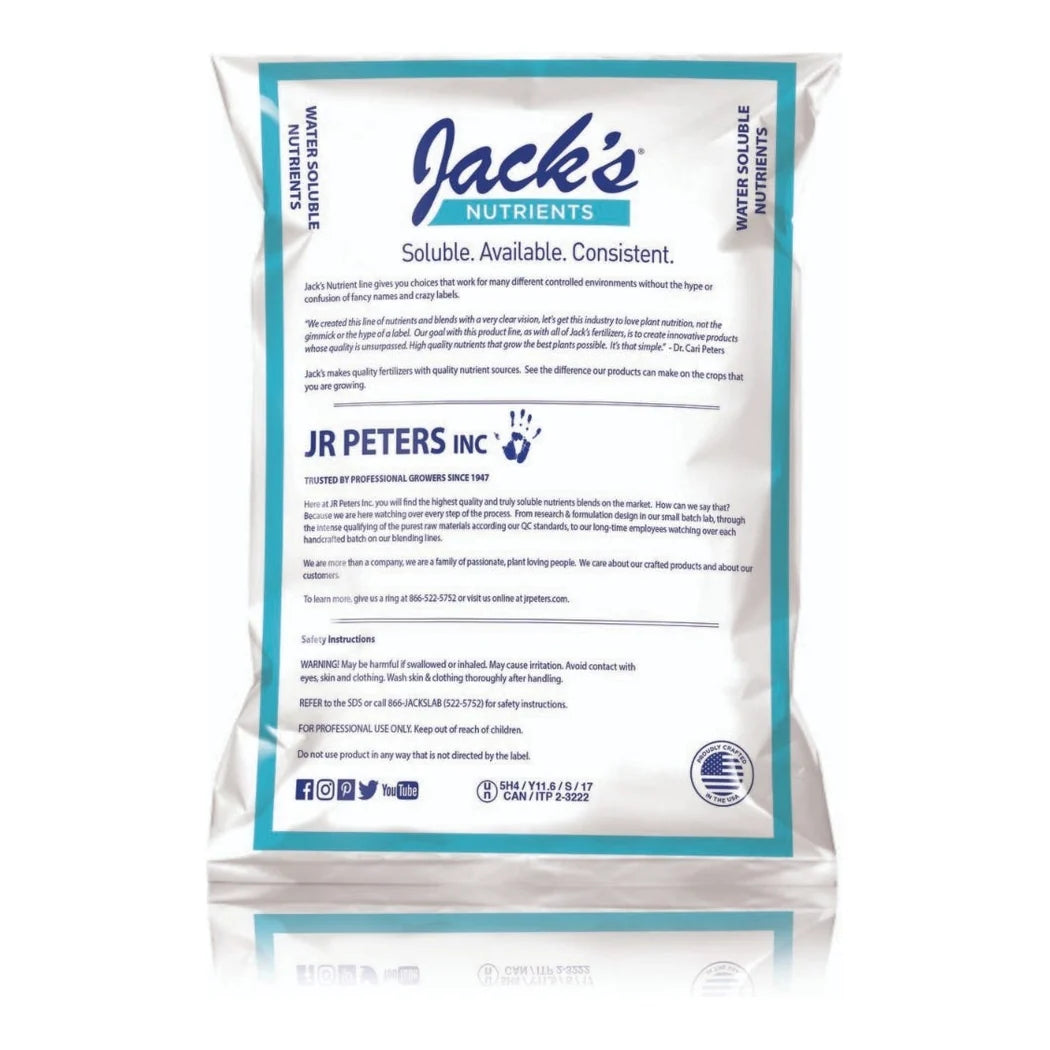
What Jack's Nutrients 15-0-0 Cal-Trate Puts in the Calcium Tank
The bag is calcium nitrate, 95 to 100 percent of it. It is a light blue powder and prill that dissolves fast and completely in water. The analysis is 15-0-0, so all of the nitrogen is nitrate and there is no phosphate or potash in it. A solution carrying 100 ppm of nitrogen from this bag carries 120 ppm of calcium with it. What marks Cal-Trate out is the minor element package riding along with the calcium. That is why the name carries the words with micronutrients. JR Peters describes it as supplying additional calcium and nitrogen as well as the minor elements, for use on all plants. It runs on its own as a calcium top-up or as the Part B in a two-part tank-mixed program. It suits crops that have a hard time moving calcium to where it is needed. Tomatoes and poinsettias are typical examples. The same holds for any fast crop that throws blossom end rot or tip burn under high light. Calcium is the structural nutrient. It builds cell walls and does not move once it is laid down. A plant needs a steady supply through the whole cycle rather than a correction after the damage shows. Nitrate nitrogen is the form roots take up fastest and the form that does not acidify a recirculating root zone. The bag is 25 lb, item 79170. Like every calcium nitrate it keeps its own stock tank, away from phosphate and sulfate concentrates. It stores dry because the prills draw water from the air. It carries no hazard pictogram and no signal word.
Running a Calcium Nitrate Part B With Micros Through a Two-Part Program
A calcium nitrate Part B with micros is the second tank of a two-part feed. The discipline is the same as for any calcium stock. Dissolve it on its own in warm water and never into a tank that already holds a phosphate or a magnesium sulfate concentrate. Calcium meeting phosphate or sulfate at stock strength drops out as a white solid that clogs an injector and takes the calcium with it. The two stocks meet only in the irrigation line, at final strength, where the concentration is too low for the reaction to matter. Set the rate from the nitrogen the plant needs and read the calcium off the ratio, since 100 ppm of nitrogen brings 120 ppm of calcium along. Because the minor elements ride in this bag, a program built around it does not need a separate trace stock. Count that when a Part A that also carries micros goes in the other tank, so the traces are not doubled. Measure EC with both parts in, then pH, and expect a nitrate feed to drift pH upward over a week in a recirculating reservoir. Watch the new growth every few days. Tip burn on young leaves and sunken ends on fruit are calcium reaching the plant too slowly. The fix is steady supply and good transpiration rather than a larger dose. Keep the stock tank lidded and out of light, because a clear nitrate concentrate in the sun grows algae. Store the bag sealed and off the floor. Calcium nitrate pulls moisture from damp air and sets into a block, and a blocked bag still dissolves but it will not scoop. Weigh the dose on a scale rather than trusting a cup.
Key Features
- 15-0-0, all nitrate nitrogen: Calcium nitrate as a fast dissolving light blue powder and prill.
- Calcium with its own micros: The minor elements ride in the calcium tank.
- 100 ppm N brings 120 ppm Ca: The ratio for the bag.
- Part B or stand-alone: The calcium tank of a two-part program, or a calcium top-up on its own.
- For crops that struggle with calcium: Tomatoes and poinsettias are typical examples.
- Own tank, always: Kept apart from phosphate and sulfate stocks until the irrigation line.
- 25 lb bag: JR Peters item 79170.
Technical Specifications
| Specification | Value |
|---|---|
| Brand | Jack's Nutrients, JR Peters |
| Item number | 79170 |
| SKU | JRP79170 |
| UPC | 671341791706 |
| Product | 15-0-0 Cal-Trate, with micronutrients |
| Analysis | 15-0-0 |
| Nitrogen | 15%, nitrate |
| Composition | Calcium nitrate 95 - 100% |
| Calcium to nitrogen | 120 ppm Ca per 100 ppm N in solution |
| Minor elements | Included |
| Form | Powder and prills, light blue, highly water soluble |
| Use | Part B of a two-part program, or on its own, all plants |
| Bag | 25 lb |
| Hazard | No pictogram, no signal word; may be harmful if swallowed or inhaled |
| Maker | JR Peters Inc., Allentown, PA |