

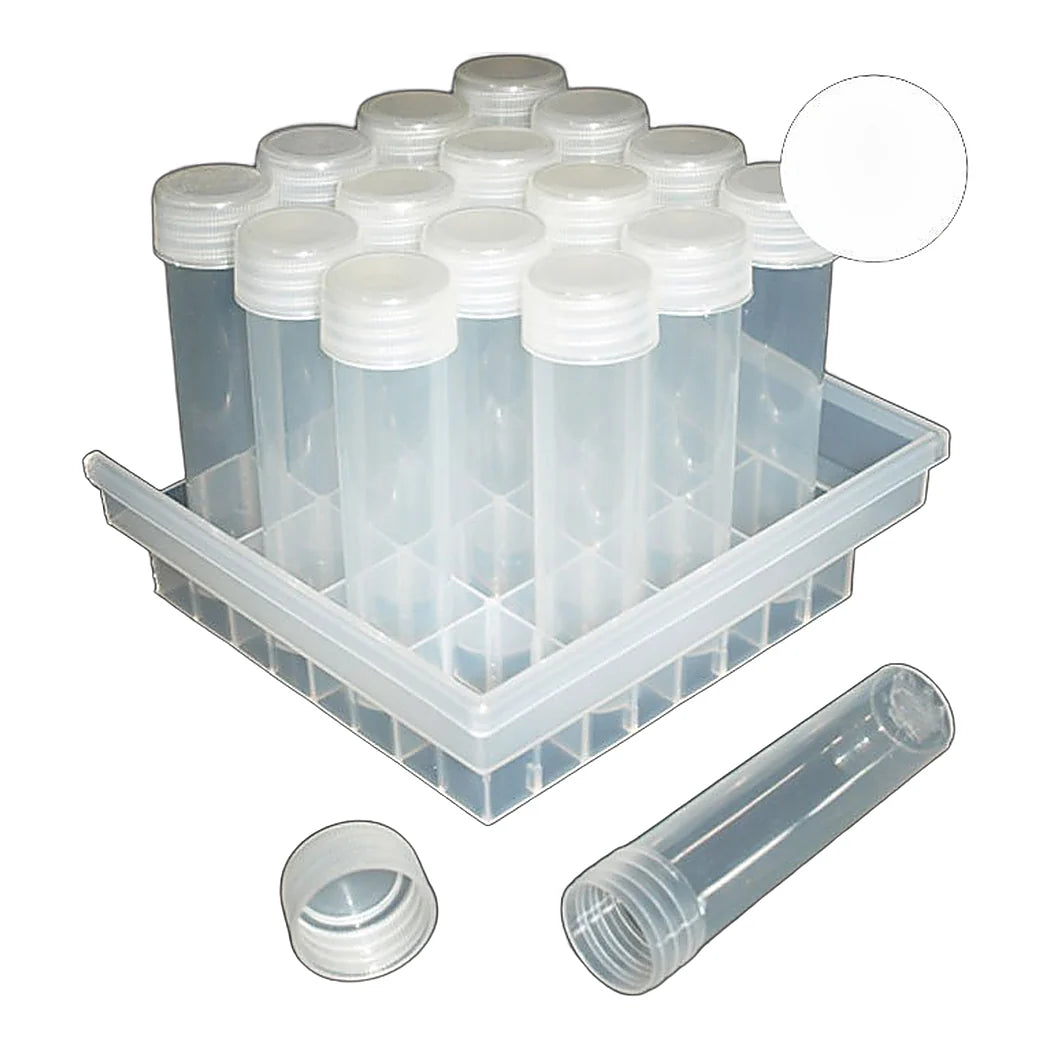
Why a microCLONE Tube Tray Goes Back in the Autoclave
A rack is not an accessory in tissue culture, it is what makes the workflow batchable. Sixteen tubes standing in one tray go into the autoclave together, come out together and get filled together. Loose tubes get knocked over, and a knocked tube is a contaminated tube. The tray is autoclavable polypropylene, which is the material choice that matters here. Polypropylene takes repeated steam cycles at a hundred and twenty one degrees Celsius without warping. Polystyrene, which looks identical on a shelf, does not. Sixteen sites match the sixteen tube starter kit, so a second tray doubles a shelf without changing anything else. Sixteen tubes come with the tray. The tray is the part that survives, and the tubes are the part that eventually does not. Chipped rims and scratched interiors hold biofilm that steam does not always reach.
Sixteen Culture Tubes, and What Reuse Actually Costs
Culture tubes earn their keep by being reused, and reuse is where a shelf quietly goes wrong. Wash, rinse in deionised water, dry, then autoclave, and keep that sequence every time. Detergent residue left in a tube will stunt an explant more reliably than any pathogen. The tray goes through the same cycle, so nothing has to be handled individually. Label the tray rather than the tubes. A grease pencil mark on the rack survives steam where tape on glass does not. Keep one tray per strain if you are running several, because mixed racks get mixed up. Autoclavable also means dishwasher and pressure cooker survivable, which is how most small rooms actually sterilise. A pressure cooker at fifteen PSI reaches the same temperature as a laboratory autoclave. Retire a tube the moment its rim chips, and keep the tray.
Key Features
- Sites: Sixteen, matching the sixteen tube starter kit
- Tubes: Sixteen tubes are supplied with the tray
- Material: Autoclavable polypropylene rather than a single use plastic
- Why that matters: It takes repeated steam cycles without warping
- Sterilising: Autoclave, pressure cooker or dishwasher all work
- Workflow: A whole rack goes through one cycle instead of tube by tube
- Labelling: Mark the tray, since tape on glass does not survive steam
- Reuse sequence: Wash, rinse in deionised water, dry, then autoclave
- When to retire a tube: As soon as the rim chips or the interior scratches
Technical Specifications
| Specification | Value |
|---|---|
| SKU | PF2003 |
| Brand | microCLONE |
| Sites | 16 |
| Tubes included | 16 |
| Tray material | Autoclavable polypropylene |
| Reusable | Yes, the tray is built for repeated cycles |
| Steam cycle | 121 C, standard autoclave conditions |
| Alternative sterilising | 15 PSI pressure cooker |
| Pairs with | The 16 tube starter kit, PF1002 |