


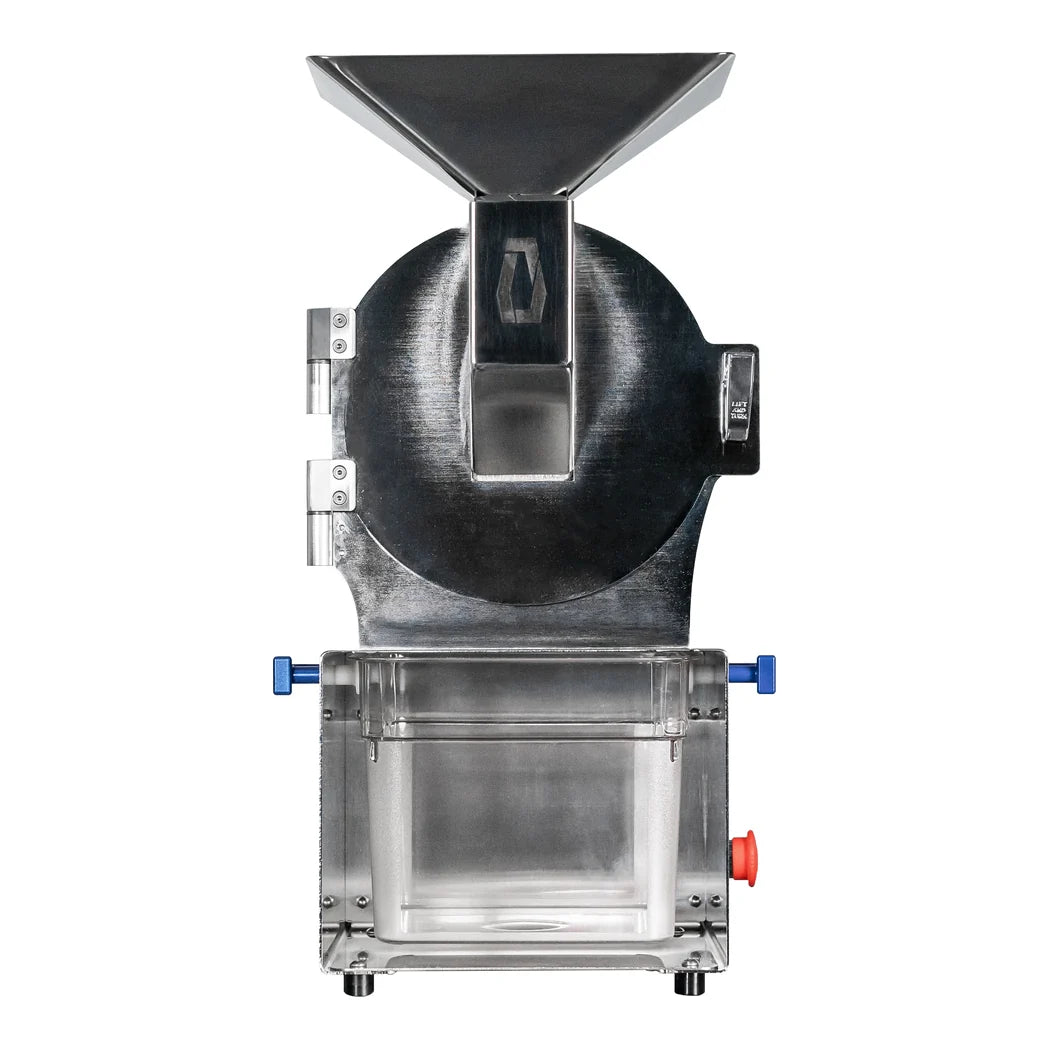
Inside the Mobius M60 Mill and What It Actually Grinds
Milling is the step that quietly decides how a pre-roll burns. Particle size sets airflow, and airflow decides whether a joint runs even or canoes down one side. This machine grinds at a low rotor speed, with an interchangeable screen deciding the output rather than brute force. Seven screens ship with it, covering the two and three millimetre sizes that pre-roll equipment expects. Coarse and ultra-coarse chunking screens handle extraction prep and fresh frozen work at the other end of the range. Speed adjusts across an eleven-step dial, so a dense dry flower and a cryogenic load do not get identical treatment. The milling chamber is stainless, measuring seven and three-quarter inches across and five inches deep. Everything the material touches is stainless steel, and the assembly comes apart without tools. A full clean-down takes about ten minutes and a screen swap takes under one. Those two figures are the difference between a strain change costing an hour and costing a coffee break.
Why a Low-Speed Mobius Grinder Protects Trichomes
Speed is the variable most mills get wrong. Spinning fast generates friction, friction generates heat, and heat drives off the terpenes a season went into building. This unit takes the opposite approach with an ultra-low-speed motor rated at 1/10 HP. Throughput reaches up to 20 lbs per hour, which suits small to medium production rather than a continuous industrial line. The proprietary Rasp Screen geometry supplies the cutting work that rotor speed would otherwise have to provide. The cabinet runs 16 in wide by 13 in long by 23 in high and weighs 60 lbs, so it lives on a bench. Power is a plain 120 V, 1.5 A supply in North America, or 240 V at 0.75 A internationally. The control panel is glove-friendly with an emergency stop in reach, and a safety interlock guards the access door. Certification covers CE and UL, while the stainless build and IQ/OQ documentation package suit a GMP facility. Warranty runs one year or 1,000 hours, whichever arrives first.
Key Features
- Seven Interchangeable Screens: Two and three millimetre grinds for pre-rolls, plus coarse and ultra-coarse chunking for extraction prep.
- Ultra-Low Rotor Speed: Minimal friction means minimal heat, which keeps terpenes and trichome structure where they belong.
- Eleven-Step Speed Dial: Dry flower and cryogenic fresh frozen material each get their own setting rather than one compromise.
- Tool-Free Screen Changes: A screen swaps in under a minute, so a strain change does not stop the line for an hour.
- All-Stainless Construction: Every contact surface is stainless steel and the unit disassembles for pressure washing.
- Bench Footprint: At 16 by 13 by 23 in and 60 lbs, the mill occupies a work surface instead of a pallet position.
- Operator Guarding: A glove-friendly panel, an emergency stop in reach and a door interlock cover the safety side.
- GMP Documentation: An IQ/OQ package and washdown-compatible build fit the mill into a validated facility.
Technical Specifications
| Specification | Value |
|---|---|
| Construction | Stainless steel |
| Speed Adjustment | 1-11 variable |
| Number of Screens | 7 |
| Standard Grind Sizes | 2 mm and 3 mm |
| Motor | 1/10 HP |
| Milling Chamber | 7.75 in diameter x 5 in depth |
| Dimensions | 16 in W x 13 in L x 23 in H |
| Weight | 60 lbs (27.2 kg) |
| Feed Rate | Up to 20 lbs per hour |
| Power Requirement | 120 V, 1.5 A |
| International Power | 240 V, 0.75 A |
| Cleaning | Full clean-down in about 10 minutes |
| Certifications | CE and UL |
| Warranty | 1 year or 1,000 hours |