

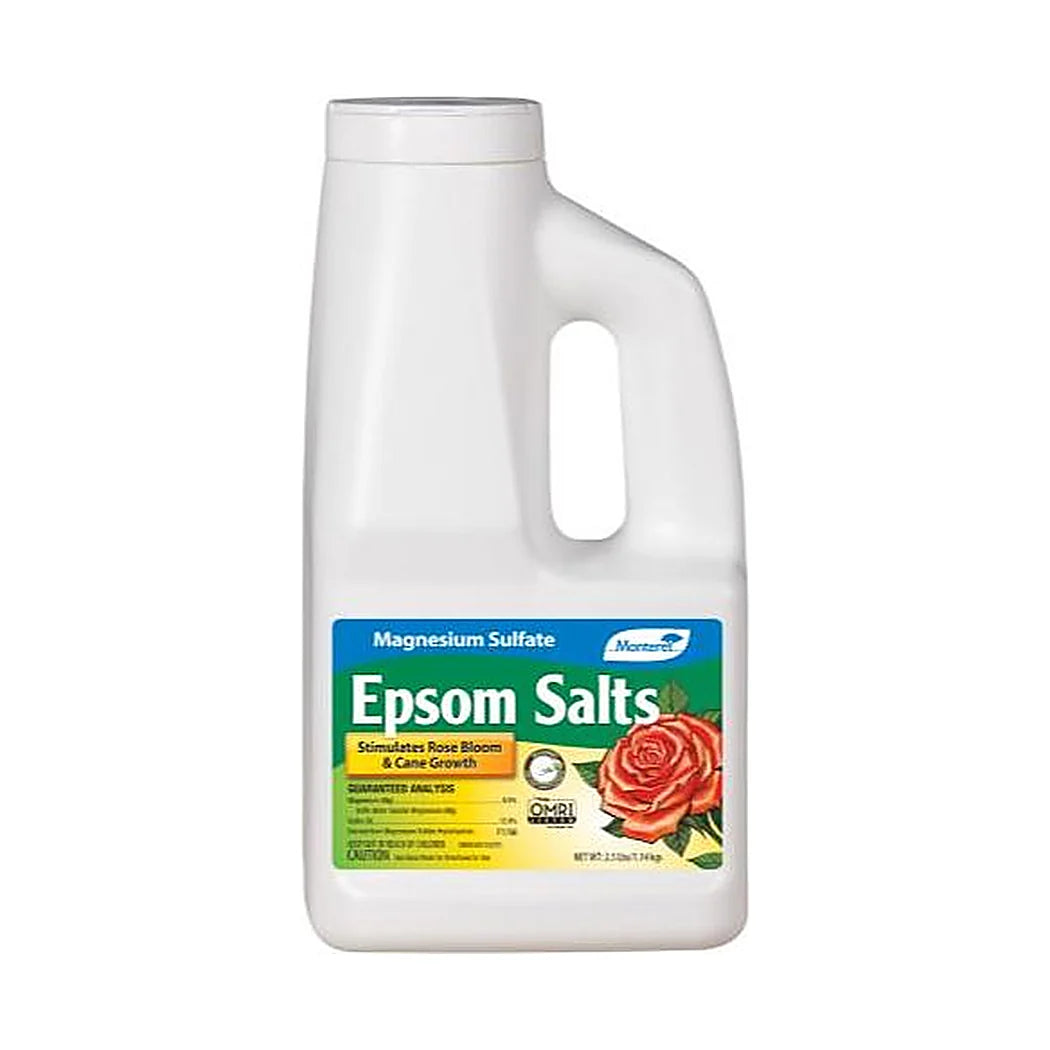
What Is Actually in a Bag of Monterey Epsom Salts
The guaranteed analysis is short and it is the whole product. Magnesium sits at 9.8 percent, all of it water soluble, and sulfur at 12.9 percent. Both come from magnesium sulfate and nothing else is in the bag. There is no nitrogen, no phosphate and no potash, which is why this belongs in the corrective column rather than the feeding one. Magnesium is the atom at the centre of every chlorophyll molecule a plant builds. Short it and the leaf cannot hold its green, which is where the classic interveinal yellowing on older foliage comes from. Sulfur is running alongside at a higher percentage than the magnesium, and it goes into the amino acids and into the enzyme work behind them. The material is agricultural grade rather than a bath product. It dissolves cleanly in water for a foliar spray, and it can equally go dry to the base of a plant. The bag is four pounds and the manufacturer code is LG7220. It is OMRI Listed, so a certified operation can use it. Certifiers generally expect a documented deficiency, by soil test or tissue sample, before an application is made.
Rates, and When Magnesium Sulfate Is the Wrong Answer
There are two rates and both are worth reading. For a foliar spray, a quarter cup, which is four tablespoons, goes into one to two gallons of water. That mix covers five hundred to a thousand square feet. Two to four applications across a season is the guidance. On soil, around roses and shrubs, a quarter cup goes to the base of the plant early in spring. A follow-up application in summer is optional. Open ground work runs at a heavier rate per thousand square feet. Now the part that matters most. This only does something where magnesium is actually short. Yellowing between the veins has several causes, and iron, manganese and nitrogen deficiencies all produce patterns that get mistaken for it. Iron shows on new growth while magnesium shows on old, which is the fastest field check there is. Adding magnesium into a substrate that already holds plenty pushes against calcium and potassium uptake instead of helping. Confirm the deficiency before reaching for the bag. Where a feed already carries magnesium, check the chart before adding more on top of it.
Key Features
- Analysis: 9.8 percent magnesium, all water soluble, and 12.9 percent sulfur
- Derived from: Magnesium sulfate, with nothing else in the bag
- Grade: Agricultural grade rather than a bath or cosmetic product
- Certification: OMRI Listed for use in certified organic production
- Foliar rate: A quarter cup per one to two gallons, covering 500 to 1,000 sq ft
- Soil rate: A quarter cup at the base in early spring, repeated in summer
- Frequency: Two to four applications across a growing season
- Bag size: Four pounds, under manufacturer code LG7220
- Use case: Correcting a confirmed magnesium shortfall, not routine feeding
- Diagnostic: Magnesium shows on old leaves while iron shows on new ones
Technical Specifications
| Specification | Value |
|---|---|
| SKU | 704623 |
| Brand | Monterey |
| Manufacturer code | LG7220 |
| Package | 4 lb bag |
| Magnesium | 9.8 percent, water soluble |
| Sulfur | 12.9 percent |
| Derived from | Magnesium sulfate |
| Grade | Agricultural |
| Certification | OMRI Listed |
| Foliar rate | 1/4 cup, or 4 tbsp, per 1 to 2 gallons of water |
| Foliar coverage | 500 to 1,000 sq ft per mix |
| Applications | 2 to 4 per growing season |
| Soil rate | 1/4 cup at the base of roses and shrubs in early spring |
| Organic certification note | Certifiers expect a documented deficiency first |