


Better than the Previous. Avoid
"Better than the Previous. Avoid violation."
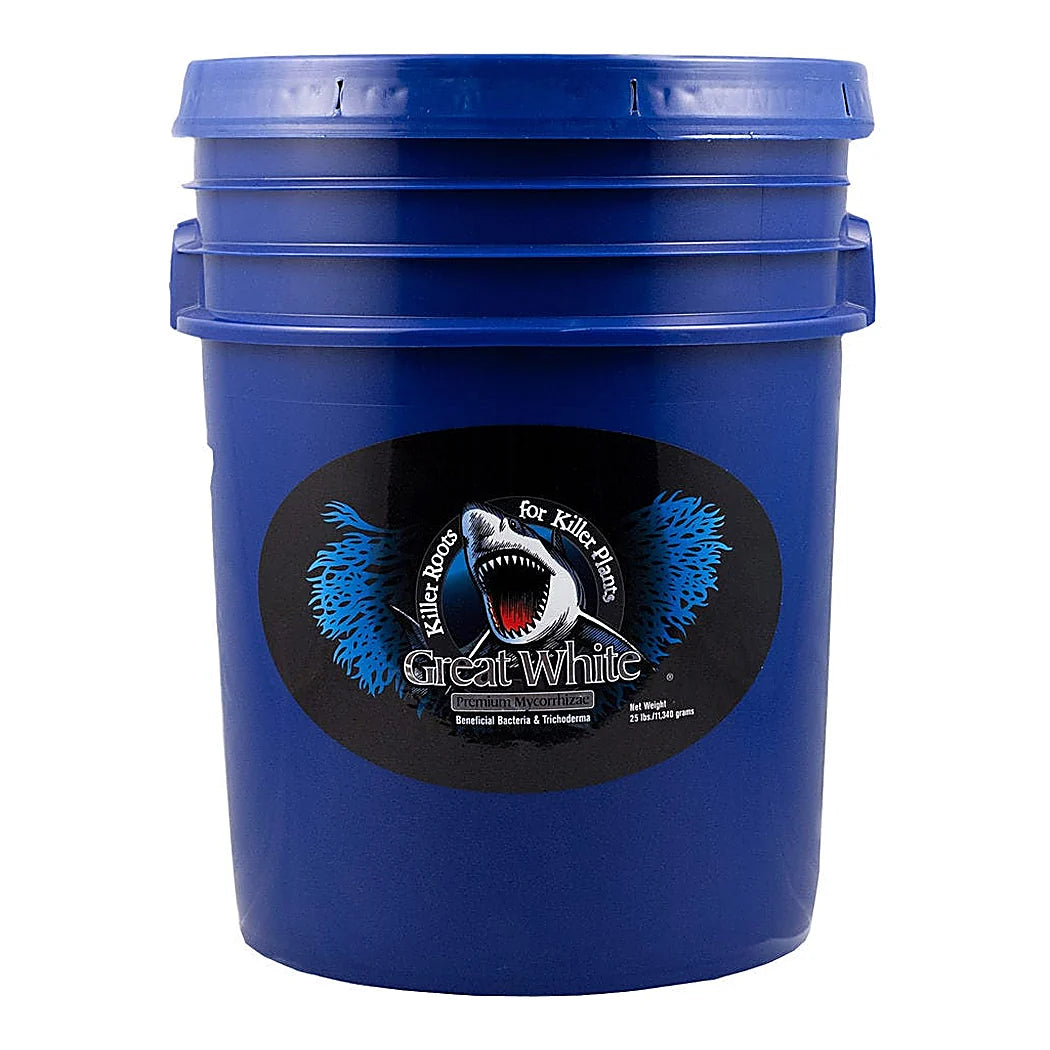
Great White is a fine, water soluble powder from Plant Revolution, the Santa Ana, California company behind the Plant Success line, made in the USA. The label runs to more than 200,000 mycorrhizal propagules per gram, and the mix is built for two kinds of root at once. The ectomycorrhizal side is led by Pisolithus tinctorius at 187,875 propagules per gram, with four Rhizopogon and two Scleroderma species behind it. The endomycorrhizal side carries the Glomus-type fungi that colonise vegetables, herbs, flowers and most annual crops. Aggregatum, intraradices, mosseae and etunicatum run at 83 per gram each, with five more at 11. Those are the fungi that grow into the root and push hyphae out through the medium, reaching water and phosphorus a root hair never touches. Behind the fungi is a bacterial package at 525,000 CFU per gram per species: Azotobacter, seven Bacillus strains, two Paenibacillus, two Pseudomonas and a Saccharomyces yeast. Two Trichoderma round it out, koningii at 187,875 and harzianum at 125,250 CFU per gram, the fast-growing fungi that occupy the root zone before anything worse can. Everything else in the tin is an inert carrier. The powder dissolves in water, which is the whole point of it. A granular inoculant has to be placed where the root will grow. A solution carries the spores to the root through a dip, a drench or a reservoir. Plant Success's directions are one level scoop, a teaspoon or 5 g, per 2 gallons of water for soil, coco and top feeding. In hydroponics it is one scoop per 10 gallons of reservoir with each regular feed. Cuttings get a dip in rooting solution and a dusting of dry powder on the cut end. Transplants get a light dusting in the hole. Seeds get a coating before sowing. The label repeats soil applications every 2 to 3 weeks and stores the tin between 40 and 85 °F, never above 140. It comes in six sizes, from the 1 oz tin to the 25 lb drum, and the powder is the same in every one.
A mycorrhizae powder does nothing in the tin and nothing on the surface of a pot. A spore has to touch a root to germinate. That rule decides every application. Dust the cut end of a cutting and the inside of a transplant hole so the powder is where the first roots emerge. Dissolve the rest into water that drains to the root zone rather than sitting on top. Stir a scoop into the first 2 gallons of water a transplant gets and pour it slowly at the stem. A fast drench runs down the pot wall and past the roots. Establish the colony before the heavy phosphorus arrives. High phosphorus switches the plant off from the fungi. Inoculate at propagation and through veg, and let the bloom feed come once the roots are colonised. In a reservoir, add the scoop with each regular feed rather than once. A recirculating tank is diluted, drained and refilled, and the population goes with it. Keep chlorine and peroxide out of the tank for a day either side of a dose. Both kill what was just added, and a sterile tank and a living one cannot be run at the same time. Use the powder, not the dry lump. A tin that has drawn moisture and caked has lost viability, and the spores in it are not worth the dip. Keep the tin closed, cool and dry between uses, and keep it out of a hot truck or a greenhouse bench in July. Judge it by the roots, not the leaves. Knock a plant out of its pot a fortnight after the first dose and look for the fine white web on the root ball. That web is the colony, and a plant with it is a plant that will shrug off a dry day.
Technical Specifications
| Specification | Value |
|---|---|
| Brand | Plant Success (Plant Revolution Inc.) |
| Product | Great White premium mycorrhizae, water soluble powder |
| Ectomycorrhizae | Pisolithus tinctorius 187,875 prop/g; Rhizopogon luteolus, fulvigleba, villosullus, amylopogon 5,219 each; Scleroderma citrinum, cepa 5,219 each |
| Endomycorrhizae | Glomus aggregatum, intraradices, mosseae, etunicatum 83 prop/g each; G. clarum, monosporum, deserticola, Paraglomus brasilianum, Gigaspora margarita 11 each |
| Bacteria | Azotobacter chroococcum; Bacillus subtilis, licheniformis, azotoformans, megaterium, coagulans, pumilus, amyloliquefaciens; Paenibacillus polymyxa, durum; Pseudomonas aureofaciens, fluorescens; Saccharomyces cerevisiae — 525,000 CFU/g each |
| Trichoderma | T. koningii 187,875 CFU/g; T. harzianum 125,250 CFU/g |
| Carrier | 99% inert, non-plant-food ingredients |
| Soil, coco, top feed | 1 scoop (1 tsp / 5 g) per 2 gal water; repeat every 2 - 3 weeks |
| Hydroponics | 1 scoop per 10 gal reservoir with each regular feed; 2 tsp / 20 gal, 3 - 4 tsp / 50 gal, 6 - 8 tsp / 100 gal |
| Solution per container | 4 in pot 3 oz; 1 gal 5 oz; 3 gal 16 oz; 5 gal 32 oz |
| Cuttings and seeds | Dip cut end in rooting solution and coat with powder; coat seeds lightly |
| Transplant | Dust the hole lightly and set the plant on it |
| Storage | 40 - 85 °F; never above 140 °F |
| Sizes | 1 oz (720308, UPC 689319012135); 4 oz (720310, 689319012012); 8 oz (720315, 689319012029); 32 oz (720320, 689319012036); 5 lb (720311, 689319012043); 25 lb (PRPSGW25, 689319012074) |
| Origin | Made in the USA, Santa Ana, CA |