

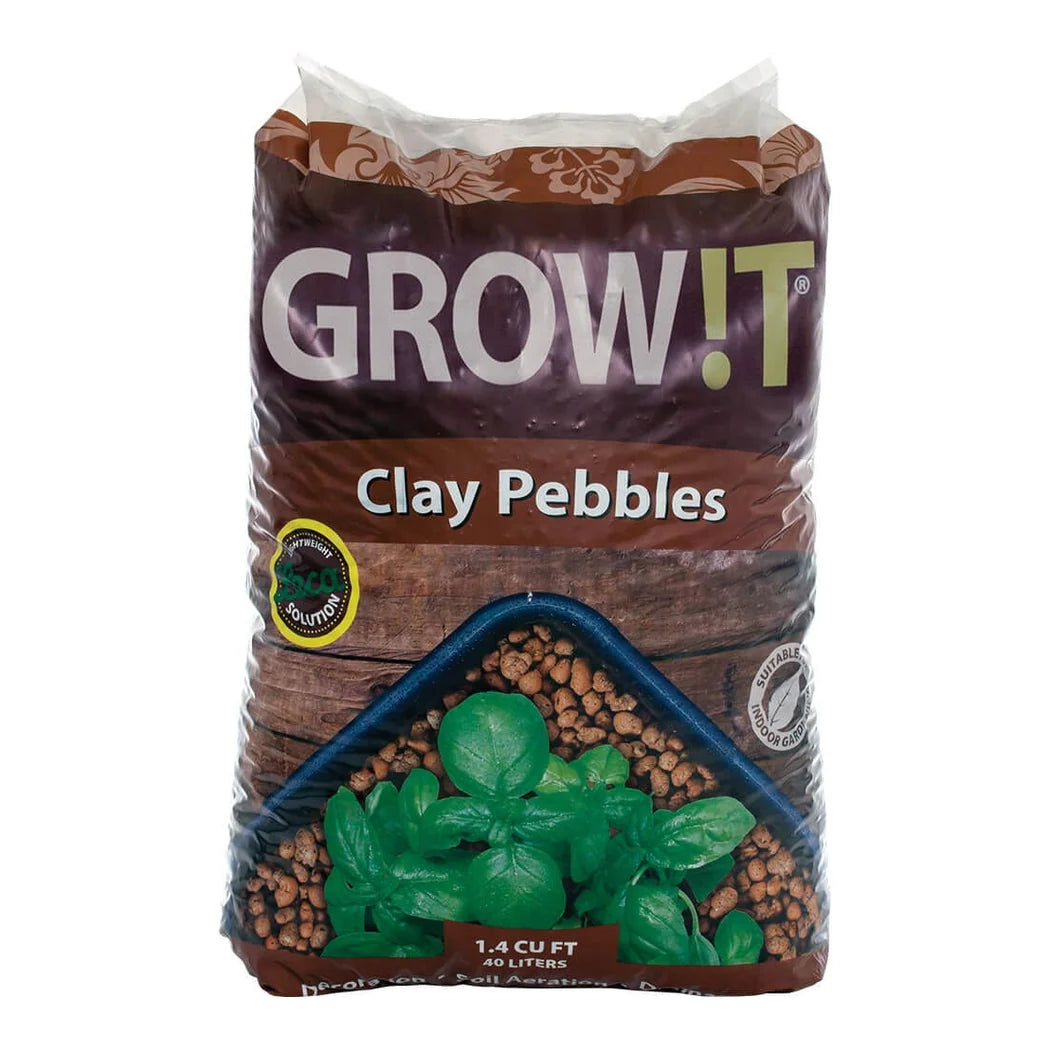
What the Clay Growing Pebbles Bring to a Table
The bag holds 40 L of expanded clay, which is the quantity that fills a bench rather than a pot. Grade is 4 mm to 16 mm, the same mixed size the smaller bags carry. Material is 100% natural clay, fired until it expands into a hard-shelled, porous ball. It arrives pre-washed and stable in both pH and EC, so it will not move the reservoir numbers while it sits in solution. A full bag weighs 28.85 lb, which is a two-handed lift but not a pallet jack job. Its part number is GMC40L with UPC 638104013444. Inert is the operative word here. The pebbles carry no nutrient of their own and they do not hold onto what you feed. The plant therefore gets the solution you actually mixed. They drain freely and hold no surplus water, which keeps oxygen in the voids between them. They also resist breaking down, and that is what stops a system slowly filling with clay fines. Fines are what clog emitters and what turns the floor of a flood table into sludge. The rough outer shell carries a large surface area, which gives beneficial bacteria somewhere to establish.
Bulk Clay Pebbles for a Whole Bench
Bulk clay pebbles go by the bag once the build is bigger than a handful of net pots. An ebb and flow table filled with them floods and drains cleanly, because there is nothing in there to float or wash out. A drip system running over pebbles spreads emitter output across the pot instead of letting it bore a channel. Deep water culture baskets take them as a collar that holds the stem while the roots hang into solution. Aquaponic beds use the same medium for its bacterial surface as much as for the drainage. Fill depth is worth thinking about before the first bag gets opened. A table filled too deep wastes medium under the root mass and slows the drain side of the cycle. Plenty of growers run shallower in the table and deeper in the pot. Blended into coco or soil, the maker suggests four parts clay to seven parts medium. At that ratio a heavy mix opens up without giving away its water holding. Give a new bag a rinse before it goes in, since a pre-wash does not survive a pallet journey intact. Reuse is where a bag this size earns its price back. Pick the old root mass out and sterilise the pebbles between runs.
Key Features
- 40 L per bag: Enough inert medium to fill a table or a bank of pots.
- 4 mm to 16 mm grade: A mixed size that beds down with air gaps throughout.
- 100% natural clay: Fired expanded clay, inert, with no nutrient of its own.
- Pre-washed: Most of the production fines are already out of the bag.
- pH and EC stable: The medium does not shift the numbers in the reservoir.
- Holds its shape: Resists crushing, so the system does not fill with clay fines.
- 28.85 lb bag: A two-handed lift rather than a pallet jack job.
Technical Specifications
| Specification | Value |
|---|---|
| Material | 100% natural clay, expanded |
| Pebble size | 4 mm - 16 mm |
| Volume | 40 L |
| Washed | Pre-washed |
| pH and EC | Stable |
| Weight | 28.85 lb |
| Suggested blend ratio | 4 parts clay to 7 parts coco or soil |
| Uses | Ebb and flow, deep water culture, drip feed, aquaponics, top dressing |
| Manufacturer SKU | GMC40L |
| UPC | 638104013444 |