

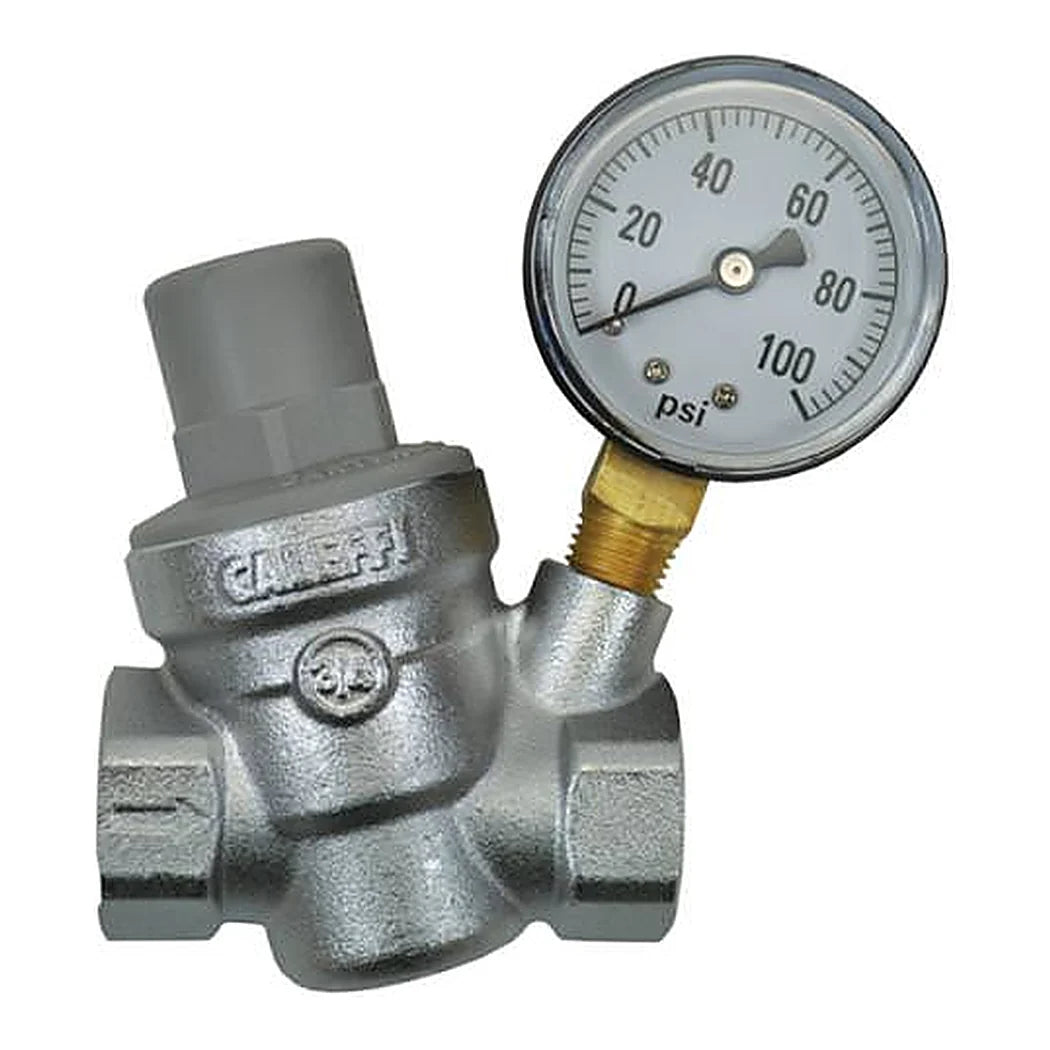
What a Water Pressure Regulator with Gauge Actually Holds
A pressure reducing valve does one job. It takes a higher incoming pressure and holds a lower, steadier one downstream. This is the 3/4 in version, female threaded on both the inlet and the outlet. The outlet range is adjustable from 15 to 87 psi, and it arrives factory set at 43.5 psi. Maximum incoming pressure is 230 psi, which covers almost any municipal supply. Maximum water temperature is 140 degrees Fahrenheit. The body is chrome plated brass, with a stainless steel gauge on a 2 in face. A face that size reads clearly from across a plant room, which is the point of putting the gauge on the valve itself. The whole assembly weighs 1.16 lbs. Setting it is a screwdriver adjustment on the top of the valve. Check that setting against your own system rather than trusting the factory figure. The manufacturer's part number for it is PR34-NPT.
Why a Dosing Line Wants a Pressure Reducing Valve Ahead of It
Every part downstream of this valve has a ceiling, and they are lower than people assume. A Lo-Flo nutrient delivery system is rated to 85 psi and the larger Hi-Flo version to 116 psi. Bluelab put a hard limit of 100 psi on their inline probes. An unregulated mains supply can sit above all three figures, and it moves through the day. There is a second reason beyond protecting parts. A water powered doser meters by the water driving it, so a line that swings in pressure is a line that swings in flow. Flow changes are what the doser is built to absorb, but a steady supply still gives a steadier result. The valve also softens the pressure spikes that crack fittings over time. That is the same problem a water hammer arrestor kit tackles from the other direction. One honest limit worth stating plainly. A reducing valve lowers pressure and cannot raise it. If a line already runs below the range you want, the answer is a booster pump rather than this part. Fit it ahead of the dosers, not between the dosers and the crop, so the whole system sees the regulated figure.
Key Features
- Adjustable 15 to 87 psi: Set with a screwdriver on the top of the valve body.
- Factory set at 43.5 psi: Worth checking against your own line before it goes in.
- 230 psi maximum inlet: Which covers almost any municipal supply pressure.
- 3/4 in FPT both ends: Female threaded on the inlet and on the outlet alike.
- Chrome plated brass body: With a stainless steel gauge rather than a plastic one.
- Large 2 in gauge face: Readable from across a room instead of up close.
- Protects downstream ratings: Inline probes cap at 100 psi and dosing systems at 85 or 116.
- 140 degrees Fahrenheit limit: The maximum water temperature the valve is rated for.
Technical Specifications
| Specification | Value |
|---|---|
| SKU | 709018 |
| Manufacturer part | PR34-NPT |
| Brand | Dilution Solutions / Dosatron |
| Product | Water pressure reducing valve with gauge |
| Connections | 3/4 in NPT female inlet and outlet |
| Adjustable outlet range | 15 to 87 psi |
| Factory setting | 43.5 psi |
| Maximum inlet pressure | 230 psi |
| Maximum water temperature | 140 degrees Fahrenheit |
| Body | Chrome plated brass |
| Gauge | Stainless steel, 2 in face |
| Weight | 1.16 lbs |
| Fits ahead of | Dosatron dosers on a Lo-Flo or Hi-Flo nutrient delivery system |
| Why it matters | Lo-Flo is rated to 85 psi, Hi-Flo to 116 psi, Bluelab inline probes to 100 psi |
| What it cannot do | Raise pressure; a low supply needs a booster pump instead |
| Barcode | 850019843156 on file (Dilution Solutions prefix); the maker publishes GTIN 8016615014273, so both numbers exist and neither was altered |