

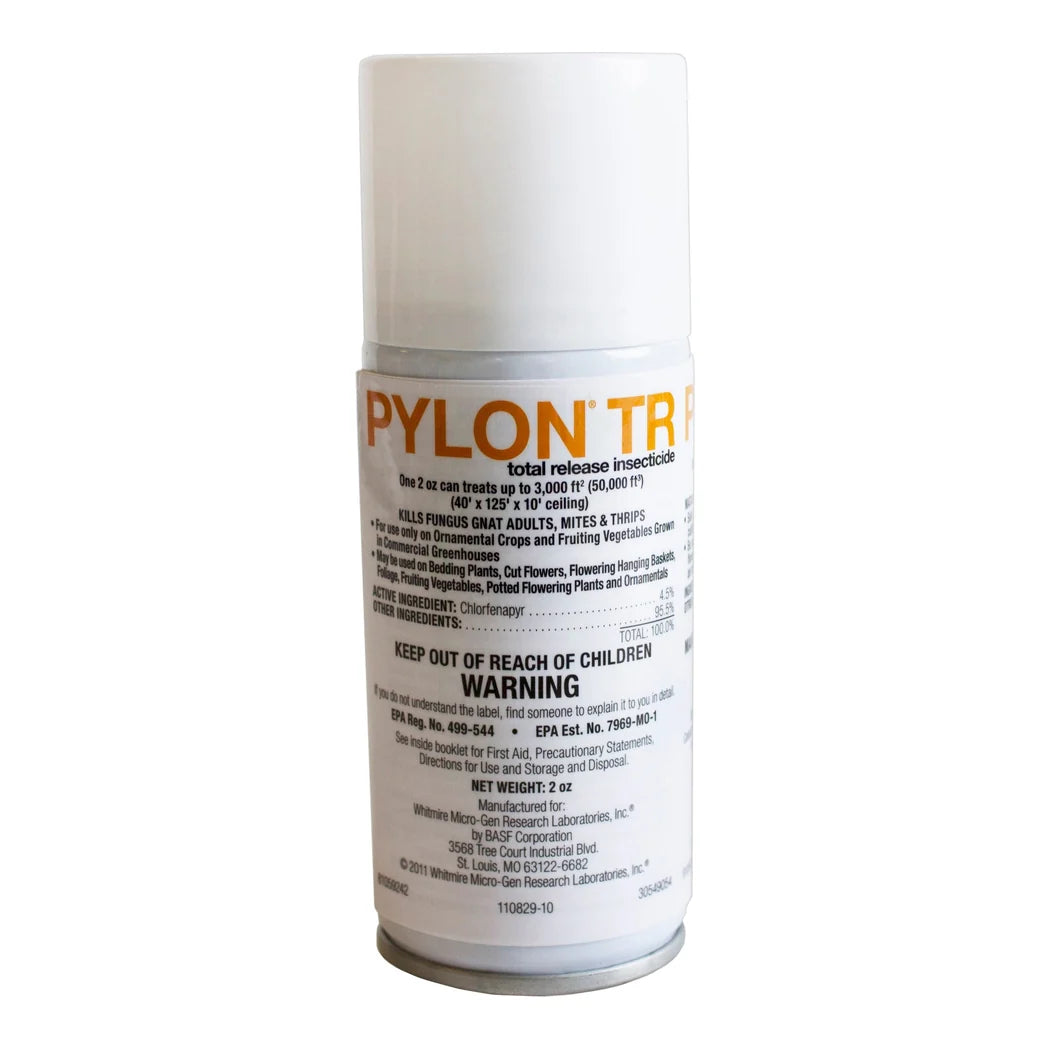
What Is Inside a Pylon TR Insecticide Can
The active is chlorfenapyr at 4.5 percent, working as both a miticide and an insecticide rather than one or the other. It is registered with the EPA under number 499-544. The signal word is Danger, which is the part of this product that deserves reading twice. BASF classify it as an extremely flammable aerosol that causes serious eye irritation and may cause drowsiness, dizziness or respiratory irritation. Labelled pests are mites, including two-spotted spider mites, plus thrips and adult fungus gnats. Labelled sites are ornamental crops and fruiting vegetables under glass, which takes in bedding plants, cut flowers, hanging baskets, foliage and potted flowering plants. One can holds 2 oz and treats up to 3,000 sq ft. The working rate is one to two cans per 3,000 sq ft. Take the low end for single-level benches and the high end where plants sit on multiple levels.
Setting Off a Total Release Fogger Without Wrecking the Result
Placement decides whether this works. The top of the can has to sit at or above the plant canopy. Clear a space about three feet across so nothing is soaked at point-blank range. Bring the can up to room temperature first, because a cold can discharges badly. Shut every vent and door before activating. Horizontal airflow fans come off just before the can goes, and they stay off for a minimum of three hours or, more usually, overnight. There are limits that catch people out. No more than three applications in one crop cycle, and at least five to seven days apart on fruiting vegetables. Nothing goes on tomatoes that mature under an inch across. Treated plant material must not go in the compost. The hard restriction is spatial: never set one off in a closet, a cabinet, or under a counter or table. Use in a small enclosed space may cause the can to explode. Only protected handlers stay in the area during application, and this is not a product for a tent.
Key Features
- Active ingredient: Chlorfenapyr at 4.5 percent, acting as both miticide and insecticide
- Registration: EPA number 499-544, with the signal word Danger on the label
- Pests: Mites including two-spotted spider mite, thrips and adult fungus gnats
- Coverage: One 2 oz can treats up to 3,000 sq ft of greenhouse
- Rate: One to two cans per 3,000 sq ft, depending on bench levels
- Placement: Can top at or above canopy, with a three foot clear radius
- Fans: All horizontal airflow fans off for three hours minimum, or overnight
- Hard restriction: Never activate in a closet, cabinet or under a counter or table
- Frequency: No more than three applications during one crop growing cycle
- Rotation: Space mixes with other BASF total release products for resistance management
Technical Specifications
| Specification | Value |
|---|---|
| SKU | 804000000000 |
| Brand | BASF |
| Active ingredient | Chlorfenapyr, 4.5 percent |
| EPA Reg. No. | 499-544 |
| Signal word | Danger |
| Hazards | Extremely flammable aerosol, serious eye irritation, respiratory irritation |
| Net contents | 2 oz aerosol can |
| Coverage | Up to 3,000 sq ft |
| Rate | 1 to 2 cans per 3,000 sq ft |
| Pests | Mites, thrips, adult fungus gnats, plus others on the label |
| Sites | Ornamentals and fruiting vegetables in commercial greenhouses |
| Maximum applications | 3 per crop growing cycle |
| Interval, fruiting vegetables | 5 to 7 days between applications |
| UPC | 804338125950 |