

What Comes in a Tissue Culture Kit, and Why Sugar Replaces Light
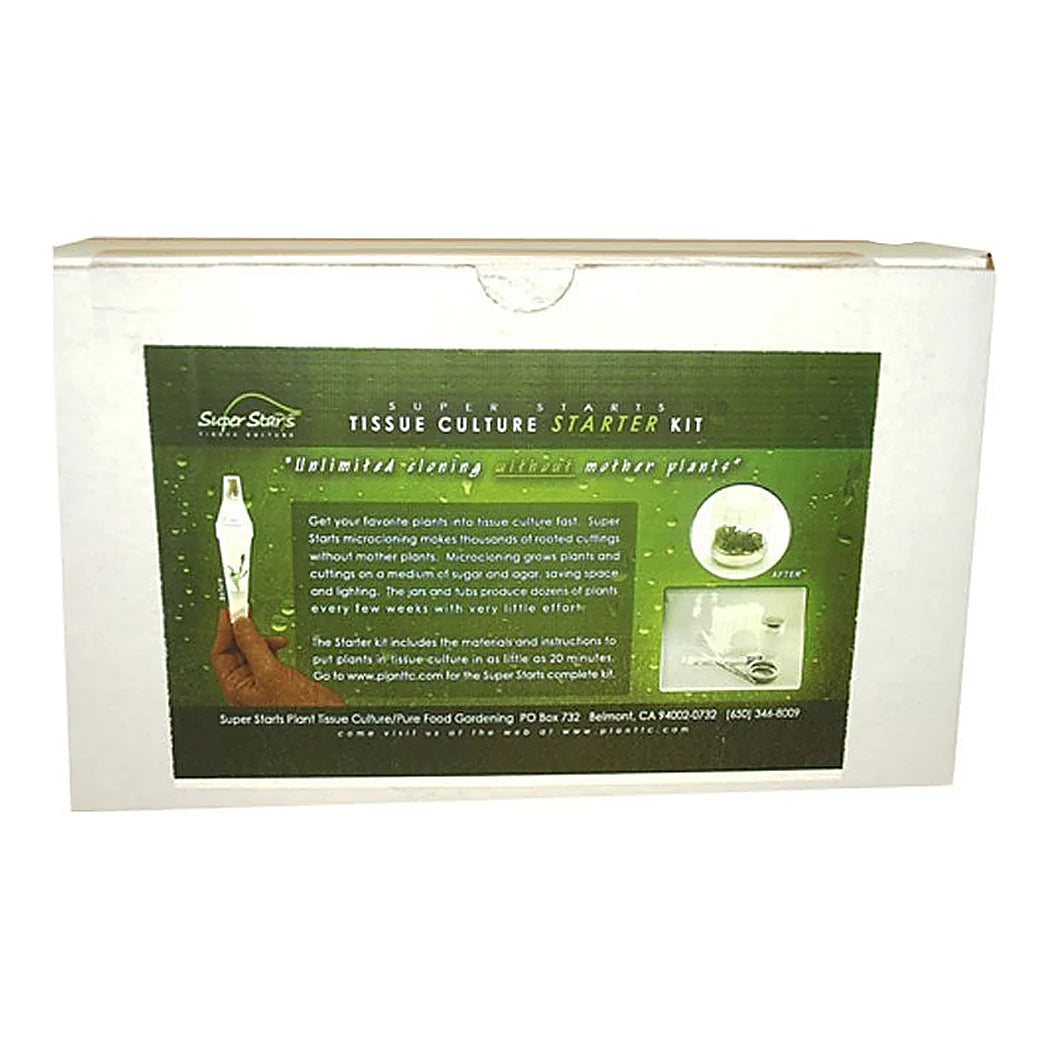
Tissue culture runs on sugar rather than on light, which is the part that surprises people coming from a cloner. Explants sit in a sealed tube and take sugar, mineral salts and hormones in through cut surfaces. Six watts per square foot of fluorescent or LED is all the light the shelf needs. The hormones in the medium push branching instead of stretch, so one node becomes several. Those new branches are the whole point. A shelf of tubes becomes the mother stock that a room of cuttings comes off. Sixteen glass culture tubes come in a reusable tray, with prepared sterile liquid medium already made up. Five Dichlor tablets handle surface sanitising, and a scalpel, eight inch forceps and sealing tape finish the set. The tubes ship non-sterile, so they go through an autoclave or a pressure cooker before first use. The medium carries preservatives, which cuts the mould rate but does not take it to zero. Packed, the box is eleven by six by six inches and weighs about three pounds.
Where Sterile Technique Decides Whether the Tubes Take
Contamination is what ends most first attempts, and it is a technique problem rather than a product problem. Every tube that goes cloudy within a week was opened in moving air. The kit does not include a laminar flow hood, and that is the honest gap in it. A still air box built from a clear tote works for a shelf of sixteen tubes. Wipe the work surface, flame or dip the scalpel between cuts, and keep hands downstream of the open tube. Dichlor tablets are for the plant surface, not for your tools. Trim from the strongest mothers and take limb tips rather than woody stem. Seal each tube with the tape so gas exchange stays slow and the medium stays put. Once a tube has rooted material it transfers straight into a rooting plug. A HEPA filter and a clean dedicated shelf are the two things worth adding before the second run.
Key Features
- Tubes: Sixteen glass culture tubes in a reusable tray
- Medium: Prepared sterile liquid cloning medium, with preservatives
- Sanitising: Five Dichlor tablets, for sanitising the plant surface
- Tools: A scalpel, eight inch forceps and sealing tape
- How it works: Explants live on sugar in the tube rather than on light
- Light needed: About six watts per square foot, fluorescent or LED
- Before first use: The tubes ship non-sterile and want an autoclave cycle
- Not included: A laminar flow hood or HEPA filter, which is the real gap
- Output: Branching in the tube turns one node into several cuttings
- Packed size: Eleven by six by six inches, at roughly three pounds
Technical Specifications
| Specification | Value |
|---|---|
| SKU | PF1002 |
| Brand | microCLONE |
| Culture tubes | 16, glass, in a reusable tray |
| Tube condition | Non-sterile as supplied |
| Medium | Prepared sterile liquid cloning medium |
| Sanitising tablets | 5 Dichlor |
| Tools included | Scalpel and 8 in forceps |
| Also included | Sealing tape and instructions |
| Light requirement | About 6 W per sq ft, fluorescent or LED |
| Also needed | HEPA air filter and a clean dedicated shelf |
| Packed dimensions | 11 x 6 x 6 in |
| Weight | 3 lb |