


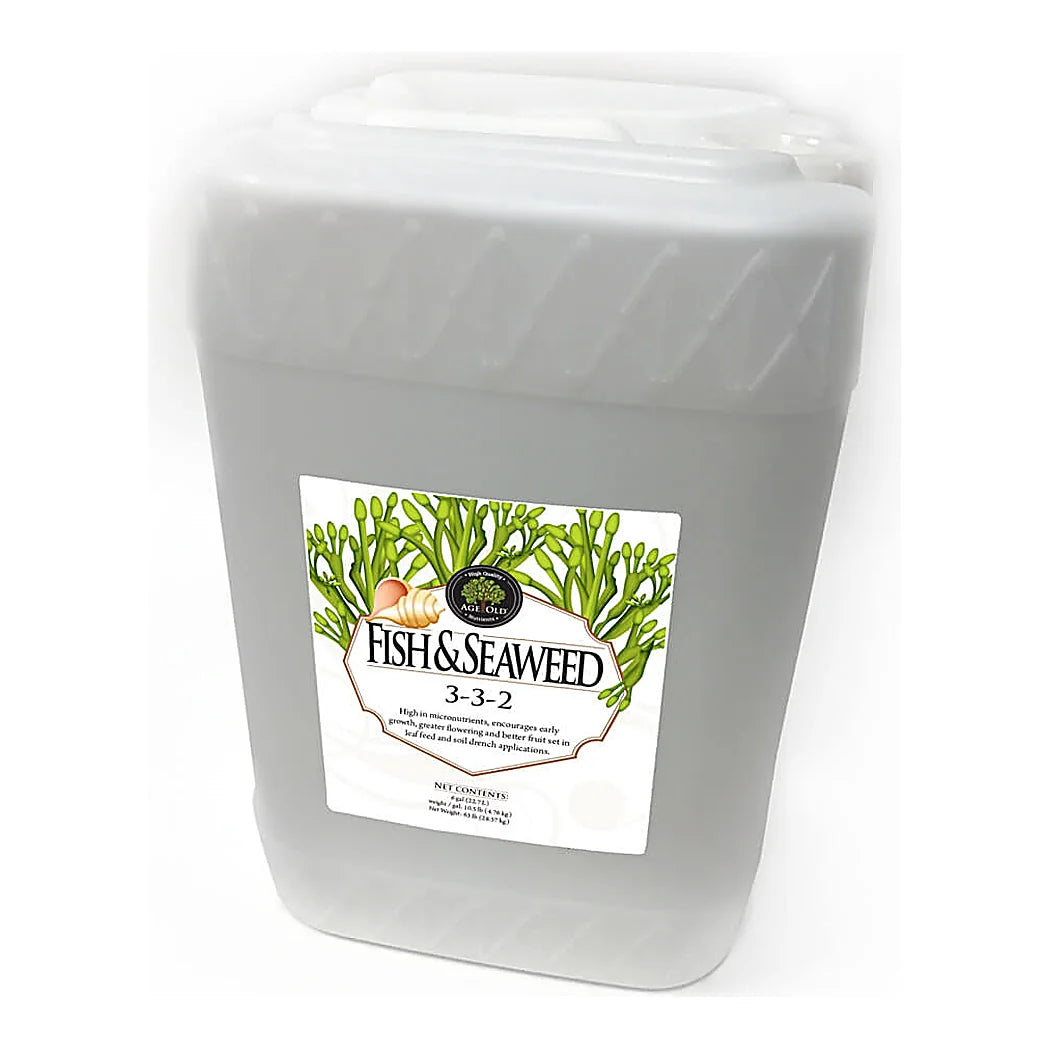
Age Old Fish and Seaweed Feeds the Plant and the Soil at Once
Unlike a straight kelp extract, this bottle carries real nitrogen. The guaranteed analysis is 3-3-2, drawn from processed fish hydrolysate and North Atlantic sea kelp. Fish supplies the nitrogen and phosphorus along with proteins that soil microbes break down over the following days. Kelp adds potassium, trace elements and natural growth compounds that help young roots settle in. For new seedlings, Age Old's rate is 1 tbsp per gallon as a drench along the row, repeated every 2–3 weeks. Ornamentals and landscape plants take 2–4 oz per gallon as a foliar spray every 2–4 weeks. Field crops run at 1–2 pints per acre, tightening the interval when plants are under stress. Transplants benefit from a root soak before they go in, which cuts down on shock. Spray early in the day, when stomata are open and leaves dry quickly afterward. Shake hard before measuring, because fish solids settle to the bottom. It does smell like fish for a few hours after application.
Using a Fish and Seaweed Fertilizer Indoors and Out
That smell is the main trade-off, and it matters more in a closed grow tent than in an open garden. Outdoors it fades by the next day, and most vegetable growers stop noticing it after the first season. Indoors, run the exhaust fan after feeding and keep it off leaves in a small, sealed room. This blend is a soil and container feed first. In recirculating hydro, fish proteins can clog drippers and feed biofilm in a warm reservoir, so most growers avoid it there. It works well as the main feed for vegetables in raised beds, or as a mid-season boost under a dry organic amendment. The small bottle suits houseplants and a patio garden, while the gallon covers a backyard vegetable season. The larger jugs and drums are for market gardens, orchards and nurseries spraying on a schedule. Age Old also sells a straight kelp product for anyone who wants seaweed without the added nitrogen. Pick this one when plants need both the feed and the biostimulant in the same pass.
Key Features
- 3-3-2 Liquid Analysis: Real nitrogen and phosphorus from fish plus potassium and trace elements from kelp.
- Fish Hydrolysate and Sea Kelp: Processed fish and North Atlantic kelp feed both the plant and the soil biology.
- Drench or Foliar: Apply at the root zone or spray the leaves, depending on the crop and the season.
- Growth, Bloom and Fruit Set: Supports early vegetative growth, stronger flowering and better fruit set.
- Transplant Root Soak: A pre-plant soak helps roots establish and reduces transplant shock.
- Five Sizes: From a 32 oz bottle for houseplants to a 55 gallon drum for farms.
Technical Specifications
| Specification | Value |
|---|---|
| Guaranteed Analysis (N-P-K) | 3-3-2 |
| Derived From | Processed fish hydrolysate, North Atlantic sea kelp |
| Form | Liquid concentrate |
| Seedlings | 1 tbsp per gallon drench, or 4–6 oz per 1,000 sq ft, every 2–3 weeks |
| Ornamentals (Foliar) | 2–4 oz per gallon, every 2–4 weeks |
| Vegetables and Field Crops | 1–2 pints per acre, every 3–4 weeks (2–3 under stress) |
| Transplants | Root soak before planting |
| Sizes | 32 oz, 1 gal, 2.5 gal, 6 gal, 55 gal |